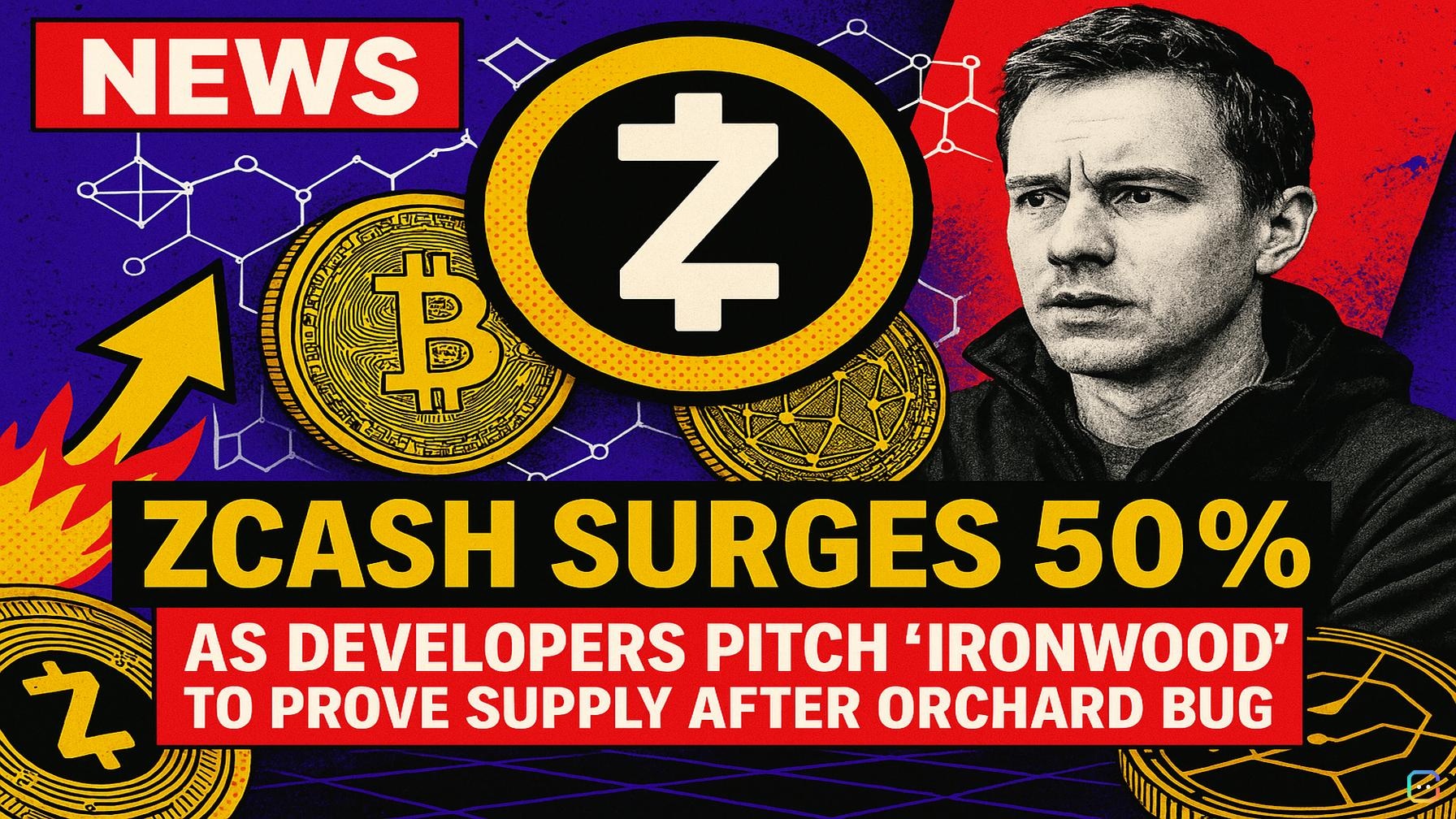
Zcash rebounds as developers unveil “Ironwood” plan to shore up supply integrity after Orchard flaw
Zcash (ZEC) has staged a sharp recovery after last week’s shock: the token’s price has climbed roughly 50% from its lows as the project’s leadership laid out a plan to repair confidence following the disclosure of a critical vulnerability in its shielded transaction system.
What happened
Security researchers at Shielded Labs disclosed a flaw in Zcash’s Orchard shielded pool — the privacy-focused layer that uses zero-knowledge proofs for shielded transactions. The researchers warned the bug could, in theory, have allowed an attacker to mint counterfeit ZEC. While Shielded Labs said prior exploitation was unlikely, it emphasized there is no cryptographic proof that the issue was never used, a particularly uncomfortable uncertainty given Orchard’s role in private transfers.
The market reacted. According to CoinGecko, Zcash’s market capitalization plunged from a peak near $10.48 billion to about $5 billion after the disclosure, before recovering to roughly $7.5 billion as fixes and assurances rolled out.
Emergency fixes and timeline
Developers moved quickly. Josh Swihart, founder of the Zcash Open Development Lab, said the team implemented a two-stage response before the vulnerability became public. First, a soft fork temporarily disabled Orchard transactions — technical details were kept private to reduce the risk of exploitation while engineers worked on a permanent solution. Second, the NU6.2 hard fork, activated on June 3, patched the underlying issue and allowed Orchard transactions to be restored.
Ironwood: a longer-term transparency fix
Days after the disclosure, Zcash founder Zooko Wilcox proposed “Ironwood,” a prospective network upgrade designed to address the root trust problem: how to give users confidence in the circulating supply without dismantling privacy.
Key elements Wilcox outlined:
- A way for users to independently verify ZEC’s circulating supply by aggregating balances across active pools immediately after activation.
- A new location for holding shielded ZEC and restrictions on transaction types that could be abused to introduce counterfeit coins.
- Additional security measures, including AI-assisted code audits, to harden the codebase.
Wilcox framed Ironwood as a balance between transparency and privacy — increasing supply verifiability while preserving shielded transactions. He reiterated confidence that the vulnerability was never exploited but acknowledged that definitive cryptographic proof is not available. The upgrade’s timeline remains open and will depend on further development and community discussion.
Who’s involved
Development work on Ironwood and related efforts involves multiple parties, including the Zcash Foundation, Tachyon Group, Valar Group, and the Zcash Open Development Lab.
Market reaction
News of the emergency fixes and the Ironwood proposal helped sentiment. ZEC rose about 6% over 24 hours to near $445, and market capitalization recovered significantly from the immediate post-disclosure trough, according to crypto.news.
Why it matters
Zcash’s situation highlights a broader tension in crypto privacy technology: zero-knowledge systems can obscure whether a protocol flaw has been abused, complicating incident response and market trust. Ironwood aims to create verifiability without sacrificing the privacy that defines Zcash — a delicate engineering and governance challenge that the community will now decide how to pursue.
Read more AI-generated news on: undefined/news