Charles Hoskinson, Cardano’s founder, says ADA is aiming for more than market share — it’s competing to become the global infrastructure layer for trust.
Speaking on a June 8 livestream titled “Why Cardano is the only Ecosystem that can run the world,” Hoskinson argued that crypto’s long-term value hinges on whether networks can reduce reliance on trusted intermediaries and deliver “verifiable” trust at scale — a role that could ultimately eclipse Bitcoin.
Market context: an “existential crisis”
Hoskinson framed the current crypto malaise not as a simple bear market but as an “existential crisis,” with investors questioning whether cryptocurrencies “even matter” as attention flows to AI, synthetic biology and other hot sectors. His response: the industry has been misunderstanding its core purpose. Rather than merely issuing currencies or blockchains, he says crypto should aim to lower the global “cost of trust” embedded in auditing, insurance, compliance, custody, reconciliation and other intermediary services — costs he pegs in the hundreds of billions annually.
Verifiable reflexivity: the central idea
The livestream centered on what Hoskinson called “verifiable reflexivity” — a property where an object (for example, a ballot) carries its own proof of legitimacy. Instead of relying on a third party to validate a vote, the ballot itself would prove it’s valid. Applied broadly, verifiable reflexivity could underpin finance, identity, governance, proof-of-reserves, solvency checks, settlement and social coordination.
How Cardano fits: infrastructure, not just tokens
Hoskinson positioned blockchains as the storage layer for verifiable reflexive transactions and described smart contracts, zero-knowledge proofs and recursion as the machinery that makes those transactions meaningful. In this framework, cryptocurrencies are the economic fuel that pays for decentralized infrastructure — not the end product.
Four pillars Hoskinson says set Cardano apart
1) Decentralization: Ouroboros
- Hoskinson highlighted Ouroboros as a protocol architecture designed to scale while becoming more decentralized, contrasting it with permissioned or compliance-gated systems that, he argues, reintroduce trusted third parties at the settlement layer.
2) The right accounting model: extended UTXO
- Cardano’s extended UTXO model preserves local determinism while enabling programmability, meaning all participants share the same view of a transaction and don’t need a third party to reconcile differences.
3) Modular expansion: Hydra, channel isomorphism and partner chains
- Hydra and “channel isomorphism” let activity run in specialized domains and return to Cardano “as if you did it on Cardano,” enabling app-specific scaling for regulated real-world assets and other commercial systems.
- Partner chains enable modularity; Hoskinson cited Midnight as an example of adding major functionality without making the base layer complex or fragile. “When you’re modular, if that module fails, it doesn’t kill Cardano,” he said, which in turn builds trust.
4) Decentralized governance with specialization
- Hoskinson conceded governance is the most unfinished component. Cardano needs stronger “executive function” — budget, strategy and execution capabilities that can set KPIs and allocate resources.
- Potential ecosystem metrics he suggested include user-paid fees, active developers, retained revenue, stablecoin supply, active users, stake ratio, TVL, decentralization and adjusted transfer value.
Self-healing and founder independence
A test for Cardano, Hoskinson said, will be its ability to survive crises — including loss of confidence in its founder. “You have to lose confidence in your founder for Cardano to get to the next level,” he said, arguing that surviving such shocks would prove Cardano is a self-healing, non-founder-led system.
The long-term market claim
If Cardano can deliver a system of verifiable trust at global scale, Hoskinson contends ADA could become “the currency of global trust.” He went so far as to say there is an “inevitability” that Cardano can win and “surpass Bitcoin” if the ecosystem continues building toward this objective.
Market snapshot
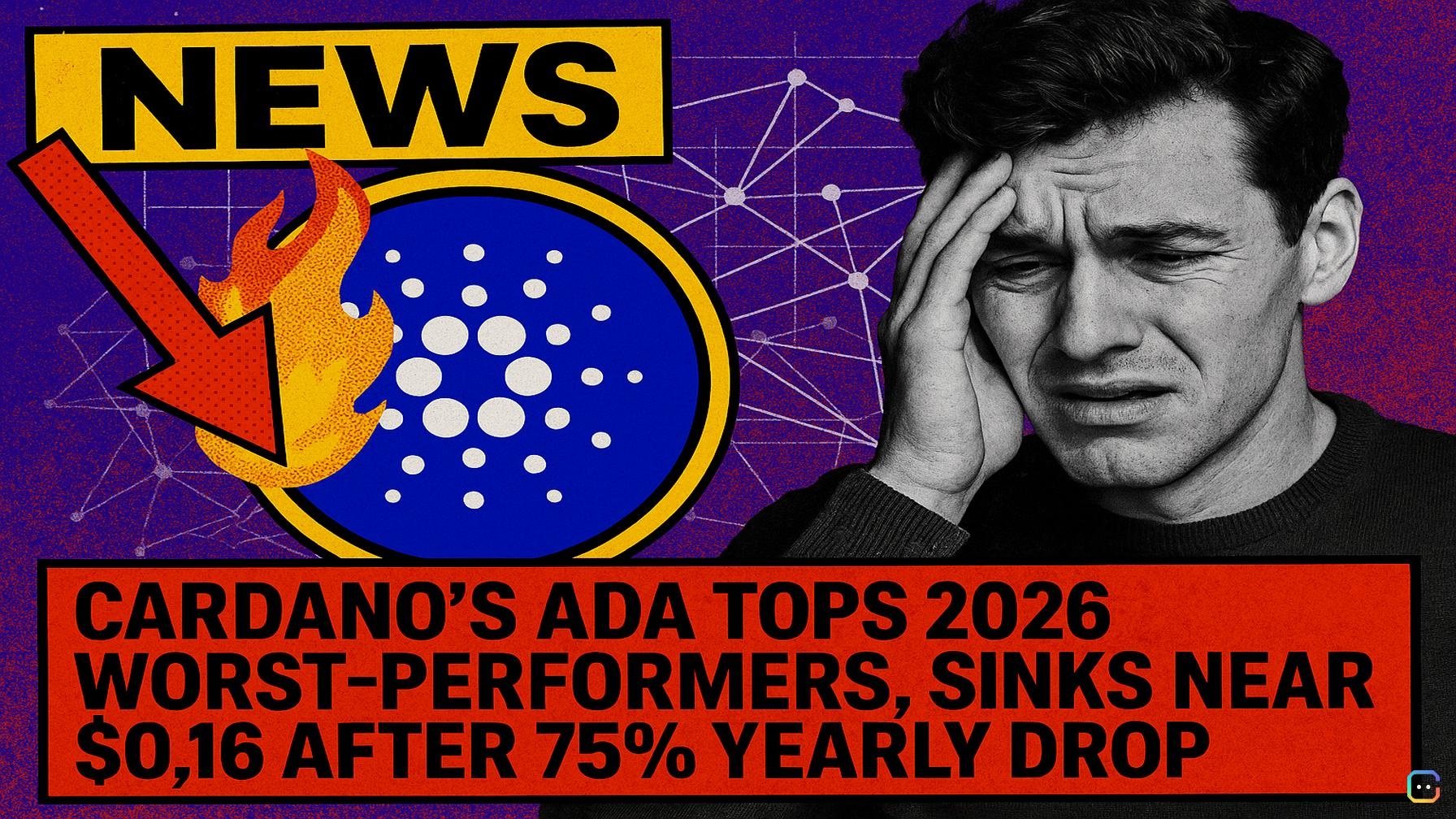
At press time ADA traded at $0.16.
Read more AI-generated news on: undefined/news