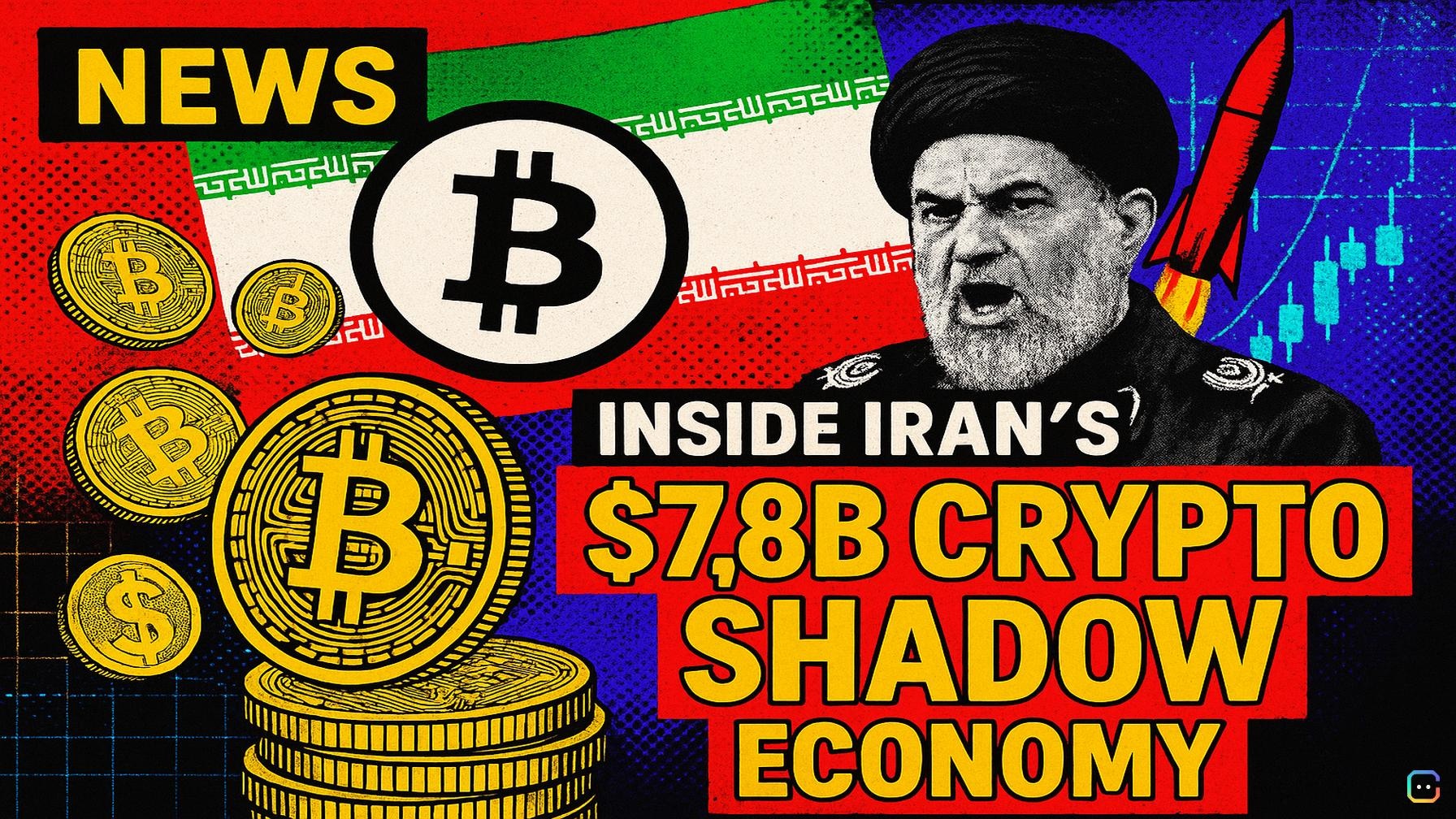
Fresh U.S. and Israeli strikes on Iran have shone new light on a shadowy but increasingly important part of Tehran’s finances: a crypto economy built alongside — and to some extent outside — its crippled banking sector. What analysts call Iran’s “crypto shadow economy” is no longer marginal. Chainalysis estimates it reached $7.78 billion in 2025, a sum comparable to the GDP of small states such as the Maldives or Liechtenstein, and the network’s activity spikes whenever political or military tensions flare.
How the system works
Iran legalized crypto mining in 2019 and gave licensed miners access to heavily subsidized electricity on the condition that mined bitcoin be sold to the central bank. That arrangement effectively converts cheap domestic energy into a cross-border asset. Miners mint BTC, transfer it to the central bank, and the bank can then move value to overseas counterparties to pay for imports — machinery, fuel, consumer goods — without routing transactions through U.S.-controlled banks. Those settlements happen on public blockchains, but the parties on either end can remain opaque, which is why crypto is attractive for economies under sanctions.
Mining footprint and cost
Estimates put Iran’s share of global bitcoin mining at roughly 2%–5%, though much mining activity is opaque and often runs out of public view. Analysts say the Iranian state’s marginal mining cost is around $1,300 per coin — a low production price that the state can sell at market rates. Whether Iran’s central bank maintains significant BTC reserves is unknown; there is no official disclosure or “treasury dashboard.”
Stablecoins and the rial
Stablecoins — especially USDT (Tether) — have become a parallel settlement tool. Elliptic’s research shows Iran’s central bank accumulated at least $507 million in USDT in 2025, apparently to stabilize the rial and finance trade. That effort has had limited success: the rial has lost more than 96% of its value against the U.S. dollar. Stablecoins are popular in sanctioned economies because they offer faster, dollar-pegged transfers and less volatility than bitcoin.
IRGC’s growing role
The Islamic Revolutionary Guard Corps (IRGC) has deepened its involvement in Iran’s crypto flows. Chainalysis finds IRGC-linked addresses accounted for more than half of Iranian crypto inflows in Q4 2025, receiving over $3 billion in value across 2025 (up from roughly $2 billion in 2024). Those figures are derived from wallets publicly tied to sanctions lists, so the IRGC’s true footprint could be larger.
Domestic users and political flashpoints
Crypto is not just a state tool. Ordinary Iranians have increasingly turned to bitcoin during economic collapse and political unrest. During protests and internet blackouts, local-exchange outflows to private wallets rose sharply, reflecting a rush to put value into self-custody. Chainalysis also documents that spikes in Iranian crypto activity tend to correlate with military clashes and internal unrest, including last year’s 12-day conflict with Israel.
Compliance, exchanges and scrutiny
The opacity of some flows has drawn international scrutiny. Stablecoins and cross-border crypto transfers have been implicated in sanction-evasion discussions, and major exchanges have faced pressure: Binance was accused of firing staff who raised alarms over funds moving to Iran-linked entities, prompting nine U.S. Senate Democrats to ask the Treasury and DOJ to investigate Binance’s controls. Such episodes highlight the balancing act for large platforms between growth and compliance.
Risks to mining and the broader system
Iran’s mining network depends on steady power. The state has imposed seasonal bans on mining before to ease grid strain, and a sustained conflict that damages infrastructure could temporarily cut hash rate and mining capacity in the country. If that happened, the global bitcoin network would likely rebalance as miners elsewhere increase output, but Iran’s ability to convert cheap energy into transferable assets would be diminished.
Why it matters
Iran’s crypto setup is a case study in how digital assets can be woven into an economy under sanctions: a mix of state-directed mining, central-bank acceptance of mined bitcoin, growing stablecoin holdings, and a prominent military actor (the IRGC) using crypto to move value across networks of affiliates. For policymakers, exchanges, and compliance teams, the system raises practical questions about enforcement, transparency, and how crypto flows react to geopolitical shocks. For markets, the main near-term effects are localized — but the spotlight on Iran underscores how crypto can become a strategic tool in conflicts and sanctions regimes.
Read more AI-generated news on: undefined/news