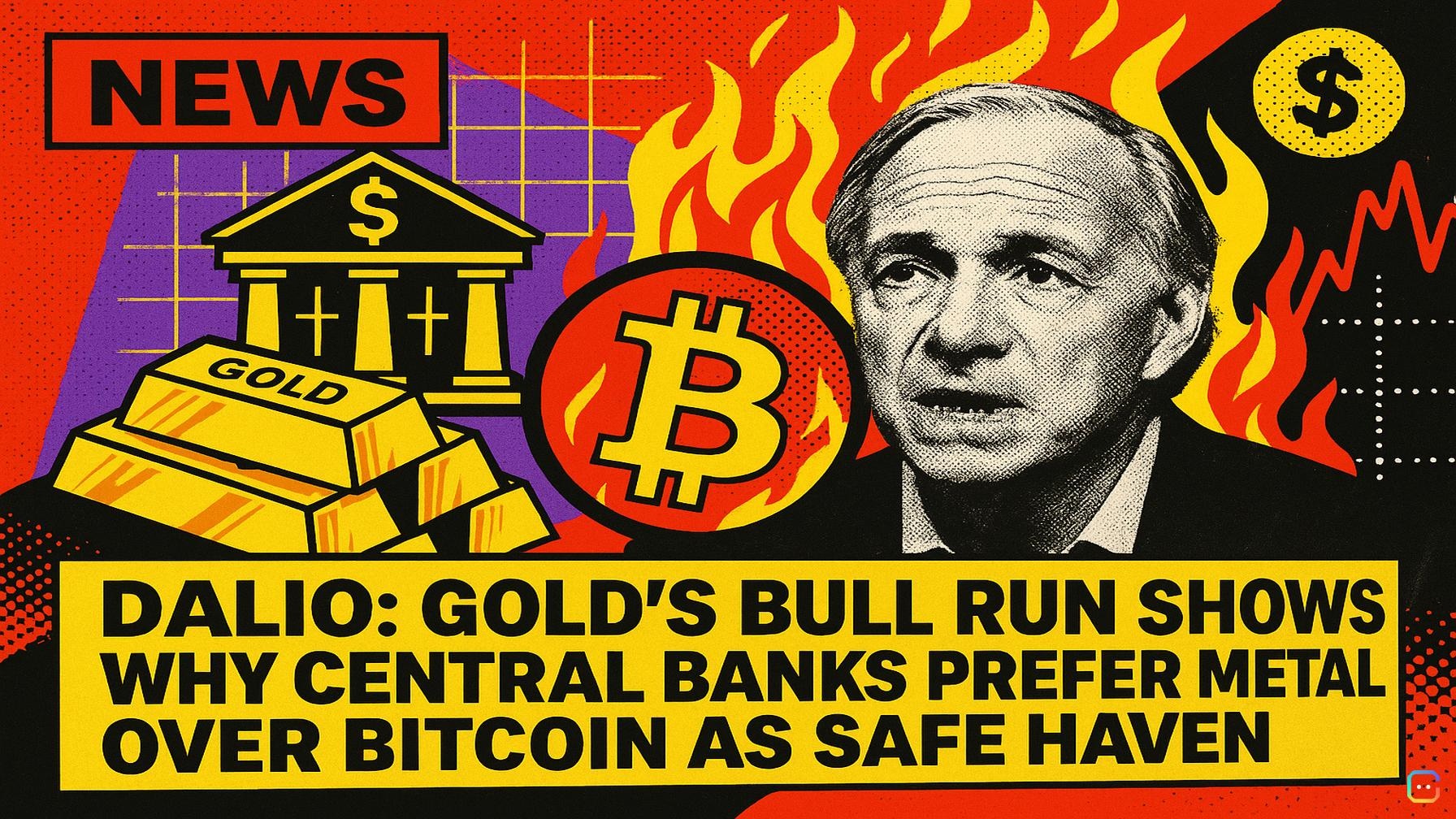
Gold's bull run is stealing the spotlight as central banks and retail buyers seek shelter from rising global uncertainty — and famed investor Ray Dalio says there's a clear reason why.
What’s driving demand
- Geopolitical strain and the fallout from the United States’ mid‑2025 trade restrictions pushed global markets into prolonged uncertainty through 2026. As confidence in free trade and some risk assets slipped, both central banks and individual investors increased allocations to perceived safe-haven assets — notably gold.
- Dalio frames the shift succinctly: “Central banks, individuals, and others are acquiring gold as an alternative because money, mechanistically, is seen as debt.” Fiats can be printed and can dilute purchasing power; gold cannot.
Gold’s price picture
- Gold [XAU] has been trading in an upward channel since November 2024, climbing from about $2,572 to an all‑time high near $5,595 before a pullback. At the time of reporting it was trading around $5,133 and consolidating for roughly a month.
- Notably, gold has gone more than 1,200 days without suffering a 20% drawdown, underscoring its appeal as a long‑term portfolio diversifier. (Source: Checkonchain)
Why central banks prefer gold over Bitcoin
- Dalio argues central banks will likely avoid buying Bitcoin because transactions lack privacy and are traceable: “Bitcoin doesn’t have privacy, and any transactions can be monitored and indirectly controlled. Central banks are not going to want to buy Bitcoin and be able to hold it.”
- That transparency — and the institutional scrutiny it invites — reduces Bitcoin’s attractiveness as an official reserve asset, Dalio says.
Bitcoin’s market behavior and correlations
- Dalio also points to Bitcoin’s market behavior: “Bitcoin’s ownership tends to have a high correlation with tech stocks.” During recent volatility, BTC fell alongside big tech names (MSFT, AAPL, META, GOOG) and broader indices like the S&P 500 and NDQ. Only a few names, such as NVDA and TSLA, showed relative resilience versus BTC.
- Through 2025, Bitcoin underperformed relative to metals, with both silver and gold staying above the market baseline while BTC moved in concert with equities. Checkonchain data shows BTC’s declines tracked SPX, SPX total return, and TILT — signifying a high correlation with conventional markets rather than acting as a standalone hedge.
Implications for crypto investors
- Dalio’s takeaway: when liquidity tightens and risk aversion rises, capital flows into assets perceived as capital-preserving — metals over crypto. Bitcoin’s smaller market size and the tendency for holders to liquidate under financial stress can amplify downward pressure.
- For BTC to meaningfully challenge gold’s current role, demand dynamics and market liquidity would need to shift substantially. Until capital rotates back into stocks and risk assets broadly, gold appears positioned to outperform Bitcoin as a safe‑haven choice.
Bottom line
Gold’s rally reflects a broader rebalancing of portfolios toward assets central banks and investors trust in uncertain times. Bitcoin remains sensitive to equity markets and liquidity conditions, making it harder — in Dalio’s view — for it to replace gold as a central-bank reserve or a go‑to crisis hedge under present conditions.
Disclaimer: This article is informational only and not investment advice. Trading or investing in cryptocurrencies and metals carries risk; do your own research before making decisions. Source: Checkonchain. © 2026 AMBCrypto.
Read more AI-generated news on: undefined/news