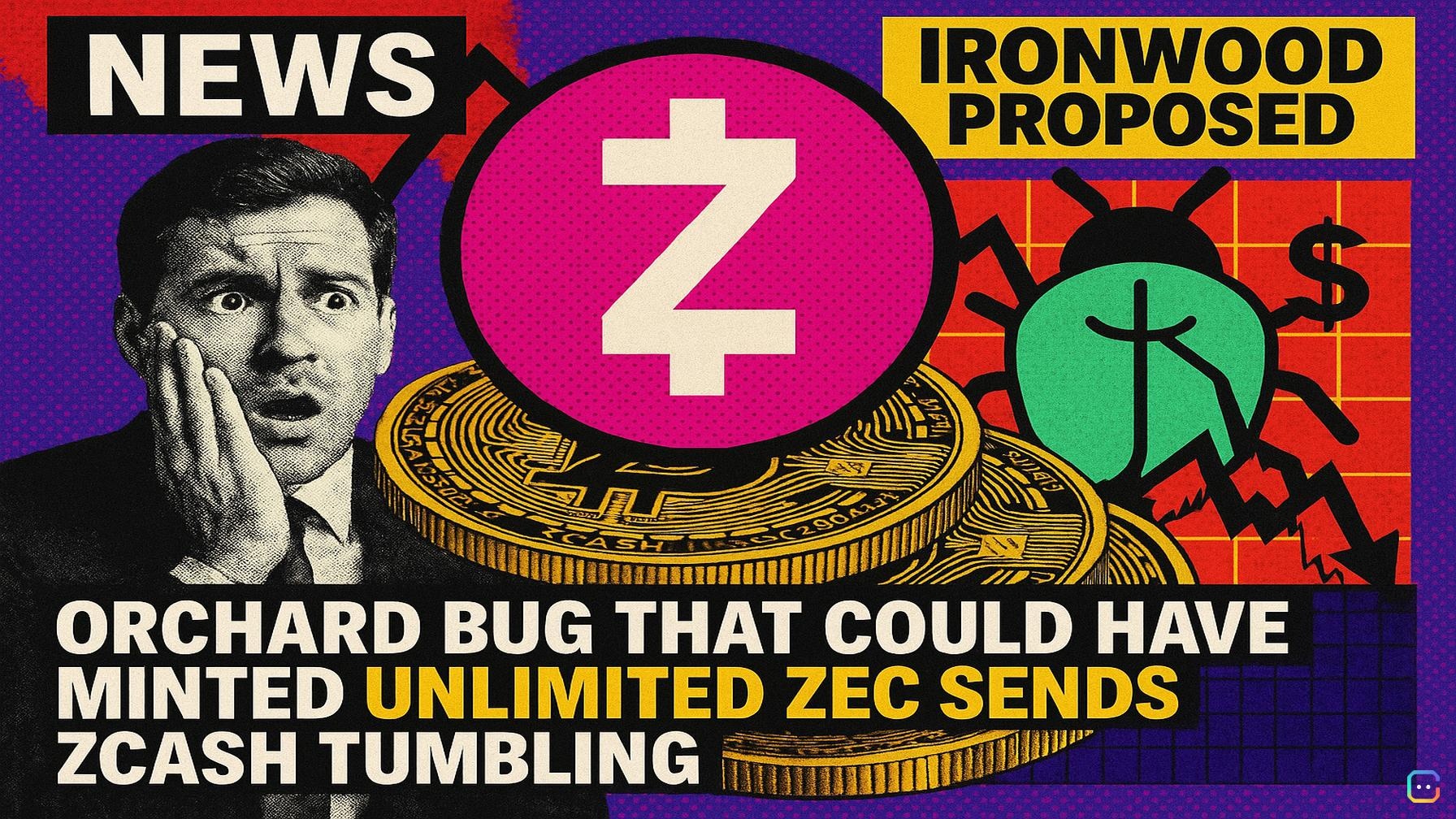
Zcash plunged and then partially recovered last week after a critical bug rocked confidence in the privacy-focused token.
What happened
- Shielded Labs — a nonprofit developer on the Zcash network — disclosed a severe flaw in Orchard, Zcash’s shielded pool that hides transaction details. The bug, present since 2022, could theoretically have allowed an attacker to mint unlimited fake ZEC without detection.
- The market reacted violently: ZEC fell from roughly $635 to about $303 in days. By Monday, June 8, it had recovered to around $442 — roughly a 45% bounce off the June 5 low — but it remained down about 19.7% over seven days and 26.2% over 30 days.
Emergency fix and the Ironwood proposal
- Developers moved fast. Shielded Labs, the Zcash Foundation and the Zcash Open Development Lab coordinated emergency patches within days of the disclosure, working with mining pools ViaBTC and Foundry to push the fix through the network.
- On June 6 they proposed a longer-term solution called Ironwood. The upgrade would:
- Create a new privacy pool built on repaired code.
- Shut down the old Orchard pool to block any further coin creation there.
- Let users aggregate balances across old and new pools and independently verify that total circulation does not exceed the 21 million ZEC cap.
- Ironwood would also act as a kind of forensic mechanism: as users migrate coins out of the old pool, any counterfeit ZEC would either be exposed when it moves or become stranded and effectively unusable. Shielded Labs says it believes the vulnerability was never exploited, but that has not been definitively proven.
- Developers have not committed to a timeline; building, testing and coordinating a network upgrade takes time.
Why the price rebound may be fragile
- Technicals warn of possible weakness. On the four-hour chart ZEC looks like it’s forming a rising wedge — higher highs and higher lows inside a narrowing range — a setup that often signals fading buying momentum.
- After the rebound, ZEC has struggled to hold above $420–$430, and failure to sustain gains there keeps upside capped. A break below the wedge’s lower trendline points to a measured downside target near $314.
- That $314 level is meaningful: it aligns with the lower trendline of a broader weekly ascending triangle and sits near the 0.236 Fibonacci retracement of the $700→$200 swing. Holding above $314 would let bulls argue the larger structure is intact; a decisive break opens the door to a drop toward the $250–$200 zone.
- For recovery to regain credibility, ZEC needs to defend wedge support and clear $450 decisively.
The bigger picture
- The 7-day price range — roughly $303.80 to $635.49 — underscores how volatile the episode has been. Beyond price action, the disclosure hits at Zcash’s core proposition: privacy, cryptographic integrity and a fixed, trustworthy 21 million supply.
- Patching the bug and proposing Ironwood are necessary steps, but rebuilding investor trust will take time and clear execution.
- What to watch next: Ironwood’s progress from proposal to implementation, any forensic findings about past exploitation, and whether ZEC can hold critical technical support levels during migration and upgrade activity.
Read more AI-generated news on: undefined/news