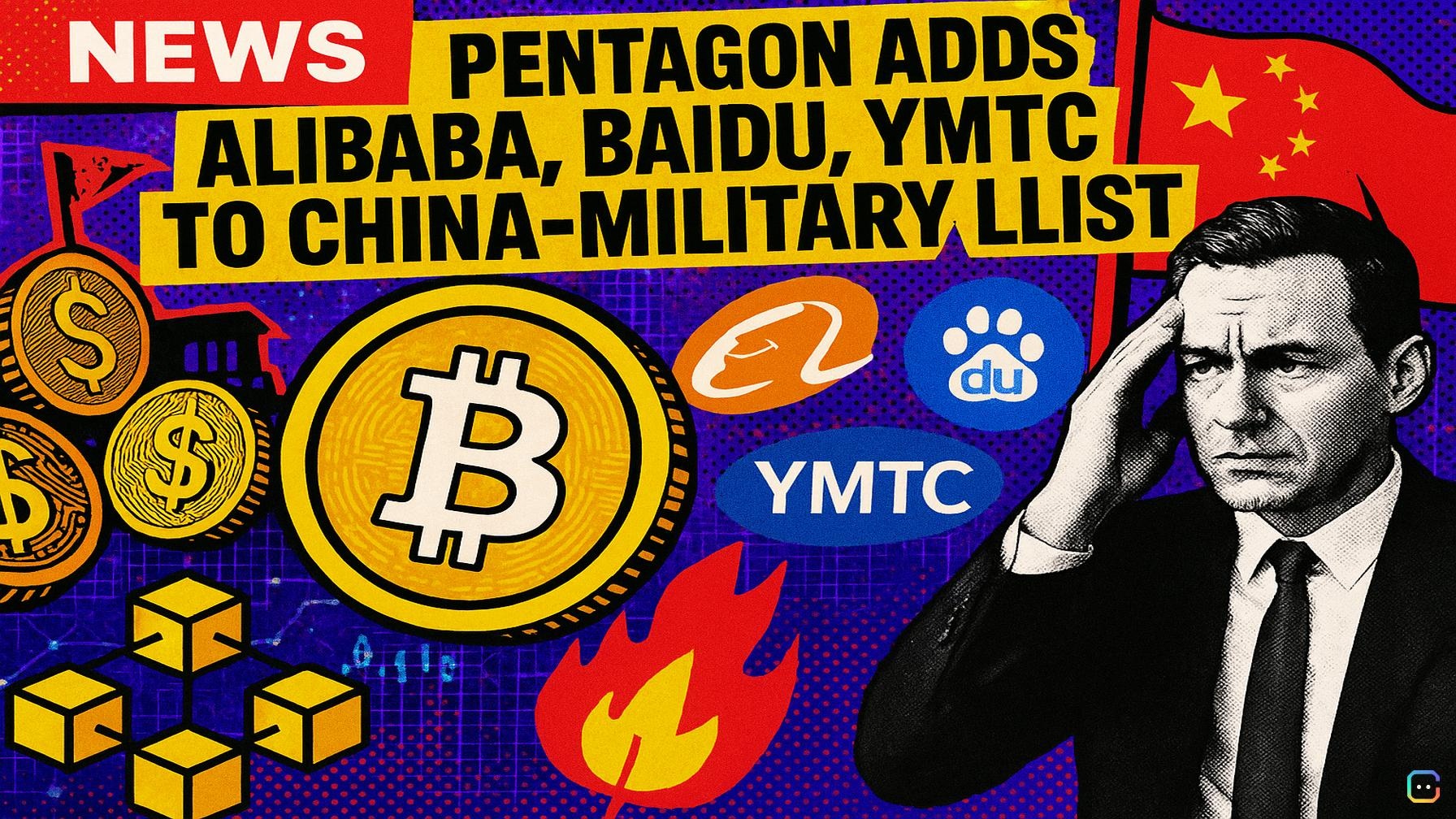
The Pentagon has expanded its roster of Chinese firms it says are linked to Beijing’s military — adding household tech names and a range of chip, biotech, robotics and telecom firms that operate in the U.S. The move doesn’t impose direct sanctions, but it changes Defense Department contracting rules and could ripple across technology ecosystems that matter to crypto builders, miners and AI projects.
What changed
- Newly added: Alibaba, Baidu, BYD, WuXi AppTec, RoboSense, Unitree, Baicells, China BlueChemical, and memory chipmakers CXMT and YMTC (the update mostly mirrors a briefly posted-and-then-withdrawn February version, but now formally includes CXMT and YMTC).
- Removed: CNOOC China Ltd and CNOOC International Trading (companies can exit the list for reasons such as name changes, lack of U.S. operations, or successful petitions for removal).
- The filing confirms many listed firms have operations in the United States.
Legal and contracting impact
- The designation itself is not a sanctions regime, but U.S. law will soon bar the Department of Defense from awarding direct contracts to listed companies (the ban starts later this month).
- Beginning in 2027, the Pentagon will face additional limits on indirect purchases involving these firms — i.e., products or services bought through third parties.
- The rules are designed to warn Pentagon suppliers, other government agencies, and private businesses about commercial links to companies the U.S. deems tied to China’s military.
Reactions and context
- China’s embassy in Washington condemned the step as discriminatory and urged the U.S. to stop what it called “wrong practice,” saying Chinese companies follow local laws.
- WuXi AppTec called its placement “clearly a mistake” and said it would take steps to correct the listing. Several newly named firms, including Alibaba, Baidu, BYD, CXMT, YMTC, Unitree, CNOOC and Nvidia, did not immediately comment.
- House China Select Committee Chair John Moolenaar backed the update, arguing it warns Americans about firms “working with the Chinese military against our national interests.”
- Craig Singleton of the Foundation for Defense of Democracies said the move signals a shift away from viewing risky entities as isolated cases — Washington increasingly sees the broader technology stack (chips, robotics, AI, biotech) as strategically contested.
Why this matters to the crypto and tech community
- The update underscores intensifying U.S.-China scrutiny across semiconductors, robotics, AI and telecom infrastructure — sectors that intersect with crypto infrastructure (miners rely on memory and semiconductors; AI and edge compute overlap with blockchain analytics and tooling).
- Even without immediate sanctions, the contracting restrictions and reputational effects could influence supply chains, partnerships and vendor choices for firms building crypto and AI systems.
Timing and background
- The new filing replaces an early-2025 list and follows a version briefly posted in February and then removed. The Pentagon is required to refresh this list at least once a year. The release came less than a month after President Trump’s meeting with Chinese leader Xi Jinping in Beijing.
Bottom line
This is a procedural but consequential escalation in U.S. scrutiny of China-linked tech firms. For crypto companies and broader tech stakeholders, the update is a reminder to review vendor exposure and supply-chain dependencies in areas — chips, AI, robotics, telecoms — now squarely in the crosshairs of U.S. national-security policy.
Read more AI-generated news on: undefined/news