Headline: RippleX moves formal verification from Payment Engine to native DeFi — Single Asset Vault and Lending Protocol first in line
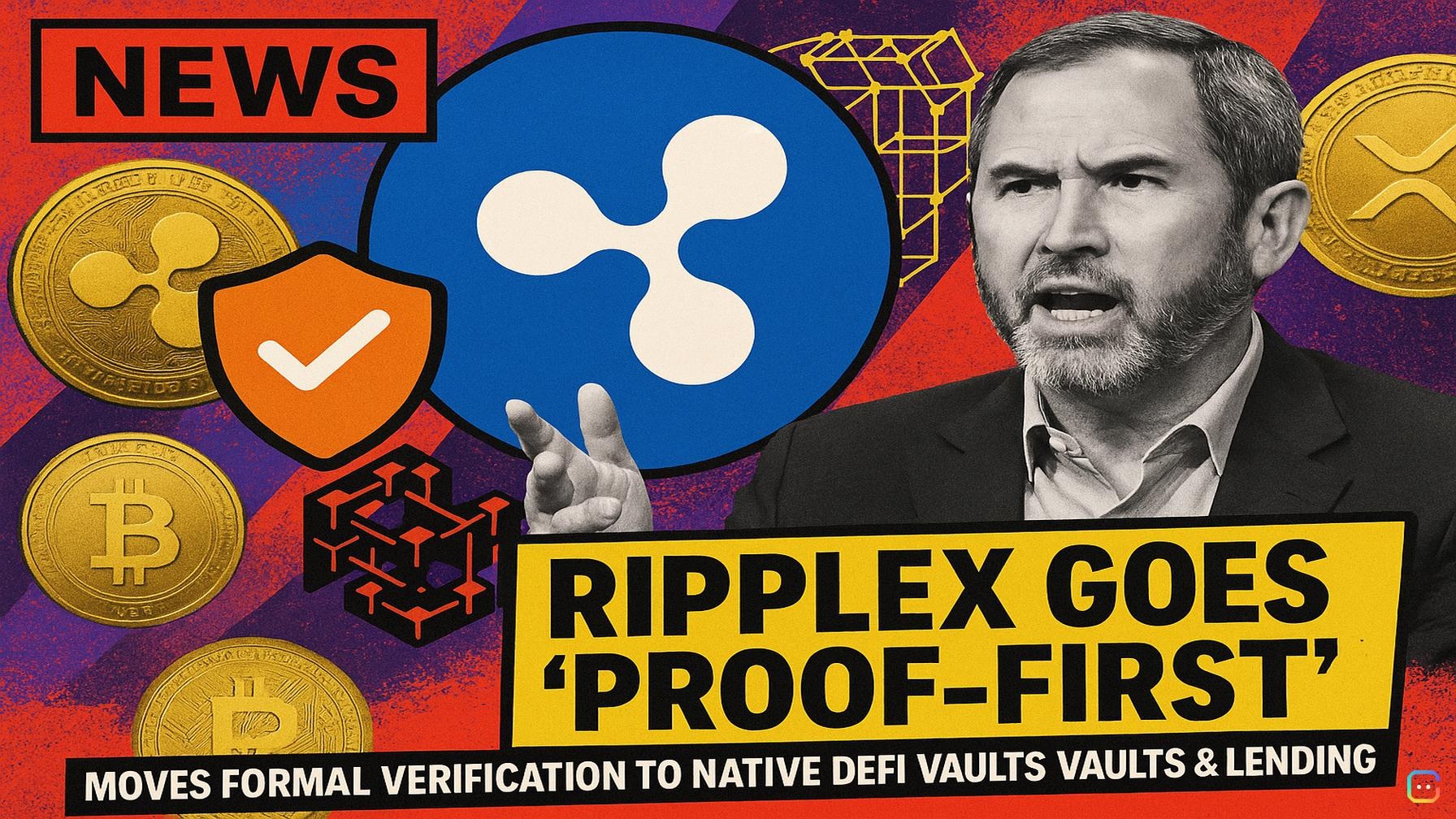
RippleX Developers announced a strategic shift in how the team applies formal verification to the XRP Ledger (XRPL). In a June 8 post, Vito Tumas said the project is moving verification effort away from the long-running Payment Engine and toward newer, protocol-native DeFi features — notably the Single Asset Vault and the upcoming Lending Protocol. The goal: prove correctness up front, not patch problems after launch.
Why the change matters
Unlike many blockchains where lending, vaults and other financial logic live in replaceable smart contracts, XRPL embeds DeFi primitives directly into its core C++ architecture. That approach can improve performance and integration, but it also raises the stakes: a bug in an external contract can often be isolated or swapped out, while a vulnerability in Layer-1 code risks ledger-wide consequences. RippleX says that risk profile is driving the new verification strategy.
From exploration to production-ready proofs
This refocusing follows an exploratory phase earlier this year with Common Prefix, which helped define the technical scope and a verification strategy for XRPL’s next generation of native financial primitives. Tumas framed the pivot as a change in development philosophy: formal verification will be embedded from day one so “provable protocol correctness” becomes a design property rather than a last-resort safety net.
The central technical challenge isn’t raw code size, RippleX explains, but preserving numerical precision across multiple sequential operations. In lending markets and vault systems, even tiny rounding or accumulation errors can compound into significant accounting mistakes — and those errors are part of the protocol’s economic surface, not a peripheral detail.
Formal verification vs conventional testing
RippleX contrasted formal verification with unit, integration and system testing. Traditional tests validate scenarios engineers anticipate, but they can only check the cases written into them. For complex DeFi protocols with vast state spaces, that ceiling is limited. Formal verification builds a precise, machine-checkable model of intended behavior and mathematically proves whether the model can ever behave incorrectly under any expressible condition.
Connecting proofs to production
The team also described a practical bridge from model to implementation: an “oracle” derived from the proven model acts as a canonical reference. The same inputs are fed to both the oracle and the xrpld C++ implementation; any difference in output is flagged, enabling continuous verification against the proven model.
Early results and next steps
Working with Common Prefix, RippleX said initial modeling for the Single Asset Vault and the Lending Protocol has already revealed edge cases that standard tests missed — a sign the verification approach is finding meaningful issues early. Tumas emphasized these are early outcomes, but they reflect a methodology with decades of formal-methods history now being applied to mainstream protocol engineering.
At press time, XRP traded at $1.17.
Read more AI-generated news on: undefined/news