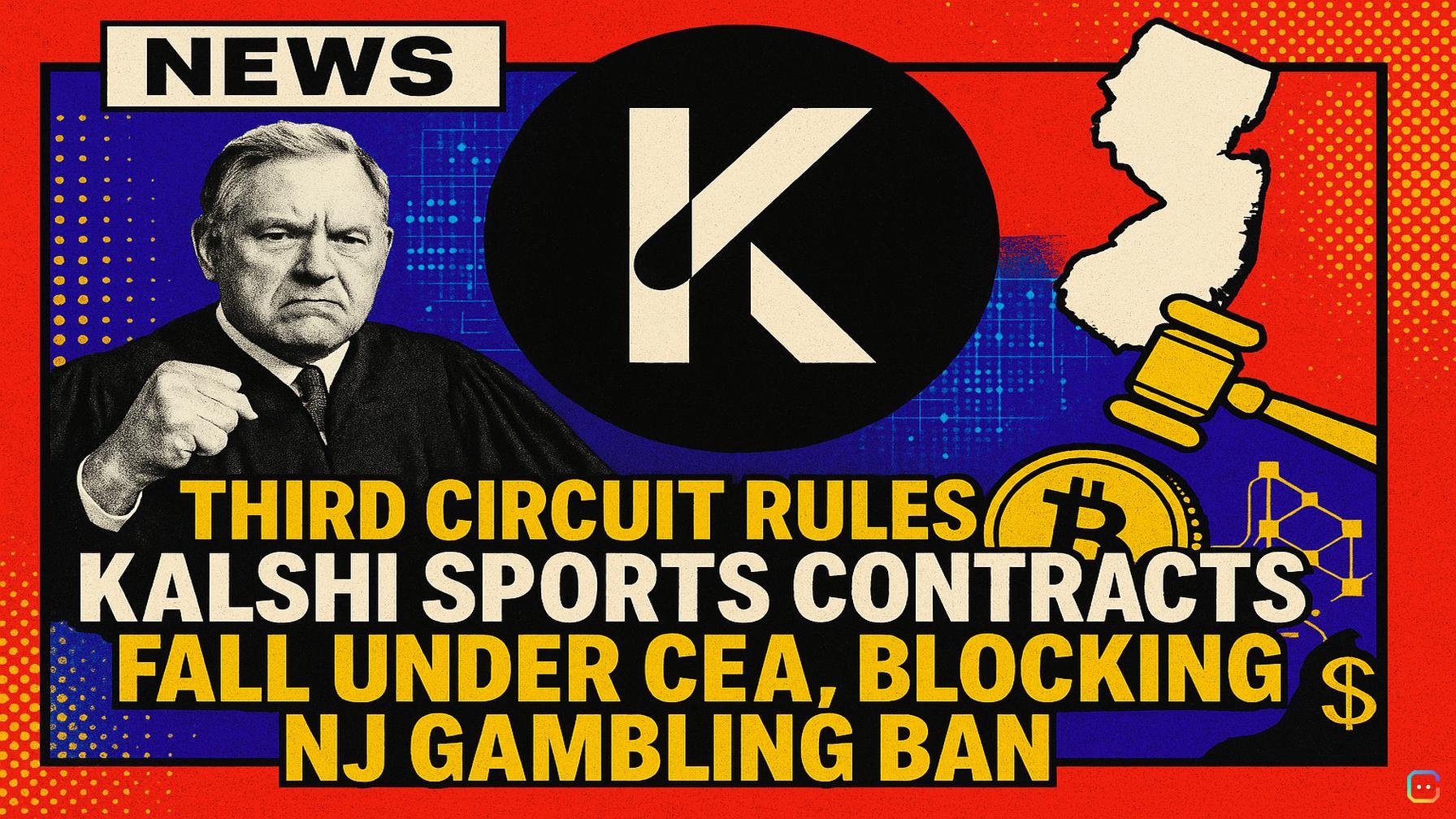
A federal appeals court on Monday dealt a significant win to prediction-market firm Kalshi, blocking New Jersey from using state gambling laws to shut down the platform’s sports markets.
In a 2-1 decision, a Third Circuit panel held that Kalshi’s sports-related event contracts fall under the federal Commodity Exchange Act (CEA) — and therefore are presumptively regulated by the Commodity Futures Trading Commission (CFTC), not by state gambling regulators. The majority opinion, signed by Chief Judge Michael Chagares and Circuit Judge David Porter, stressed that Kalshi self-certified its products on a designated contract market (DCM) and that the CFTC has not found those sports event contracts contrary to the public interest.
New Jersey had argued Kalshi’s contracts aren’t “swaps” because a sports outcome isn’t “joined or connected” to a financial or commercial measure. The court rejected that test, saying it would exceed what the CEA requires. The ruling thus prevents the state from bringing an enforcement action against Kalshi while the federal framework applies.
A dissent from Circuit Judge Jane Roth pushed back, calling the contracts essentially sports gambling and saying state rules don’t undermine the CEA’s congressional objectives. Roth pointed to contracts betting on NFL winners, point spreads and total points as examples of gambling-style products.
Why it matters for crypto and prediction markets
- The decision reinforces the CFTC’s argument that event contracts — including sports and political markets offered by firms such as Kalshi and Polymarket — are swaps governed by federal law, potentially preempting a patchwork of state bans and cease-and-desist orders.
- But the legal landscape remains fractured. States across the U.S. have launched enforcement actions against prediction-market platforms; some state courts have issued temporary restraining orders or preliminary injunctions favoring states, while federal courts have delivered mixed results.
- The Ninth Circuit recently refused to block Nevada’s enforcement action against Kalshi, allowing that state to press a temporary restraining order and preliminary injunction; a separate Ninth Circuit hearing involving several companies is scheduled later this month. That split among appellate courts creates continued legal uncertainty for market operators and users.
Federal regulator weighs in
CFTC Chairman Rostin Behnam (note: if quoting the article’s original name Michael Selig — please verify; the current CFTC Chairman as of this ruling was speaking at a conference) emphasized the agency’s interest in defending its “exclusive jurisdiction over these markets.” The CFTC filed an amicus brief in the Ninth Circuit and has argued that its statutory definition of commodity is broad — covering everything from grains to sports and political events — and should be applied uniformly.
Bottom line
The Third Circuit’s ruling is a meaningful win for prediction-market operators, signaling that federal law may preempt state-level gambling enforcement. But conflicting rulings from other circuits mean the industry still faces an unsettled legal battlefield that could reshape how crypto- and fintech-based prediction markets operate in the U.S.
Read more AI-generated news on: undefined/news