Headline: From Meme Avatar to Digital Doppelgänger — Meta Is Building a Photorealistic AI Clone of Zuckerberg
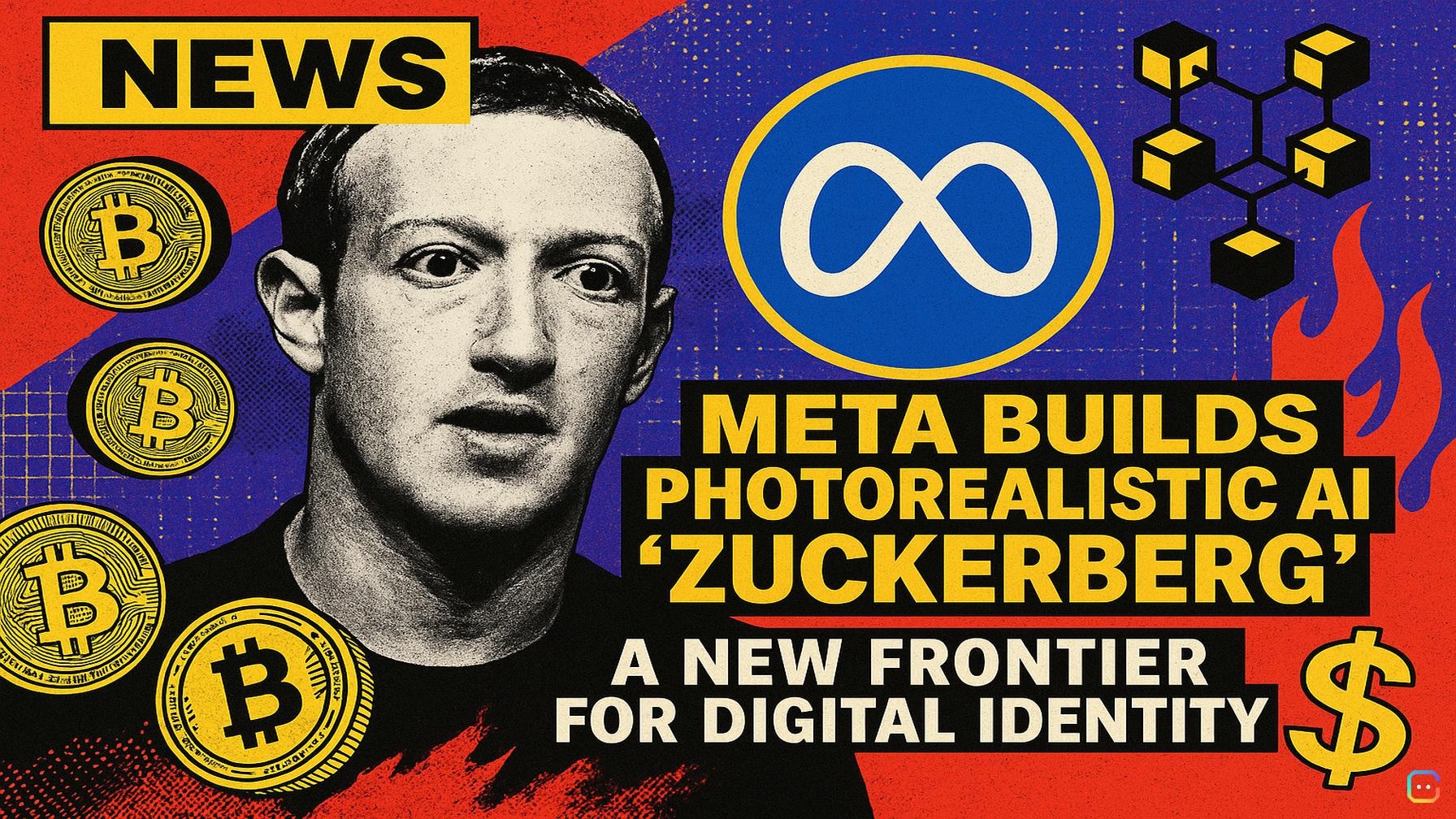
What was once a punchline is becoming a serious engineering project. In August 2022 Mark Zuckerberg’s blocky Horizon Worlds avatar—memed for its dead-eyed, legless simplicity—came to symbolize Meta’s struggle with the metaverse. Today, according to the Financial Times, Meta is quietly working on the opposite: a photorealistic, AI-powered 3D replica of Zuckerberg meant to hold realistic conversations with employees on his behalf.
Four people familiar with the project told FT that Zuckerberg is personally involved in training and testing the system. The AI is being fed his mannerisms, speech patterns, public statements and recent strategic thinking so it can "talk like him, think like him" and step in for one-on-ones that the real CEO might miss. The stated aim is to make staff “feel more connected to the founder”—a far cry from the viral embarrassment of the Horizon avatar.
The initiative sits inside Meta’s newly formed Superintelligence Labs. Scaling a photoreal, conversational agent is computationally expensive and technically demanding, and Meta has invested accordingly: last year it acquired voice-technology firms PlayAI and WaveForms, and it’s forecasting capital expenditure of $115–$135 billion for 2026 — nearly double the prior year’s plan. Last week the company unveiled Muse Spark, the first model from Superintelligence Labs, pitched as a compact system with capabilities in health reasoning and visual understanding; the announcement sent Meta shares up about 7%.
Internally, Meta is pushing employees to adopt AI tools and to build their own agents. Staff are being encouraged to work with an open-source framework called OpenClaw, and product teams have been given a "skills baseline exercise" that includes system design tests and the intriguingly named “vibe coding.” The company’s shift to AI marks a deliberate pivot away from the costly Reality Labs metaverse play—once burning billions per quarter (Reality Labs spent $10.2 billion in 2021)—and from the cartoonish avatar that became shorthand for the failure of that first push.
For the crypto community, the project is notable beyond corporate theatrics. It raises questions about digital identity, authenticity, and how AI-driven agents could change workplace communications and avatar economies. Whether this photorealistic Zuckerberg becomes a morale-boosting stand-in or a perpetual supervisor remains to be seen—but it underscores how Meta is doubling down on AI as its next big bet, trading virtual plasticity for uncanny realism.
Read more AI-generated news on: undefined/news