Headline: TSMC posts record Q1 profits as AI chip demand strains capacity — what crypto pros should watch
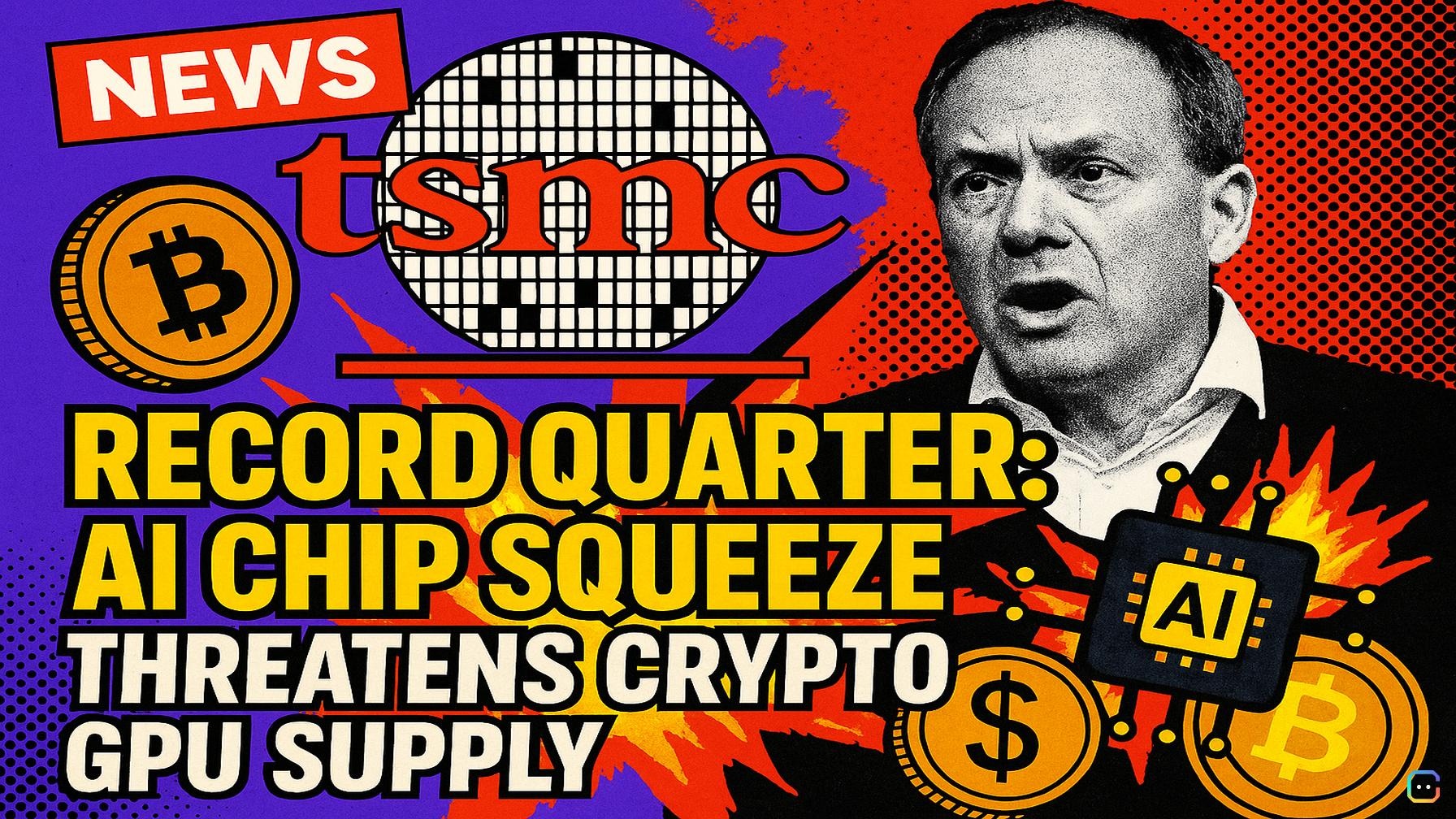
Taiwan Semiconductor Manufacturing Company (TSMC) delivered blockbuster first-quarter results on Thursday, driven by surging demand for AI processors that lifted both revenue and profit to record highs — a trend that has implications for crypto infrastructure and compute-hungry blockchain applications.
Key results
- Net income: $18.2 billion for Q1 (ended March) — up 58% year-over-year, beating expectations.
- Revenue: about $35 billion — up 35% year-over-year and slightly ahead of forecasts (~$34.8B).
- This marks TSMC’s fourth consecutive quarter of record profits and its eighth straight period of double-digit growth.
- LSEG SmartEstimates shows TSMC topped analyst forecasts on both sales and profit.
What’s driving growth
- AI-related compute demand is the primary engine. High-performance computing (HPC) — encompassing AI and 5G workloads — accounted for 61% of Q1 revenue.
- Advanced-node chips (7 nm and below) made up roughly 74% of wafer revenue; 3 nm products alone contributed about 25%, underscoring a rapid migration to more power- and performance-efficient nodes.
- Major customers include Apple and Nvidia, with Nvidia now TSMC’s largest client thanks to rising need for AI accelerators.
Management outlook and capital plans
- CEO C.C. Wei said “AI-related demand continues to be extremely robust,” and that advances in AI are creating long-term, multi-year growth signals.
- TSMC raised its 2026 revenue outlook to growth of more than 30% in U.S. dollar terms, a touch higher than previous guidance.
- Q2 revenue guidance: $39 billion to $40.2 billion — implying roughly 10% sequential growth.
- Capital expenditure for 2026 is expected at the high end of the previously guided $52–$56 billion range as the company accelerates capacity build-out.
- Expansion plans include a new advanced fab in Tainan, broader scaling of 3 nm capacity across Taiwan, the U.S., and Japan, and U.S. investment tied into a larger $165 billion Arizona initiative.
Risks and supply-chain posture
- TSMC acknowledged supply-chain risks stemming from the Middle East conflict (potential impacts on energy and specialty gases like helium and hydrogen) but said it does not expect near-term disruptions. The company maintains safety inventories and multiple sourcing for critical inputs.
Analyst view
- William Li of Counterpoint Research said AI demand has pushed TSMC’s capacity to the limits and expects tight supply to persist through 2026. External analysts similarly report high utilization across TSMC fabs as AI workloads continue driving orders.
What this means for the crypto sector
- GPU and accelerator scarcity: The same wafer real estate powering AI accelerators is under strain, which can ripple into GPU availability and pricing. That matters for crypto miners, validators, and projects relying on local or on-prem compute for node operation, model training, and data indexing.
- Faster chips, lower energy per operation: The shift to 3 nm and other advanced nodes improves performance per watt — a win for energy-sensitive blockchain operations (e.g., large-scale validation or model-backed smart-contract services).
- Cloud and data-center capacity: Hyperscalers expanding AI infrastructure may prioritize AI workloads; crypto projects dependent on cloud GPUs could face higher costs or scheduling competition.
- Longer-term opportunity: Greater AI compute capacity fuels services that augment crypto applications — smarter oracles, on-chain analytics, bot-driven market making, and L2 scaling solutions that use ML for optimization.
Bottom line
TSMC’s blowout quarter underscores how AI demand is reshaping the semiconductor supply chain and capacity planning. For crypto firms and infrastructure providers, the takeaway is clear: silicon is getting scarcer and more advanced, which brings both cost pressures and performance gains. Monitoring TSMC’s capacity expansion and node transitions will be important for planning hardware procurement and estimating future compute costs.
Read more AI-generated news on: undefined/news