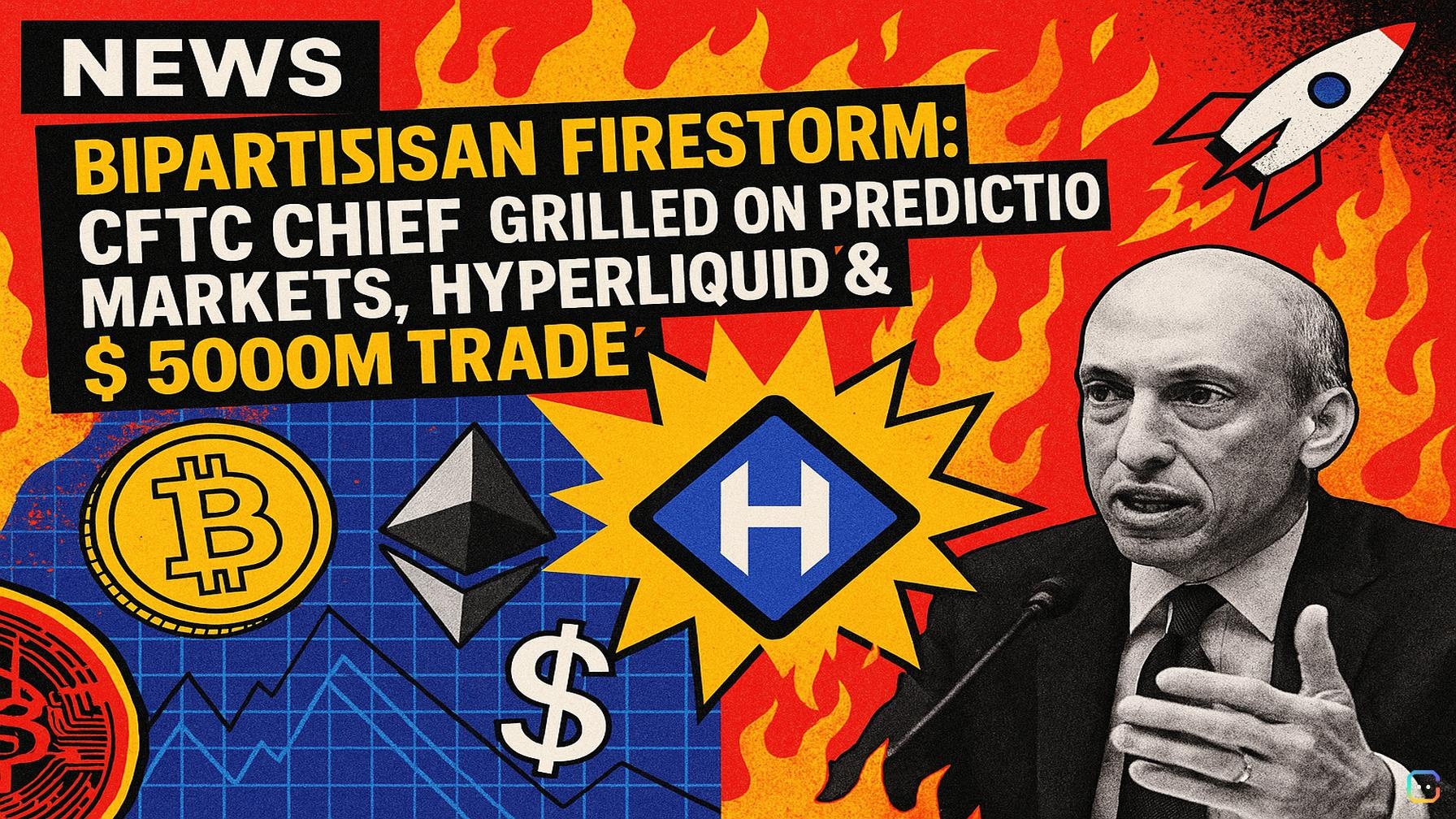
CFTC Chair Mike Selig faced sharp bipartisan scrutiny Thursday as lawmakers pressed him on how the agency plans to police emerging crypto-adjacent financial products—most notably prediction markets and Hyperliquid, a popular decentralized exchange for perpetual futures.
At a House Agriculture Committee hearing (the panel that oversees the CFTC), Democrats zeroed in on a pattern of suspicious futures trades timed just before major announcements from President Donald Trump and other administration actions. Lawmakers said those trades delivered unnamed investors hundreds of millions in gains. Selig emphasized the agency’s commitment to rooting out insider trading but bristled when questioned about possible involvement by people close to the president, including family members. The president’s son, Donald Trump Jr., is an advisor to two leading prediction market platforms, Polymarket and Kalshi.
Rep. Jim McGovern (D-MA) pointed to a March 23 social media post from the president about new negotiations with Iran: about 15 minutes before the post, traders reportedly placed roughly $500 million in wagers on the price of oil, which plunged after the statement. Asked whether Trump Jr. or other family members might have had prior knowledge, Selig replied, “I’m not going to play speculation games with you,” and defended the CFTC’s efforts to investigate suspicious trading.
Lawmakers also attacked prediction markets on ethical grounds. Rep. Jim Costa (D-CA) called wagers tied to war and the deaths of political leaders “profiting from tragedy,” and asked whether such markets were ever meant to fall under the CFTC’s supervision. Selig said he is preparing a proposed rulemaking on prediction markets for public comment, and pointed out that the agency’s statute casts a broad net over what constitutes a commodity or swap—an answer that some lawmakers interpreted as a de facto defence of controversial event contracts.
The hearing featured an awkward exchange in which Selig struggled to distinguish an unlabeled sports bet from an event contract tied to the same baseball game—an example lawmakers used to argue consumers can’t tell the difference between gambling and certain CFTC-regulated event contracts. “It’s clear to me you can’t tell [the difference], because the average consumer also can’t tell,” said Rep. Gabe Vasquez (D-NM).
Republicans pressed Selig from another angle, focusing on the systemic risk posed by offshore crypto platforms. Rep. Austin Scott (R-GA) raised Hyperliquid—a decentralized exchange for perpetual futures (derivatives with no expiration)—arguing that even though the platform operates outside U.S. jurisdiction, its heavy trading in contracts like oil could still affect the domestic economy. “If the volume that I’m seeing is correct,” Scott warned, “it has the potential to be detrimental to the United States consumer.”
Selig has recently signaled plans to broaden retail access to perpetual futures despite acknowledged risks, a stance that left members of both parties uneasy about how quickly novel crypto-native products are being integrated into mainstream markets without clear guardrails.
The hearing underscored growing bipartisan demands for clearer regulatory boundaries around prediction markets, event contracts, and decentralized derivatives—issues that cut to the heart of how traditional regulators will handle financial innovation born in the crypto space.
Read more AI-generated news on: undefined/news