Bank of AI and Peking University’s PKUBlockchain this week published what they call the first comprehensive research report on the coming “agent economy,” arguing that as AI systems evolve from assistive tools into autonomous economic actors, crypto infrastructure must evolve with them.
Titled “Web4.0: When AI Agents Become Economic Entities — Infrastructure, Market Landscape, and Investment Outlook,” the report frames AI agents as on‑chain actors that will need the same basic financial and identity plumbing as humans or companies: the ability to send and receive payments, prove identity, call off‑chain tools, and build verifiable track records. To close those gaps the authors identify three infrastructural layers they see as missing or immature:
- x402: a proposed payment protocol optimized for stablecoin transfers between agents.
- ERC‑8004: an on‑chain “ID card” standard for agent identities.
- MCP (Model Context Protocol): a standard for secure, verifiable invocation of off‑chain tools and models.
Bank of AI positions its own technology stack as a reference implementation, claiming to unite “five core components into a unified Agent financial operating system” that links these protocols from specification to product. That pitch sits alongside independent research — including a FinChain proposal for an “Agentic RWA Stack” — that projects AI agents could manage “tens of trillions of US dollars” in assets and commercial flows by 2030, underscoring why payments and identity rails are suddenly a focus for builders and investors.
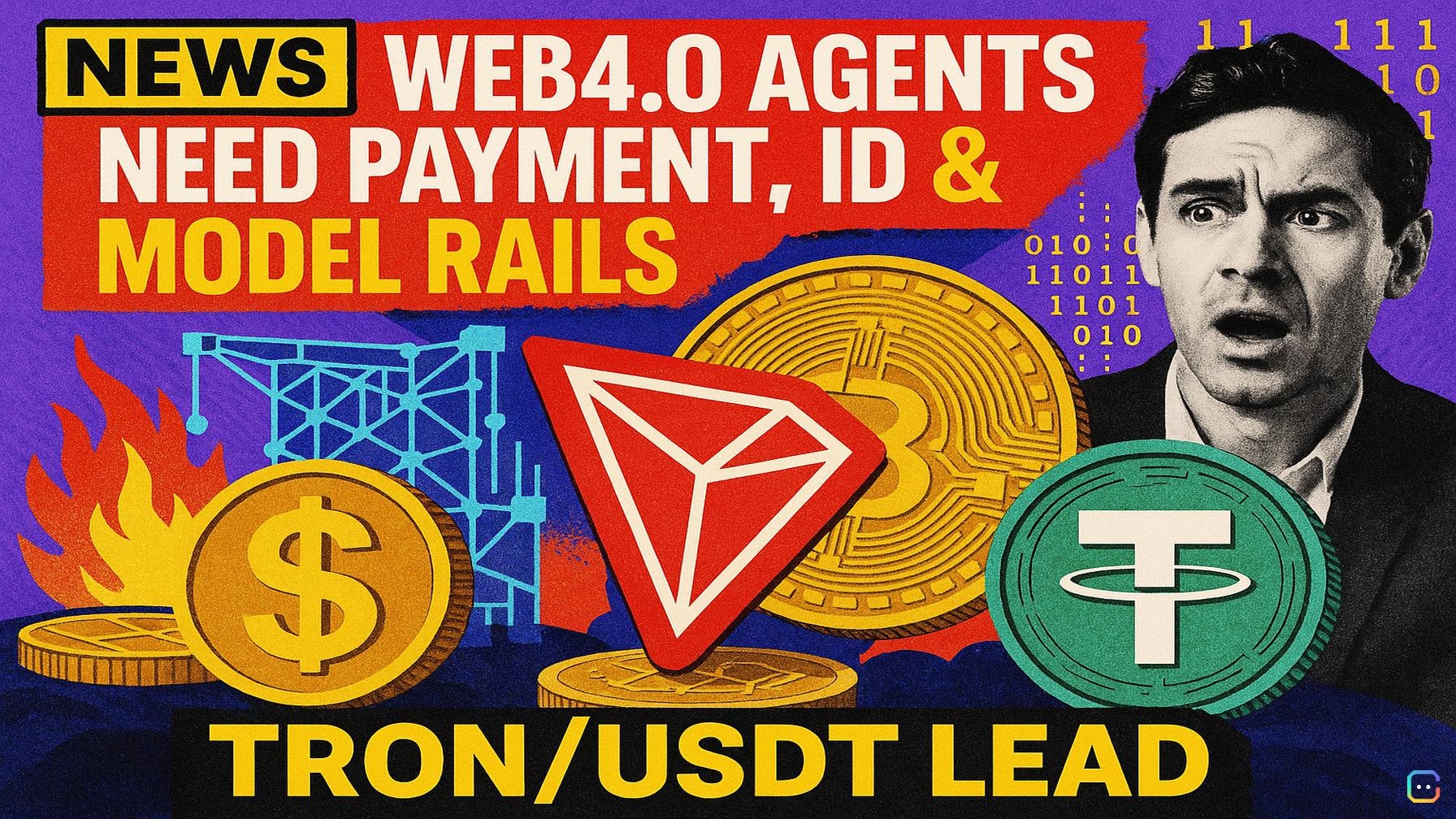
A central theme of the report is that Tron and USDT are the natural settlement rails for this agent‑driven Web4.0. The authors point to Tron’s scale and low fees as ideal for “high‑frequency micro‑settlements by AI agents,” citing daily stablecoin volumes north of $22 billion and roughly $86 billion of USDT hosted on Tron. Independent analytics from Nansen and others corroborate that picture: TRON routinely processes over $21 billion in daily stablecoin transfers, maintains more than $80 billion of USDT supply, and sees roughly 2.0–2.2 million stablecoin transactions per day. Earlier on‑chain data has shown Tron surpassing Ethereum in USDT supply — the float climbed past $73.8 billion in 2025 and later exceeded $80 billion — positioning Tron as Tether’s primary settlement layer for routine dollar transfers.
That prominence has regulatory and capital implications. Abu Dhabi’s ADGM has recognized USDT on Tron as an accepted fiat‑referenced token even as U.S. lawmakers increase scrutiny of Tether’s global footprint. Meanwhile, TRON DAO has earmarked a $1 billion AI fund to back projects that combine AI agents with on‑chain payments — the same junction the Bank of AI report seeks to formalize.
Bottom line: as the concept of autonomous AI agents moves from theory toward production, the debate is shifting from “can agents act?” to “what rails do they need?” Bank of AI and PKUBlockchain’s report stakes out a protocol roadmap — payment rails, on‑chain IDs, and model invocation standards — and points to Tron and USDT as the current practical backbone for high‑frequency, low‑cost agent settlements. Expect the infrastructure conversation — and funding — to accelerate as builders try to make that vision practical.
Read more AI-generated news on: undefined/news