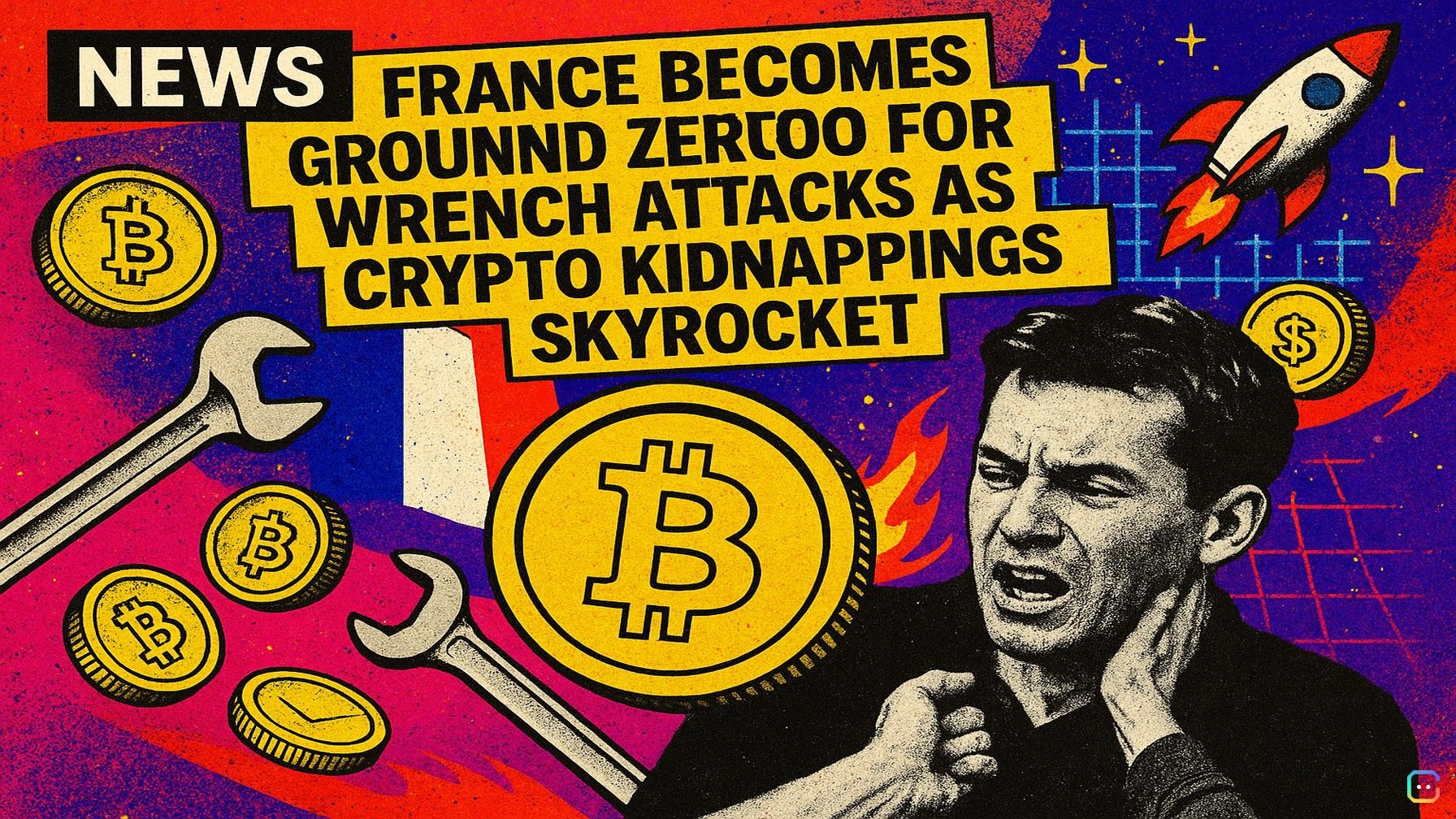
France has quietly become ground zero for a worrying spike in so‑called “wrench attacks” — violent, targeted efforts to force crypto holders to surrender access to their digital assets.
The trend was impossible to miss this week during a major international blockchain conference in Paris. VIPs were escorted by a police motorcade to dinner at the Palace of Versailles, and security at the Carrousel du Louvre was visibly ramped up. French officials used the forum to sound the alarm: Jean‑Didier Berger, Minister Delegate to the Interior, said France has recorded at least 41 crypto‑related kidnappings and home invasions so far this year — roughly one every two to three days. Berger and Interior Minister Laurent Nuñez are preparing new measures; a prevention platform launched by authorities has already attracted thousands of registrations, officials said.
Global data show the problem is escalating. CertiK and researcher Jameson Lopp track 188 physical coercion incidents since 2014, and recorded 72 verified incidents in 2025 — a 75% increase year‑over‑year. Incidents that involve physical assault rose even faster, up about 250% year‑on‑year.
What is a “wrench attack”? The term refers to attackers using physical force — from home invasions and kidnappings to torture — to extract wallet keys, seed phrases or coerced transfers. Unlike bank transfers, crypto moves are irreversible: once the victim is forced to authorize a transaction, funds can be moved across wallets and chains in minutes.
How attackers find victims is changing. “We’re seeing a shift from ‘find a wallet’ to ‘hunt a person,’” Phil Ariss of TRM Labs told CoinDesk. Rather than exploiting code, attackers increasingly profile individuals using social media, public appearances, leaked data and routine tracking to identify vulnerable targets. “The biggest avoidable mistake is tying real‑world identity, location and routine too tightly to visible crypto wealth,” Ariss warned.
Insider leaks and compromised state data have worsened the issue. One high‑profile French case involved a tax official who sold sensitive information to attackers, raising fears that exposed government datasets are directly feeding crime networks.
The attacks now target a broader swath of holders — not just high net‑worth whales but mid‑level investors and even families, with reports of children being threatened. Brutal examples underline the stakes: in January 2025, Ledger co‑founder David Balland and his partner were kidnapped in France; one attacker severed a finger and sent it to associates as a ransom signal before police rescued Balland. Other cases include a prolonged two‑week captivity and torture in New York and a Canadian home invasion that escalated to waterboarding and sexual violence.
Security researchers say both opportunistic criminals and increasingly coordinated groups are involved. Lopp and TRM Labs observe more organized crews with defined roles, pre‑attack surveillance and follow‑home tactics — “less like one‑off robberies and more like small kidnap or robbery crews specializing in crypto jobs,” Ariss said. After obtaining assets, attackers typically convert funds into stablecoins and route them across chains to frustrate recovery efforts.
Underreporting obscures the full scale. Many incidents are logged simply as robberies or home invasions, with the crypto element omitted from initial police reports, making it harder for authorities to connect cases and spot patterns.
What can crypto holders do? Security experts stress that self‑custody remains possible but riskier. Mitigations include multi‑signature wallets, withdrawal delays, spending limits and other setups that prevent a single coerced action from draining most funds. “If coercion cannot produce immediate access to the majority of funds, the risk and return changes,” Ariss said.
As crypto adoption grows and on‑chain defenses improve, attackers are shifting to the physical realm where human targets can be easier to exploit. That evolution is turning wrench attacks from a niche threat into a broader public‑safety problem — and forcing governments, exchanges and users to rethink how to protect digital wealth in the real world.
Read more AI-generated news on: undefined/news