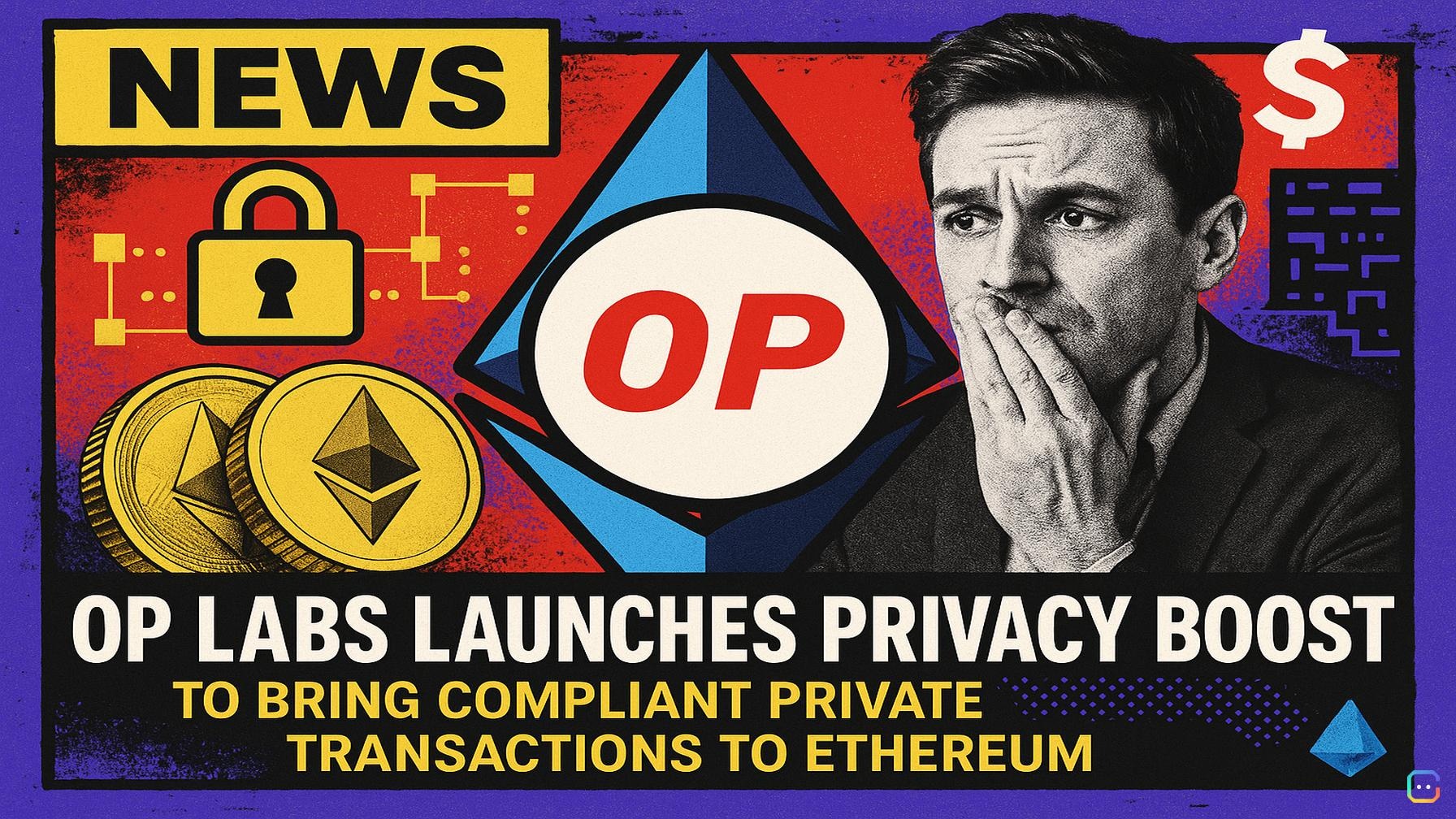
OP Labs rolled out a new privacy product this week aimed squarely at bringing enterprises onto Ethereum — starting with its own layer-2, OP Mainnet (the network formerly called Optimism). Branded “Privacy Boost,” the offering is designed to let businesses make private transfers and interact discreetly with DeFi apps while meeting regulatory requirements.
What Privacy Boost is
- Privacy Boost is delivered as an SDK and API-like interface that developers and firms can plug into existing software to enable confidential on-chain activity. OP Labs says it wants the layer to be something any protocol can adopt, not just a feature of OP Mainnet.
- The product supports self-custody using zero-knowledge proofs (ZKPs) and leans on Trusted Execution Environments (TEEs) to accelerate private transactions. OP Labs says those TEEs can be configured to satisfy KYC and audit needs — a key requirement for financial institutions.
Why this matters
- For many traditional firms, full public visibility of amounts, counterparties and balances has been the main barrier to bringing real-world financial flows on-chain. OP Labs co-founder and CTO Karl Floersch told Decrypt that compliance concerns have previously “killed” enterprise architectures that tried to go fully public. Privacy Boost is pitched as a fix to that problem, making on-chain activity viable for regulated players.
- OP Labs’ own research, the company says, shows privacy ranks above other blockchain priorities such as fees or throughput — even within crypto. The firm argues that privacy is now a prerequisite for mainstream adoption rather than an optional add‑on.
How it fits into the ecosystem
- OP Mainnet already hosts major DeFi apps like Aave, and OP Labs plans to expand Privacy Boost to additional networks in the coming weeks. The move comes as other projects target enterprise-grade private ledgers: networks such as Canton (which limits visibility to relevant parties) have been courting incumbents — Visa last month said it joined the DTCC-backed Canton network.
- Rival teams have been making similar privacy claims: Starknet’s developers have highlighted private transaction functionality for assets like Bitcoin. OP Labs frames Privacy Boost as the “synthesis” of years of engineering to meet both privacy and compliance needs.
Business context and market signal
- OP Labs recently trimmed staff, letting go of 20 employees “last month” as it narrowed focus. The market for the OP token has also cooled sharply: CoinGecko shows OP has fallen roughly 83% over the past year to just over $0.12.
- OP Labs warns that lack of privacy exposes institutional portfolio positions and consumer spending histories to legal, competitive and operational risks — a dynamic that could block further enterprise adoption unless addressed.
Bottom line
Privacy Boost represents OP Labs’ bet that confidential transactions plus configurable compliance are the missing bridge between institutions and public blockchains. If enterprises buy in, the product could shift how and where regulated money moves on Ethereum and beyond — and further cement privacy as a non-negotiable feature for mainstream crypto use.
Read more AI-generated news on: undefined/news