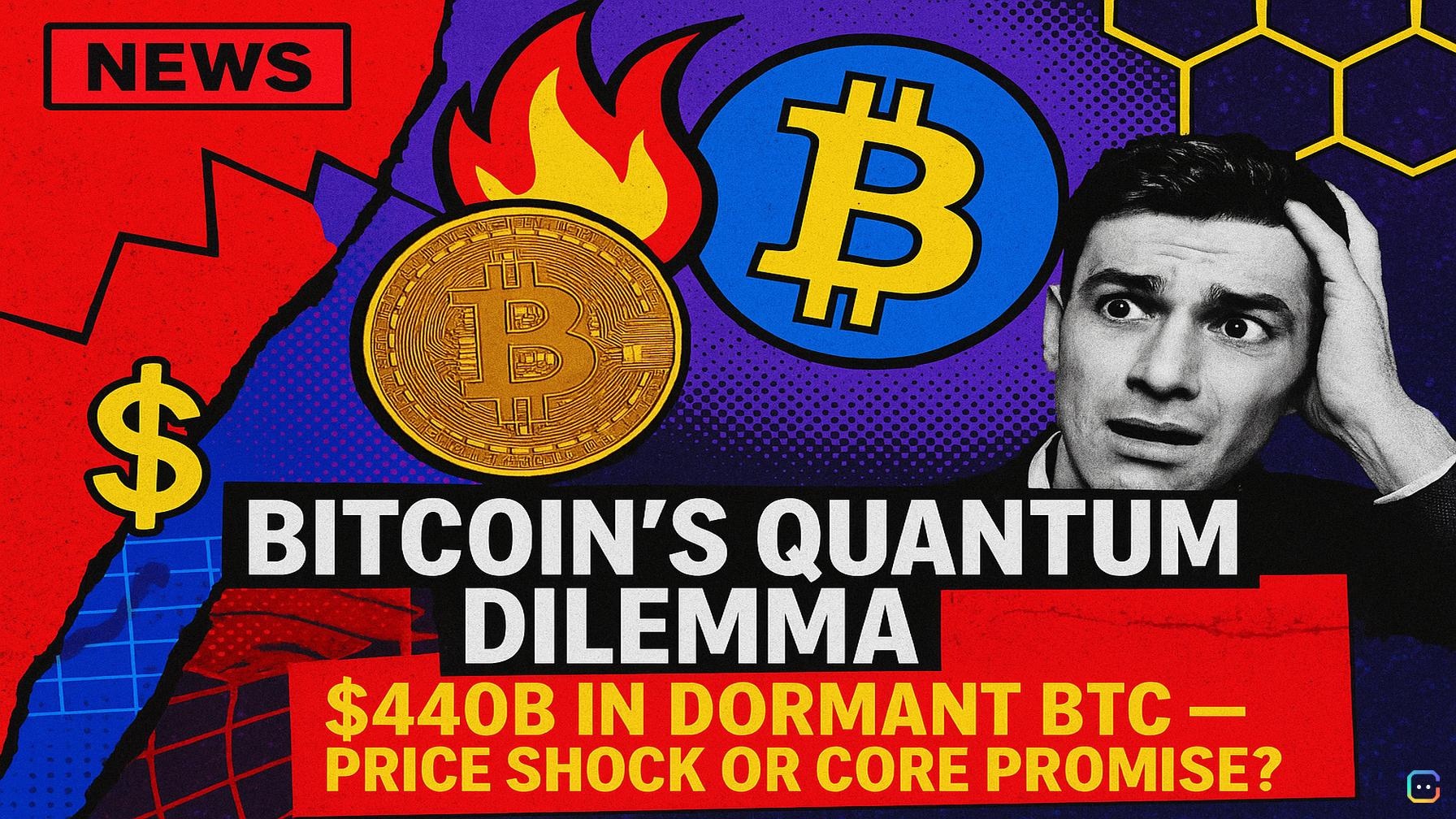
Quantum debate threatens one of bitcoin’s biggest price shocks — or its core promise
A simmering fight among Bitcoin developers and industry insiders over whether to freeze dormant wallets vulnerable to future quantum attacks could trigger an immediate and dramatic market repricing — or fracture the network’s most sacred principles.
Why it matters
About 5.6 million BTC — wallets untouched for more than a decade and therefore most at risk if powerful quantum computers ever break current cryptographic signatures — are at the center of the debate. Those coins are worth roughly $440 billion today and are part of about 19.8 million BTC currently in circulation. Freezing them, some warn, would not only remove those tokens from market assumptions but set a precedent that could force institutions and funds to re-evaluate bitcoin’s risk profile overnight.
The proposal on the table
A group of core developers led by Jameson Lopp released Bitcoin Improvement Proposal 361 (BIP-361), which contemplates phasing out Bitcoin’s current signature scheme and providing mechanisms that could effectively freeze assets that fail to migrate to new protections. Lopp has said he would prefer freezing the dormant coins to leaving them exposed to potential quantum theft.
What proponents say
Supporters of action argue the quantum threat is existential and imminent enough that radical tradeoffs may be necessary. Market analyst Jason Fernandes and Moon Technologies CEO Ken Kruger say the community must weigh stark choices: freeze funds or risk mass theft. Fernandes stresses that the risk is practical, not philosophical — preserving capital and the network’s survival may override abstract purity. Kruger frames a carefully designed fix as an opportunity for Bitcoin to prove its resilience.
What opponents warn
Detractors say freezing coins would violate Bitcoin’s core guarantees of immutability and unconditional ownership and require a contentious hard fork. Samuel “Chad” Patt argues freezing would force an instant repricing — potentially the worst single trading day in Bitcoin’s history — because institutional risk desks will treat all 19.8 million coins as “conditionally owned.” Kent Halliburton and venture partner Khushboo Khullar also object, advocating voluntary migration and better tooling instead of protocol-level confiscation. Trader Mati Greenspan predicts that, if wallets are cracked, the market reaction would be to offer bounties to expose problems — not rollbacks or freezes.
Market and governance stakes
Critics emphasize precedent: once the protocol demonstrates it can seize or freeze coins, the censorship-resistance thesis underpinning many institutional allocations is undermined. Proponents counter that Bitcoin has adapted before (SegWit, Taproot) and that conservative upgrades to secure the chain from quantum attacks may be necessary to prevent far worse outcomes.
Possible outcomes
- A protocol change (contentious hard fork) enabling freezing — high political cost, immediate market repricing risk.
- Voluntary migration and better tooling — slower, may not protect truly dormant addresses.
- Doing nothing — leaves millions of BTC exposed if quantum breakthroughs arrive.
Bottom line
The disagreement cuts to Bitcoin’s identity: protect the monetary network at the expense of absolute immutability, or preserve core property rights even if that risks catastrophic theft down the line. With billions of dollars and the network’s reputation on the line, this debate could become one of Bitcoin’s defining governance tests.
Read more AI-generated news on: undefined/news