Signal in the age of infinite noise
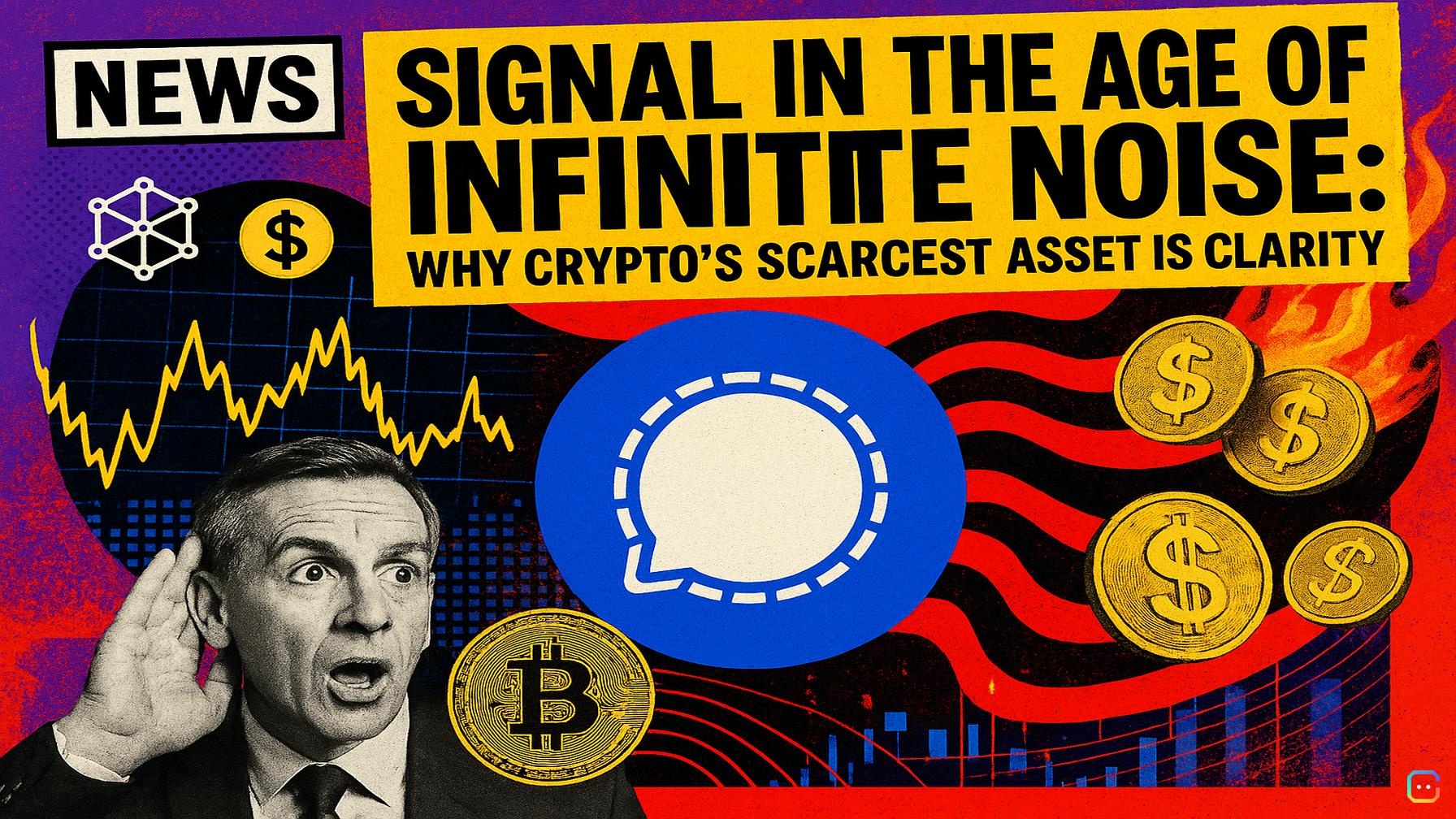
We live in a paradox: there is more analysis available now than at any point in history, and yet collective clarity about what’s actually happening is worse than it was five years ago. The difference isn’t access to data — it’s scale and the collapse of the old filters that once separated useful insight from empty commentary.
When analysis was expensive to produce, being wrong had real reputational and financial costs. Today, those costs are essentially zero. Anyone can spin up a convincing macro take—polished, jargon-rich, and supported by cherry-picked charts—in minutes. The result: noise is expanding exponentially while true signal remains roughly constant. The dangerous part is that this noise no longer looks like noise. It looks like analysis.
The tools people use are optimized to sound right, not to be right. Bad takes are now well-formatted, sourced, and persuasive; what’s missing is the ability to tell the difference. That’s the real battleground.
Proof and track record
For the past two years I’ve focused on using the same data environment everyone else has access to, but synthesizing it differently. I did it publicly—posting on X with timestamped calls and no deletions—across geopolitics, energy, macro, crypto, and markets. The account grew from zero to over 140,000 followers organically, with no paid promotion and no name attached. Signal Core on Substack, the home of the full forecasting operation, became the #3 best-selling crypto publication on the platform within nine months. In a market drowning in noise, that signal alone stood out.
A concrete example
In January, most market participants judged a direct U.S.–Iran confrontation unlikely. Diplomatic channels appeared open and markets weren’t pricing in conflict. Oil traded as if nothing was coming. Yet—more than a month before the strikes—we flagged the rising risk publicly on January 13. When the strikes occurred and oil surged toward double its earlier levels, the market was caught off guard.
The inputs weren’t secret: public statements, internal economic pressure inside Iran, and the absence of typical de‑escalation patterns. The edge wasn’t new data; it was synthesis—reading those inputs as a converging system rather than isolated headlines. That’s the hard part, and it’s where most market participants fail.
AI and the manufacture of false agreement
The problem has become worse with AI. Rather than creating many independent perspectives, AI tools are producing thousands of near-identical takes—minor variations on a default output. Before AI, agreement among analysts carried weight. Now, mass agreement can simply mean everyone used the same model. The tools aren’t just noisy; they manufacture a false consensus that masks true uncertainty.
Why this matters now
We’re entering a short window where foundational shifts across finance, technology, and geopolitics are compounding:
- Digital assets are integrating with traditional finance faster than expected.
- Regulatory frameworks that stalled for years are being rewritten in real time.
- AI is reshaping capital allocation.
- Geopolitical alignments are changing.
- Monetary policy is at a turning point.
- Labor markets are being restructured.
These changes are arriving simultaneously. That should make signal more valuable than ever—but instead, clarity is collapsing precisely when it’s most needed.
What separates winners
Signal isn’t about having the most data or the loudest platform. It’s the ability to see a structure beneath the noise: to recognize patterns before they’re obvious, to defend a position when the feeds scream otherwise, and to be right often enough that your calls hold up over time. Credentials and institution size no longer guarantee clarity—many big misses in recent years were made by established players, while independent operators caught key moves.
Where real signal still shows up
Finding communities that genuinely filter insight rather than amplifying model outputs is getting harder. Most venues echo the same algorithms. Events that still function as honest filters are rare. Consensus 2026 in Miami stands out as one of the exceptions—people there have skin in the game, their disagreements are real, and their consensus isn’t manufactured. I’ll be hosting a small invite-only session there on what signal extraction at scale actually looks like.
Bottom line
The next year will reshape more of the economic and geopolitical landscape than the past decade for many sectors. The scarcest asset in those markets won’t be data or tools—it will be signal: the ability to see clearly when everyone else is drowning in noise. Investors, builders, and allocators who learn to recognize and prioritize true signal now will compound that advantage for years. Those who don’t will keep following the crowd—and miss the moments that matter most.
Read more AI-generated news on: undefined/news