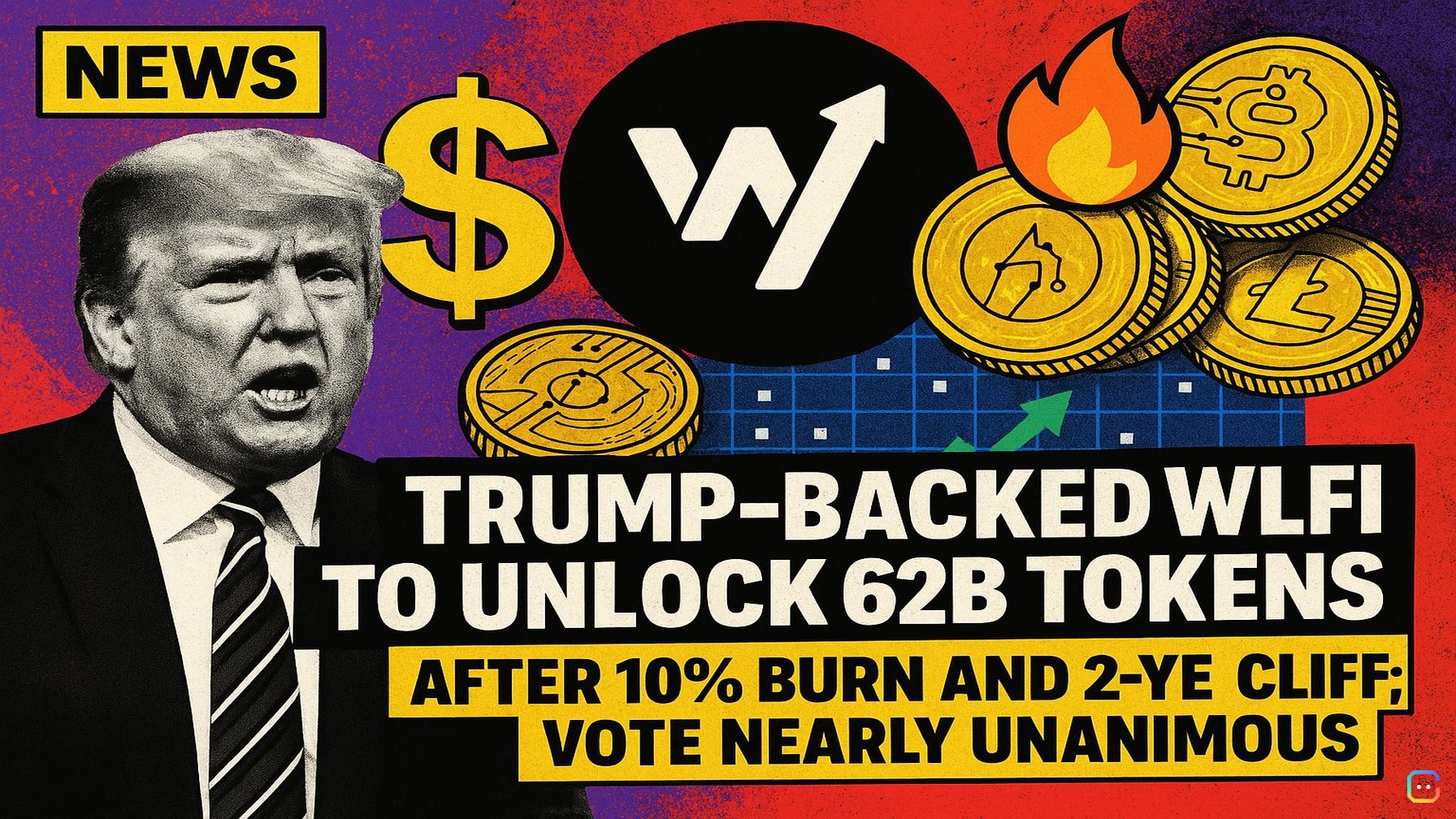
World Liberty Financial, a crypto project backed by former U.S. President Donald Trump, is fast-tracking a major tokenomics overhaul: a proposal to unlock 62 billion WLFI tokens is all but guaranteed to pass after early votes blew past quorum and delivered near‑unanimous support.
What the proposal does
- The plan calls for founders, team members and partners to burn 10% of their holdings — roughly 4.5 billion WLFI — as a show of commitment.
- After that burn, the proposal would begin releasing the remaining tokens on a fixed schedule: a two‑year cliff followed by a five‑year vesting period that distributes roughly 40.7 billion WLFI.
- Because of the two‑year cliff, no tokens would reach the open market for at least two years.
Why it matters
- The change replaces open‑ended lockups with a predictable future supply schedule, creating a clearer exit path for holders who previously had limited liquidity options.
- That predictability can reduce uncertainty around future dilution and may be seen as a step toward maturing WLFI’s tokenomics.
Voting and governance dynamics
- The tally so far shows near‑unanimous approval: 99.5% voted in favor.
- Participation mirrors prior WLFI proposals, underscoring that a relatively small group of large holders can steer major decisions. The largest wallet alone accounts for nearly 13% of votes cast; the top four wallets together control about 40% of voting power so far — enough to decisively influence outcomes.
Legal clouds
- WLFI is also embroiled in litigation. Tron founder Justin Sun has sued the project, alleging his tokens were frozen and his governance rights stripped — claims WLFI has denied.
What’s next
- With early votes surpassing quorum and overwhelming support, the unlock proposal looks set to pass. Market impact should be limited in the short term because of the two‑year cliff, but the governance concentration and ongoing lawsuit add layers of political and legal risk to watch as the plan moves forward.
Read more AI-generated news on: undefined/news