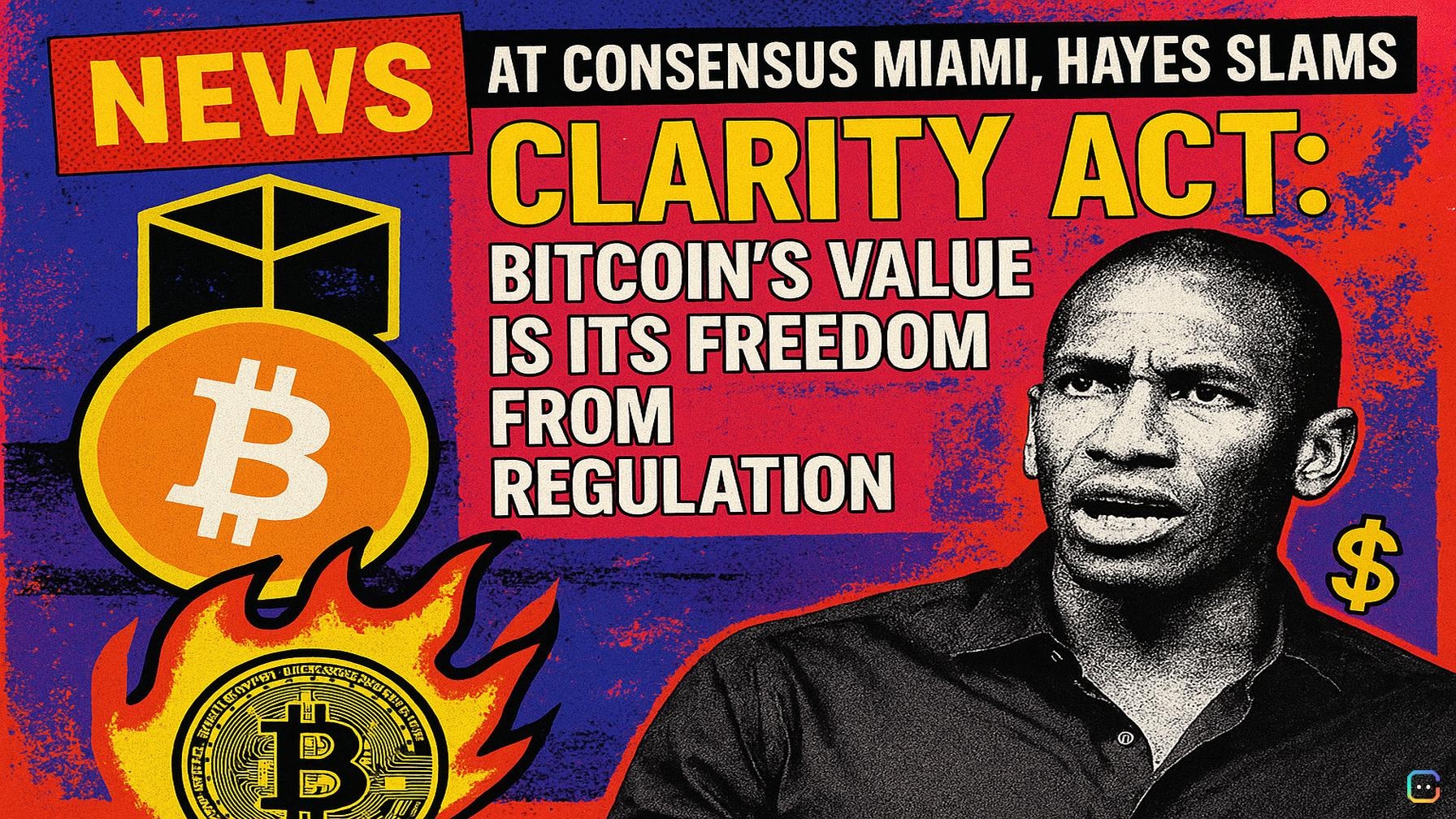
BitMEX co-founder and Maelstrom CIO Arthur Hayes used his Consensus Miami 2026 slot to deliver a blunt rebuke of proposed U.S. crypto regulation, arguing that bills like the CLARITY Act miss what makes bitcoin valuable: its existence outside traditional regulatory systems.
Speaking on May 5, Hayes told the audience that bitcoin’s core appeal — and its price dynamics — stem from its detachment from government-controlled monetary systems. “This is the value that bitcoin provides outside of the regulatory apparatus,” he said. “It’s precisely the reason that it does not adhere to the regulatory regime that some of you wish to put it under with bills like the Clarity Act and other things.”
Hayes boiled his view of bitcoin valuation down to a single variable: the amount of fiat currency in circulation. “If you want to talk about the price of bitcoin and what’s the fair value, all that matters is how many units of fiat are there today,” he said, dismissing legislation as largely irrelevant to that calculation.
Beyond economic theory, Hayes attacked the politics behind the CLARITY Act, saying it primarily benefits centralized crypto firms with Washington lobbying operations rather than the decentralized projects that inspired the asset class. That stance contrasts sharply with much of the Consensus 2026 messaging, where several industry leaders — including Ripple CEO Brad Garlinghouse — have urged the Senate to move the bill forward as a way to bring regulatory clarity.
The CLARITY Act has already cleared the House and the Senate Agriculture Committee, but faces several hurdles: a Banking Committee markup and then a 60-vote threshold on the Senate floor, all before the May 21 Memorial Day recess. Banking groups have continued pushing back — particularly over stablecoin yield provisions — compressing an already narrow legislative window, according to prior coverage.
Hayes’s comments framed a broader fault line in crypto policy debates: whether formal regulation should be embraced as a path to mainstream adoption and institutional safety, or resisted as a threat to the permissionless, decentralized principles that many say define bitcoin.
Read more AI-generated news on: undefined/news