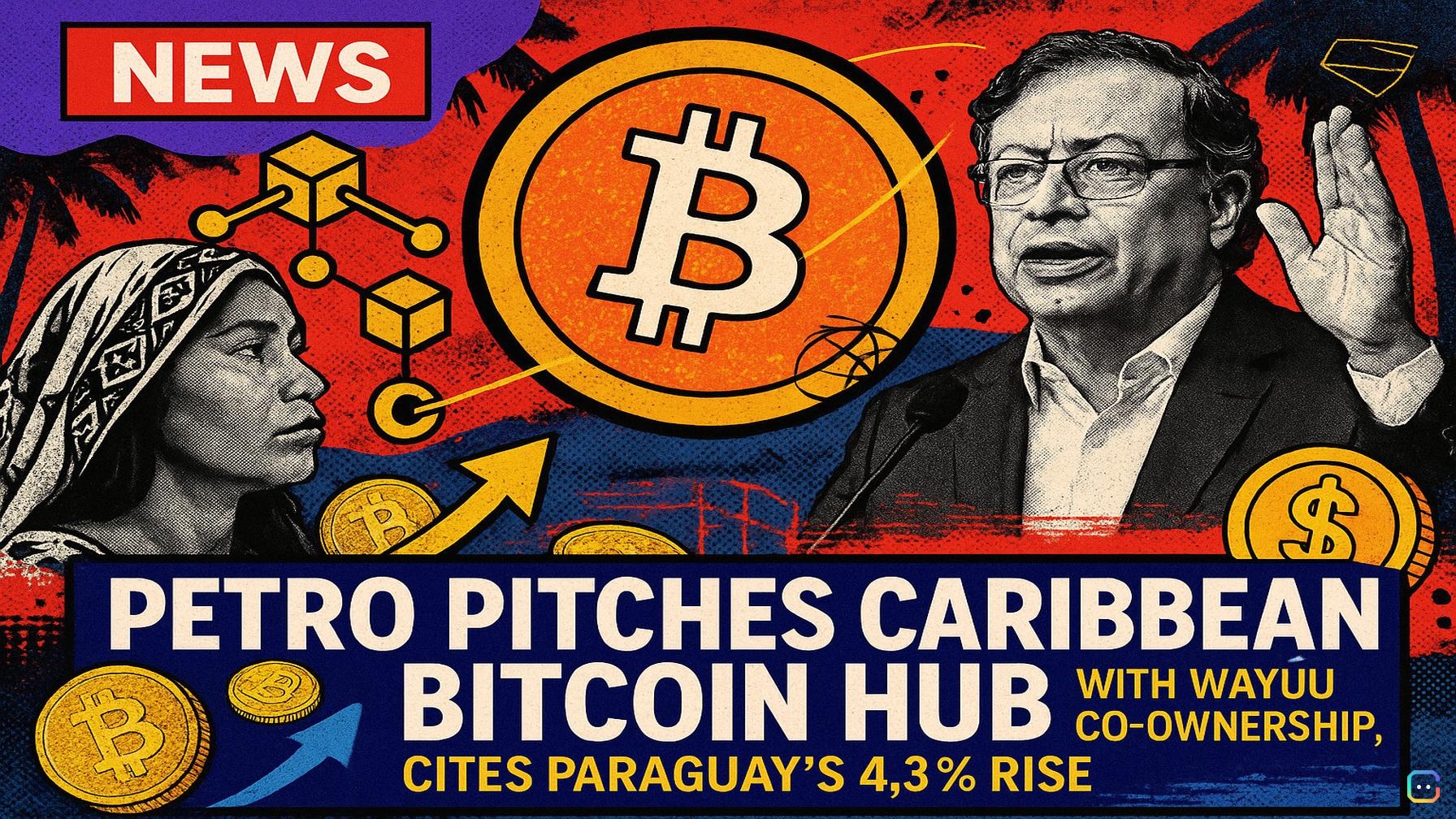
Paraguay’s recent climb to roughly 4.3% of the global Bitcoin hashrate has sparked interest across South America — and prompted Colombia’s president to pitch a domestic mining play.
What Petro proposed
- Colombian President Gustavo Petro publicly suggested turning parts of the country’s Caribbean coast into a Bitcoin-mining hub, citing Paraguay as a working example for development-minded nations.
- He named three potential sites: Barranquilla, Santa Marta, and Riohacha.
- Unusually, Petro insisted the Wayúu — Colombia’s largest Indigenous community and long-time residents of the region — should be made co-owners of any mining ventures there.
Why Paraguay matters in Petro’s pitch
- Paraguay has leveraged abundant hydroelectric power (notably from the Itaipú dam) to attract mining activity and now ranks fourth globally in Bitcoin mining hashrate, behind the US, Russia and China.
- That 4.3% figure is the kind of quick, visible win Petro points to as a model other developing countries can follow.
The environmental and energy angle
- Petro frames the plan as a way to avoid fossil-fuel–driven mining; Colombia already generates about 75% of its electricity from renewables (World Bank, April 2024), more than double the global average.
- Tapping surplus clean power for mining, Petro argues, would turn idle or underused electricity into export revenue without the emissions burden of fossil-powered operations.
Economic case and market dynamics
- Analysts (including Hashlabs) say Bitcoin mining can convert surplus electricity into a cash-generating export for emerging economies.
- The opportunity is widening as some US commercial miners pivot toward higher-margin businesses like AI and high-performance computing, opening space for countries with low-cost electricity to capture more of the global mining market.
A practical constraint
- Petro has limited runway: his term ends in August, and Colombia’s constitution bars re-election. The next presidential vote is set for May 31, leaving only a short window to advance such a project from proposal to policy.
Bottom line
Petro’s proposal combines energy strategy, Indigenous participation, and crypto policy in a single playbook. Whether Colombia can move fast enough — and win the political consensus — to turn its coastal renewables into a meaningful slice of the global Bitcoin network remains to be seen.
Read more AI-generated news on: undefined/news