Poland’s crypto rulebook is suddenly up for grabs — and the fight in the Sejm looks set to reshape how the country enforces digital-asset rules.
What’s happening
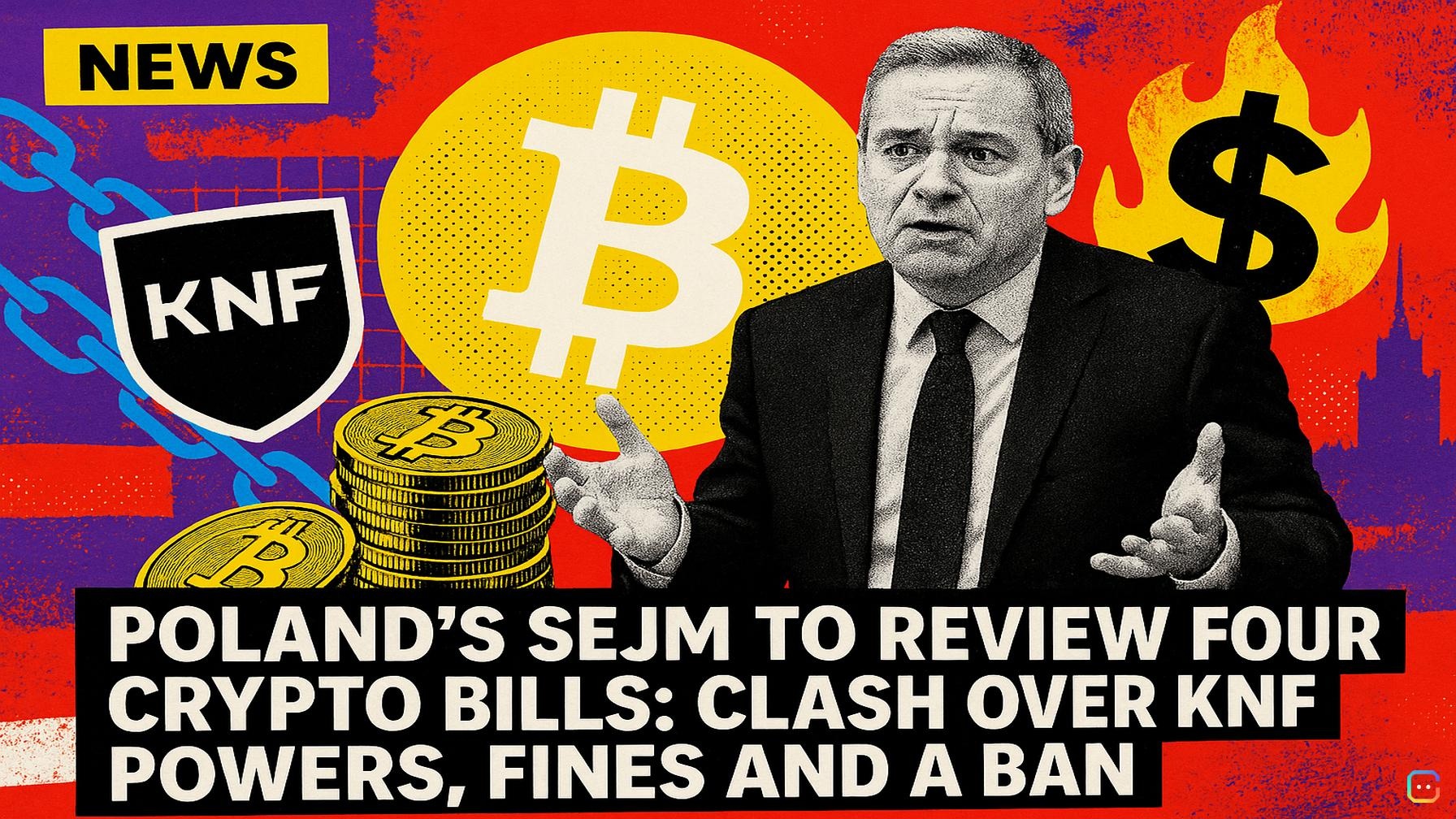
The lower house of Poland’s parliament, the Sejm, has opened formal review of four competing cryptocurrency bills at once, Speaker Włodzimierz Czarzasty confirmed. Drafts come from the government, the presidential office, the Poland 2050 party and the Confederation party. A second-reading vote could happen as soon as Thursday.
Why four bills?
The fragmentation is partly the result of repeated political deadlock. President Karol Nawrocki has twice vetoed crypto-related legislation, forcing lawmakers to restart negotiations and produce multiple competing drafts rather than a single consensus text. At the heart of the debate is a relatively narrow — but potent — technical question: how much enforcement power should the Polish Financial Supervision Authority (KNF) get over crypto firms, especially the authority to freeze accounts and to levy maximum fines?
The numbers matter
The presidential draft limits fines to about 20 million zlotys (~$5.5 million). The Finance Ministry’s version raises that cap to 25 million zlotys (~$6.9 million) — a 25% difference that signals a deeper policy split over whether Poland should tilt toward protecting investors with stronger enforcement or toward a lighter touch that favors innovation.
A ban enters the ring
Complicating matters, the opposition Law and Justice party (PiS) has introduced a separate bill that would ban crypto-related activities outright. PiS previously withdrew support for earlier proposals; its ban draft will only be formally reviewed after the four main bills have been processed, Speaker Czarzasty said. The outright-ban approach is legally and politically risky: it would clash with EU rules and is likely to face constitutional and EU-law challenges.
Corruption questions surface
Czarzasty also raised questions linking industry funding to political activity, specifically calling out exchange Zondacrypto and probing whether crypto sector money influenced political decisions. That introduces a corruption subtext into what had been a largely technical regulatory tussle.
MiCA and the EU context
Poland’s debate isn’t about whether to implement the Markets in Crypto-Assets (MiCA) regulation — MiCA entered into force across the EU in December 2024 and already provides a harmonized licensing framework. Rather, Warsaw is arguing over how aggressively to layer national enforcement powers on top of the EU baseline. That distinction makes PiS’s ban both legally problematic and politically radical.
Why this matters beyond Poland
Poland punches above its weight in the region’s crypto ecosystem: it has one of the largest retail crypto user bases in Central and Eastern Europe, and Zondacrypto (formerly BitBay) is one of the region’s older, well-capitalized exchanges operating under a MiCA transitional license. A regulatory outcome that grants KNF sweeping freeze powers and higher fine ceilings (around 25 million zlotys) would be manageable for established players; an outright ban, even if vulnerable to legal challenge, would create immediate operational uncertainty for exchanges and retail users alike. Retail-heavy markets have historically reacted strongly to sudden legal and tax shifts, and Poland’s vote — whatever the result — will be watched closely by exchanges and compliance teams across the EU’s eastern flank.
What’s next
Expect intense lobbying and political maneuvering in the coming days as lawmakers choose among four drafts while a fifth, far more extreme ban proposal waits in the wings. The Sejm’s second-reading vote — possibly on Thursday — could set a national enforcement posture that will reverberate across Central and Eastern Europe’s crypto markets.
Read more AI-generated news on: undefined/news