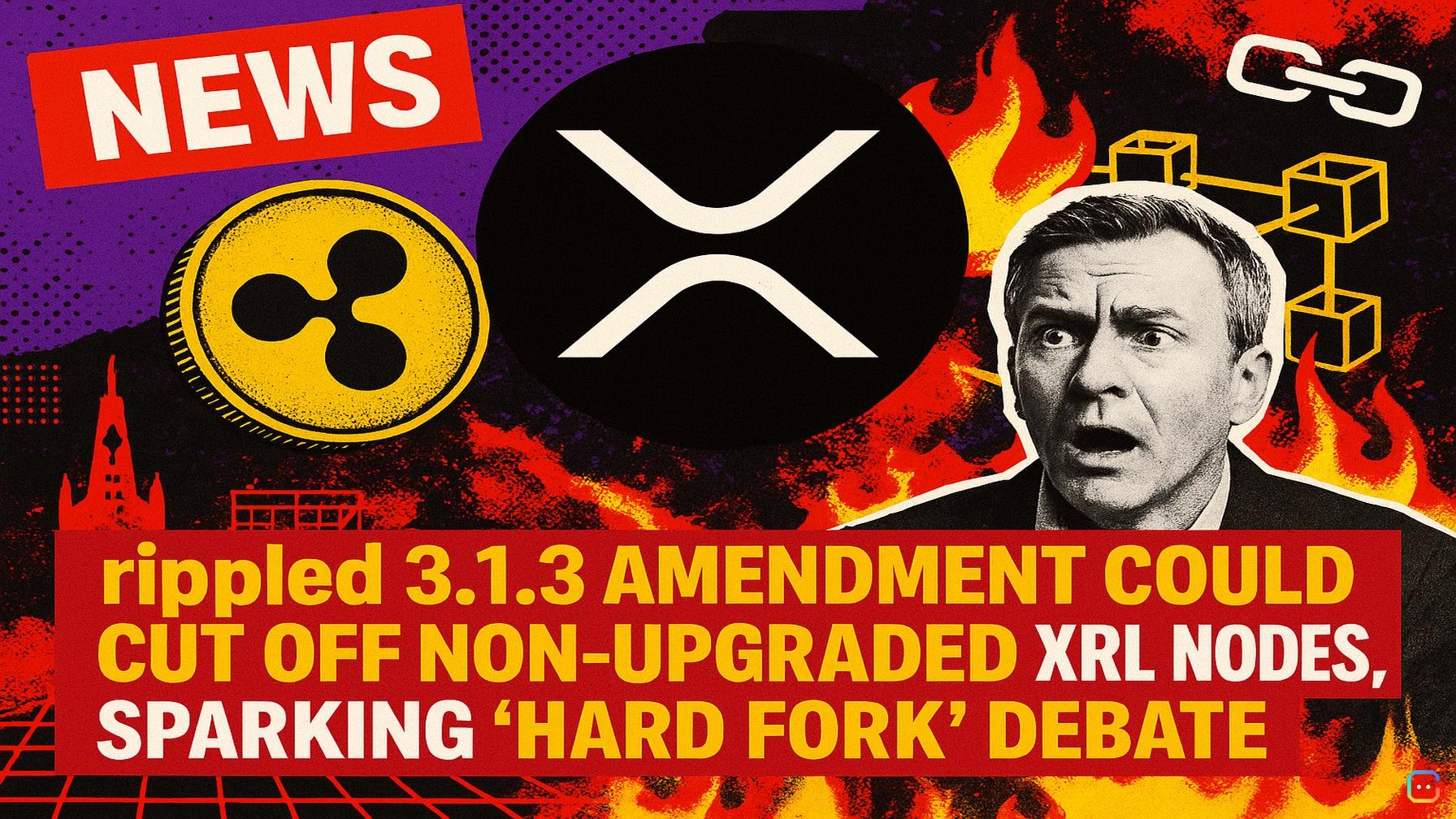
The XRP Ledger community is locked in a debate after operators warned that an upcoming server update will effectively cut off nodes that don’t upgrade in time — prompting arguments over whether the change is a genuine “hard fork” or simply the ledger’s amendment system doing its job.
What’s happening
Ripple’s reference server software, rippled, shipped version 3.1.3 with a fix package called fixCleanup3_1_3. The release patches issues affecting NFTs, Permissioned Domains, Vaults and the Lending Protocol. Because the fixes are important, the amendment’s default vote was set to “Yes,” meaning the network will automatically adopt it unless a supermajority of trusted validators block it.
Timeline and uptake
Validator operator Vet flagged the release on May 18 and said roughly 40% of the network had upgraded at that point, warning the fix would activate in nine days and that “every node that hasn’t been updated to 3.1.3 will be unable to communicate to the network.” RippleX head of engineering J. Ayo Akinyele later updated the figure to 44% and urged operators to update quickly, noting “Only 8 days left before the fix amendment activates — don’t be left out!”
Why some call it a hard fork
Critics seized on the early upgrade numbers, arguing that a sizeable share of nodes could be cut off once the amendment activates. One X user, ScamDaddy, wrote: “The XRPL will hard fork in 9 days. As of this moment, 60% of the network will be forked off,” and questioned who should determine mainnet rules if many nodes remain on older software.
Why others disagree
Many in the XRPL community pushed back, saying “hard fork” is the wrong framing. XRPL’s amendment mechanism relies on validator voting: an amendment passes if more than 80% of trusted validators signal support for two weeks, after which the change becomes permanent for future ledgers. Amendment blocking is designed to protect the ledger when older software can no longer interpret the network’s rules.
Technical consequences for outdated nodes
The impact is concrete. Servers that don’t run the amendment-aware code won’t be able to determine ledger validity, submit or process transactions, participate in consensus, or vote on future amendments. In short, they’ll be functionally cut off until operators upgrade their rippled instance.
Voices from infrastructure operators
Daniel Keller, CTO of Eminence (which runs an XRPL Full History Node), cautioned that simple node counts can overstate the risk. “The only question is: how many of them actually matter to XRPL operations?” he wrote, pointing to abandoned nodes or those that would update shortly. Keller framed the cutoff as a matter of maintenance discipline rather than a decentralization failure: “Running a node is a responsibility, not a participation trophy. If you can’t maintain infrastructure, you should get filtered out. That is network hygiene.”
Another community member, Krippenreiter, echoed that the amendment block is a security feature, not a sign of a network split: it prevents nodes that haven’t updated from misinterpreting transaction data or rules.
Bottom line
Technically, nodes that fail to upgrade to rippled 3.1.3 before the fixCleanup3_1_3 amendment activates will be unable to communicate with the network. Whether that reality constitutes a “hard fork” or a deliberate safety mechanism depends on your view of amendment governance and what counts as the operational network.
Market snapshot
At press time, XRP was trading at $1.38.
Read more AI-generated news on: undefined/news