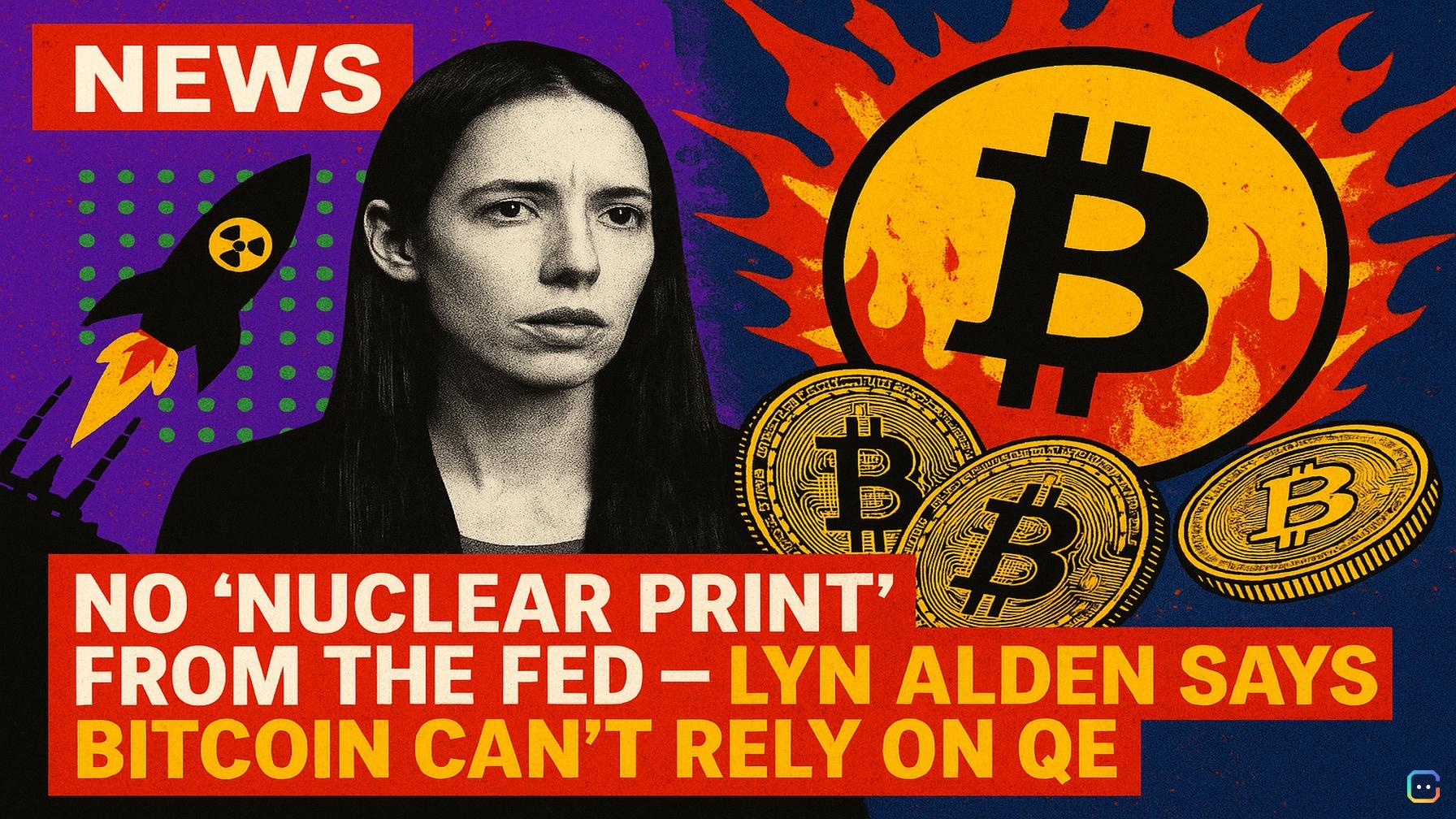
Don’t expect a Fed-fueled miracle to bail out bitcoin this cycle. In a recent Coin Stories interview with Nathalie Brunell, macro strategist Lyn Alden argued that the next policy move from the Federal Reserve will look more like a gradual balance-sheet expansion than the kind of “nuclear print” that historically turbocharged risk assets. That, she says, leaves bitcoin to win on its own fundamentals and narrative — not on a macro backstop.
Alden described the current crypto cycle as unusually muted. Prices aren’t the only disappointment: participation is thin. “Sentiment is worse than 2022,” she said, pointing to a missing retail bid, no meaningful “alt season,” and a market that has largely “run out of narratives.” She also noted that bitcoin’s cycle top — which she pegged at $126,000 — fell short of her expectations for a truly satisfying rally.
Why won’t the Fed step in with massive QE? Alden pushed back on the reflex that every market downdraft forces an emergency liquidity response. She emphasized the Fed’s main concern is the plumbing of the Treasury and interbank lending markets; a 10–30% pullback in stocks alone is unlikely to compel a shock-and-awe stimulus. Brunell cited Chairman Jerome Powell’s comments about slowly expanding the Fed’s balance sheet with roughly $40 billion in short-term Treasury bill purchases — a far cry from the trillions some Bitcoin advocates expect. Alden’s take: current market “plumbing” doesn’t demand a big print. Banks have healthier cash ratios than in prior crises, so a little QE goes a long way.
Historically, Alden said, QE-scale interventions were responses to specific stresses — an overlevered banking system and acute private-sector balance-sheet problems. Today’s environment lacks those conditions unless there’s a COVID-scale shock or an escalation into broader “financial war.” The base case, she argues, is incrementalism: slow, supportive balance-sheet creep rather than dramatic liquidity injections.
That distinction matters for bitcoin. Gradual QE is mildly supportive, Alden said, but it’s not a panacea. Without emergency stimulus, “bitcoin still has to compete on its own merits for investor attention,” she warned — up against AI darlings like Nvidia, commodity plays, and other yield or store-of-value narratives. The muted cycle, she argued, reflects mediocre topline demand and competition for investor mindshare from AI-linked equities and even precious metals. Sovereign buyers largely didn’t show up, retail stayed sidelined, and the marginal bid has come mainly from corporate and higher-net-worth buyers aided by ETFs.
Alden also downplayed the idea that derivatives and ETFs are solely to blame for capped upside. While they can temporarily “inflate” synthetic supply, the bigger problem is simply that demand hasn’t been robust enough to overwhelm a now-larger, more liquid bitcoin market. She expects bottoms to form as “fast money gets out” and coins rotate into “strongly held hands,” making a slow grind higher more likely than a sharp V-shaped recovery.
For an upside to reignite, Alden outlined a plausible scenario: AI trades peak, bitcoin sits “cheap for a while” in long-term wallets, and only a marginal amount of new demand — possibly plus continued corporate-treasury buying — is needed to restart reflexive flows. But her core warning is clear: don’t bank on policy theatrics to rescue this cycle. Bitcoin’s comeback, she suggests, will depend on whether enough investors still value “self-custodial, undebasable savings” when so many other assets are competing for attention.
At press time, bitcoin traded at $67,556.
Read more AI-generated news on: undefined/news