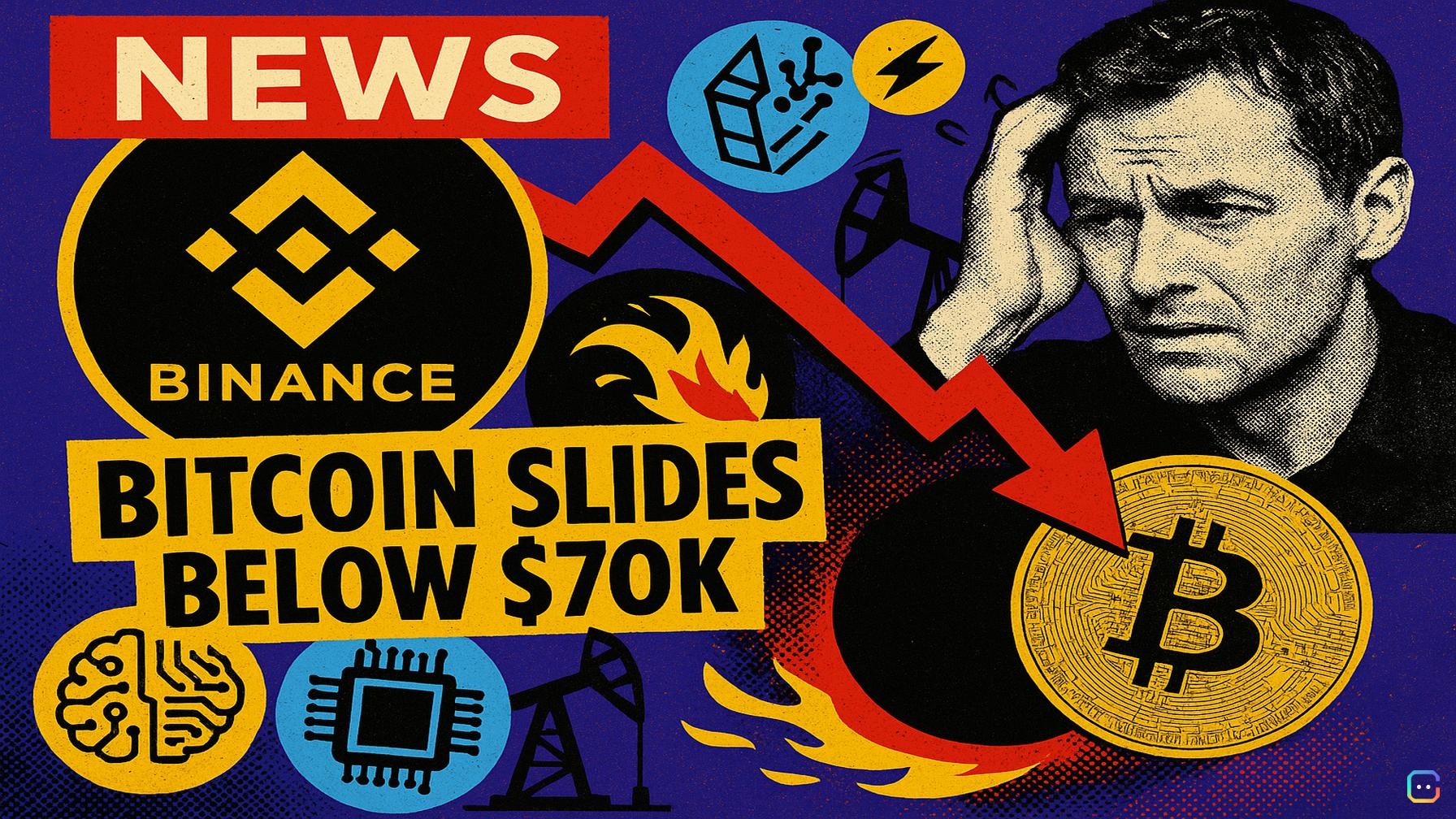
Bitcoin has slid below $70,000 as a wave of capital concentrates in a handful of U.S. equity sectors, leaving the crypto giant struggling to compete for liquidity, according to a new report from Binance Research.
The firm points to a surge in the Cboe Dispersion Index — which recently hit 42, its third-highest reading on record — as evidence of extreme concentration within the S&P 500. Binance Research says that when a small group of investment themes soaks up the majority of flows, alternative assets like Bitcoin typically lose out.
What’s attracting money now
- Strong demand for artificial-intelligence infrastructure and semiconductor stocks.
- Rotation into defense names, energy firms and commodity plays.
As capital floods those areas, Binance argues, Bitcoin is left fighting for attention and funding on multiple fronts.
A recurring pattern
Binance Research outlines a repeating market dynamic: outsized returns from a few equity themes attract heavy inflows, concentrating capital into a limited set of winners and creating what the report calls a “capital black hole” that reduces liquidity for other risk assets.
The report cites historical precedents:
- 2015: Bitcoin fell about 20% during a rotation into FAANG and biotech stocks.
- 2016: BTC declined ~18% amid a defensive sector rotation.
- 2018: Bitcoin plunged roughly 68% amid late-cycle FAANG leadership and the collapse of the ICO market.
- 2022: A rally in energy stocks coincided with about a 50% drop in BTC.
More recently, Binance links Bitcoin’s fall from roughly $115,000 to $71,000 in late 2025 to heavy investor interest in AI and semiconductor names. The current quarter has seen another rotation into AI, defense and energy, and Bitcoin is down about 11% in that period, the report notes.
Crypto-specific and macro pressures
Binance’s analysis arrives as Bitcoin faces both industry-specific and macro headwinds. On June 2, BTC dipped below $70,000 during Asian trading after U.S. spot Bitcoin ETFs posted $483 million in daily net outflows — extending an 11-session withdrawal streak that has seen more than $3.4 billion leave those funds. Additional market stressors cited in the report include:
- Mt. Gox-related transfers of 10,306 BTC (about $739 million), reviving concerns that creditor distributions could boost supply.
- A disclosure that Strategy sold 32 BTC — its first sale in roughly four years — which injected short-term panic.
- Oil market volatility tied to U.S.–Iran talks and potential disruptions around the Strait of Hormuz, pushing investors toward traditional safe havens such as gold and silver.
Derivatives and technical picture
Derivative-market dynamics have amplified losses: more than 152,000 traders were liquidated over a 24-hour span, with total liquidations exceeding $744 million after Bitcoin lost key technical support. Chart-wise, BTC has broken below the rising channel that supported its recovery from February lows, putting $68,700 and $65,000 into focus as the next downside targets.
Outlook: rotation vs. crisis
Despite the weakness, Binance Research stresses that rotation-driven selloffs have historically been more recoverable than industry-specific crises. Past peaks in equity dispersion were often followed by Bitcoin bottoms within 0–20 weeks, with a median recovery around two weeks. Crucially, Binance notes the current market lacks a major crypto-native shock comparable to past collapses, suggesting a more constructive medium-term outlook if the selloff is driven mainly by sector rotation rather than structural problems in crypto.
Read more AI-generated news on: undefined/news