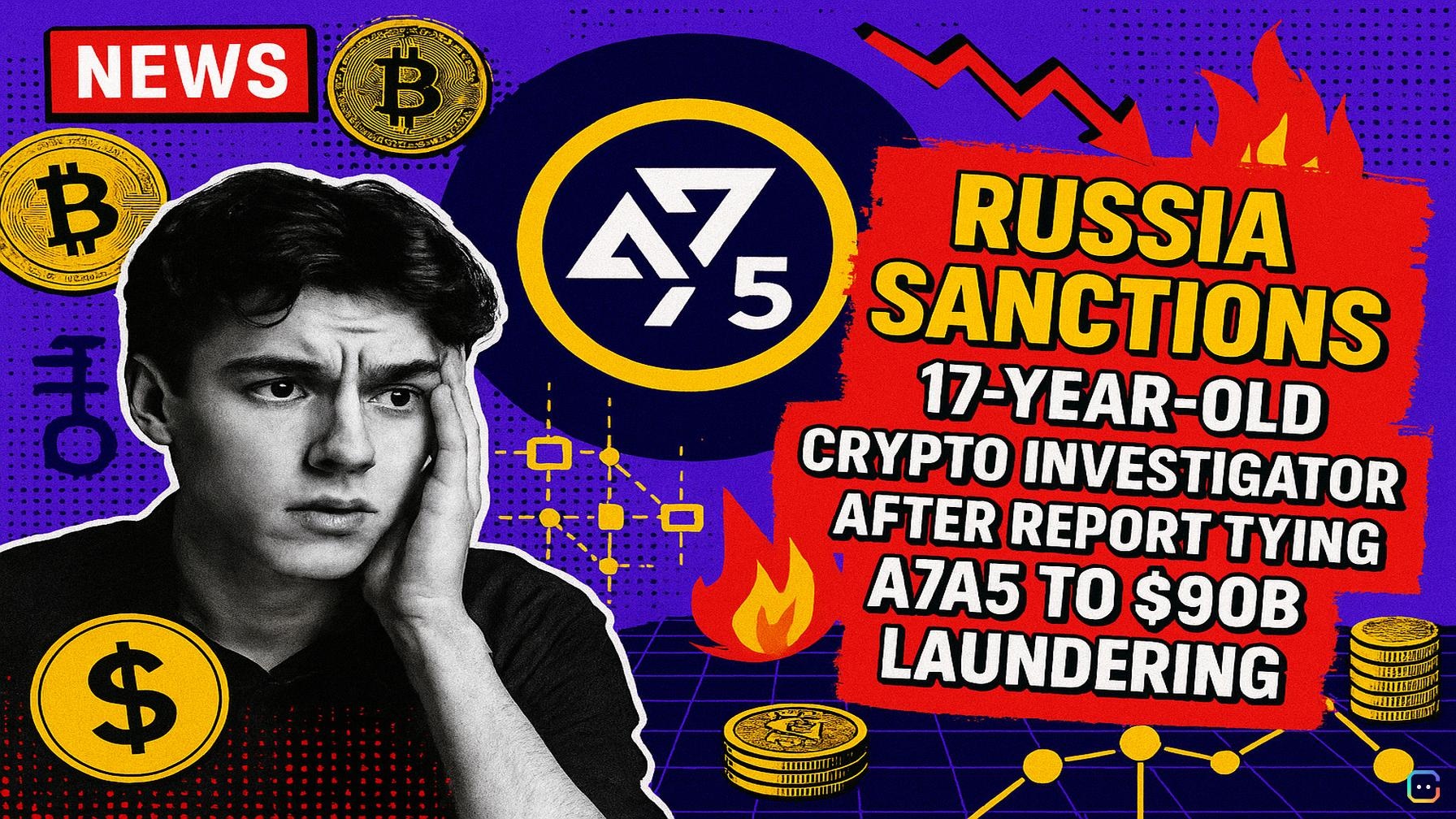
Russia has added a 17-year-old British crypto investigator to its sanctions list, in what appears to be the youngest individual ever targeted by Moscow’s punitive measures. The move was announced Wednesday by the Russian Foreign Ministry and also names four other UK-based figures: Washington Post reporter Catherine Belton; Alice Mary Laugher, managing director of Committed to Good; Richard Nicholas Westbury, founder and chairman of Chelsea Group; and journalist Richard Holmes of The i Paper. All five are now barred from entering the Russian Federation.
The action looks like direct retaliation for a March 2026 report by the teenager, Alexander Browder, published through the Henry Jackson Society and titled “Confronting the Illicit-Finance Hydra in Crypto Markets: Protecting Retail Investors and Disrupting Hostile Government Exploitation.” Browder, the founder of the Global Cryptocurrency Laundering Database, alleges that state actors including Russia, Iran and North Korea have laundered roughly $350 billion via cryptocurrency.
A central focus of Browder’s research is A7A5, a ruble-backed stablecoin launched in January 2025 by UK-sanctioned Moldovan businessman Ilan Shor in partnership with Promsvyazbank, a Russian bank already under sanctions. Citing UK government data, Browder’s report says the A7A5 network processed about $90 billion in transactions last year—transactions the research frames as part of a system designed to evade Western sanctions.
Browder’s work is built on his Global Cryptocurrency Laundering Database, which he describes as the first and largest open-source database of crypto laundering cases: 164 cases spanning two decades. That compilation underpinned the report’s claims and appears to have triggered Moscow’s response.
Rather than retreating, Browder publicly welcomed the sanction. In an X post on June 3, 2026, he said being added to the list was a “badge of honor,” wrote that he was “proud to be the first high school student in the world to ever be sanctioned by an authoritarian regime for uncovering corruption,” and asserted: “I have exposed their Achilles’ heel. Without A7A5 they would not be able to fund their war of aggression.”
The sanction carries an added political resonance: Browder is the son of Sir Bill Browder, a well-known Kremlin critic who was banned from Russia in 2005 after exposing corruption and who helped drive the U.S. Magnitsky Act targeting Russian officials. That family connection underscores the geopolitical stakes surrounding investigations into crypto-enabled sanction evasion.
Why this matters to the crypto sector: the case highlights how tokenized stablecoins and opaque transaction networks can be leveraged for state-level sanction circumvention, raising fresh compliance and enforcement challenges for regulators and custodians. It also signals the personal risk faced by researchers and journalists who expose these systems—and the potential for geopolitical blowback when crypto transparency efforts intersect with national security.
Read more AI-generated news on: undefined/news