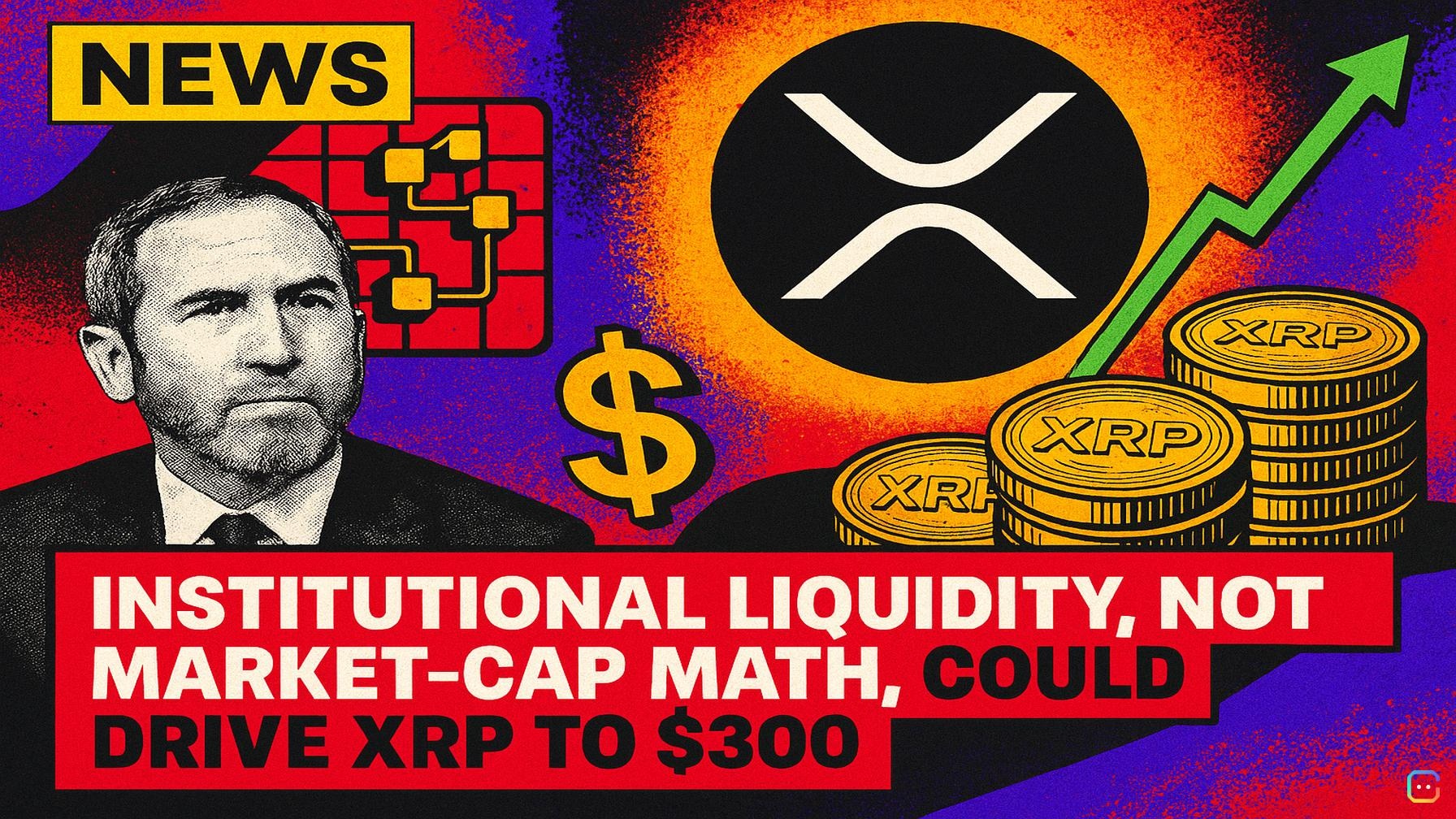
XRP has spent much of 2026 trading below the price targets many in its community expect — but one prominent commentator says those targets are being measured with the wrong yardstick.
CharuSan, an analyst and frequent XRP commentator, argues that applying traditional market-cap logic (the same framework used to value stocks) misses how XRP is designed to function. Rather than behaving like a static store-of-value that rises mainly because retail investors buy on exchanges, CharuSan says XRP is meant to operate as a high-velocity liquidity and bridge asset for institutional flows. If that design is realized, price dynamics will be driven by instantaneous liquidity demands from large financial systems, not just ordinary exchange order books.
Why market-cap comparisons may be misleading
- Most community price models take circulating supply × price to reach a target market cap. CharuSan calls this “stagnant” thinking for a token intended to route liquidity at scale.
- If XRP is integrated into institutional settlement rails, liquidity routing, and large-value transfers, the relevant supply is the XRP available at the exact moment a transfer is executed — which can be far lower than circulating supply shown on paper.
- In that scenario, even a market cap of $500 billion or $1 trillion could be insufficient given the size of global markets that might demand instant liquidity.
Where demand could come from
CharuSan points to several large pools of potential liquidity demand if the XRP Ledger were used widely by institutional systems: derivatives, equities and debt markets, DTCC clearing volumes, FX settlement, bank transfers, OTC markets, and Nostro/Vostro account operations. Full integration of those systems would create sustained, high-throughput liquidity needs that differ qualitatively from retail trading.
A $300 price target — but conditional
The analyst’s headline assertion is that XRP would be “mathematically forced” toward roughly $300 per token under a full-integration scenario. That projection is explicitly conditional: once institutional automation, APIs, and settlement software begin routing large transfer orders into liquidity pools, market behavior would be dominated by the need to source immediate, deep liquidity rather than by small-scale order-book activity.
CharuSan illustrates the point with a previous example from his series on the topic: a $200 billion bank transfer. At a hypothetical price of $20 per XRP, that transfer would require about 10 billion tokens — a quantity difficult to source instantly if multiple banks and institutions are drawing liquidity at the same time. RippleNet currently lists more than 300 banking partners, and roughly 40% of them are actively using On-Demand Liquidity (ODL), the service designed to source XRP liquidity for cross-border payments.
Bottom line
The argument reframes XRP not as a stock-like asset whose price target is reached by investor accumulation, but as a potential infrastructure token whose price would be set by instantaneous liquidity needs if widely adopted by institutional rails. Whether XRP reaches such levels depends on how deeply and quickly major financial systems integrate the Ledger and ODL into their settlement and routing processes — a development that remains speculative rather than assured.
Read more AI-generated news on: undefined/news