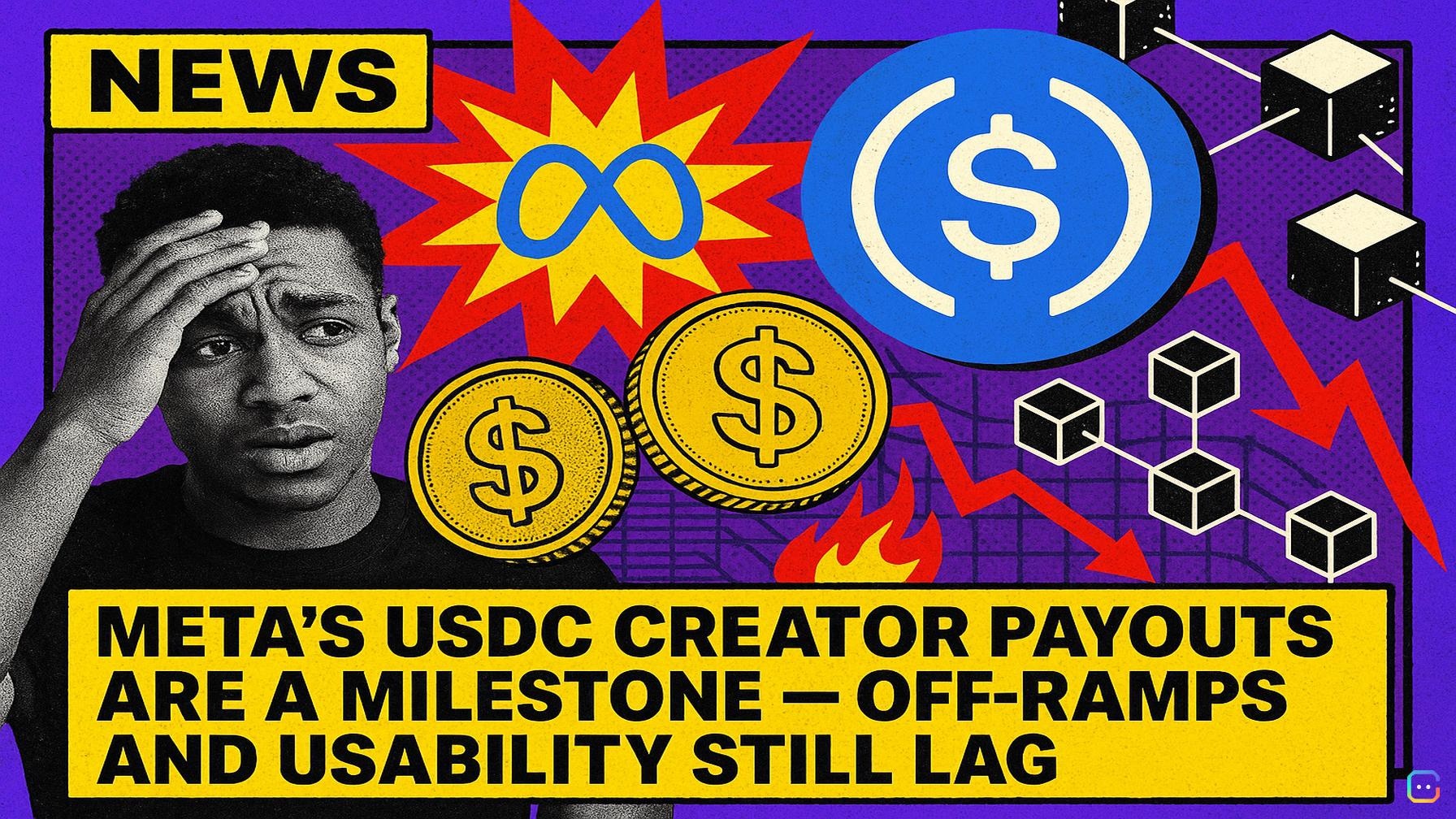
Meta’s move to pay creators in USDC is a milestone — but it’s not a finished payments product.
In March, Meta said it would start paying creators in USDC in Colombia and the Philippines, with plans to expand to more than 160 countries by year-end. For a company that handles nearly $3 billion in annual creator payouts, choosing on‑chain settlement over traditional banking rails is a clear signal: stablecoins are now core infrastructure. But the rollout also highlights an important gap — settlement is solved; conversion and everyday usability are not.
What creators actually face
Meta’s system speeds up cross‑border settlement: transfers are near‑instant, fees are tiny, and moving money between accounts onchain is far easier than slow banking rails. But receiving USDC from Meta is only the first step. Creators must:
- Connect an external wallet and choose a supported network (e.g., Solana or Polygon).
- Manage their own private keys and custody.
- Avoid sending funds to the wrong address or to an unsupported chain — Meta warns those funds cannot be recovered.
- Convert USDC into local fiat by routing funds through exchanges or liquidity providers, passing compliance checks, selling into fiat, and withdrawing via local banking systems.
That conversion chain — the “off‑ramp” from crypto to local currency — introduces fees, delays and operational friction that sit completely outside Meta’s ecosystem. For creators in Bogotá or Manila whose livelihoods depend on predictable payouts, that onboarding and conversion complexity is nontrivial. Many creators are content professionals, not crypto specialists; asking them to manage wallets, chains and exchanges effectively hands the complexity to the user.
Why pilot markets matter
The choice of Colombia and the Philippines exposed this tension. Both have large creator economies but costly cross‑border payment systems where conversion fees can eat a meaningful share of smaller payouts. The Philippines, for example, already has deep mobile wallet adoption — platforms like GCash and Maya are widely used — making it exactly the kind of market where stablecoin payouts should shine. Yet local off‑ramp infrastructure is fragmented: liquidity is uneven, compliance regimes differ, fees fluctuate and user experiences vary across providers.
Card networks vs. onchain-first models
Other players have taken a different tack by keeping stablecoins largely invisible to end users. Mastercard’s roughly $1.8 billion acquisition of BVNK expanded stablecoin settlement across 130+ jurisdictions and tied it into established reporting and compliance systems. Visa’s work with Bridge enables stablecoin‑linked cards that let users spend digital dollar balances at any merchant that accepts Visa, with conversions happening in the background.
The contrast is an architectural choice about where to place complexity:
- Meta’s onchain-first model optimizes settlement but places conversion, custody and compliance burdens on users. Users see USDC balances, manage wallets and navigate exchanges.
- The card‑network model embeds stablecoins behind existing fiat rails. Users never touch USDC or blockchain networks; they just see pesos in a wallet or a balance on a card.
Both approaches use stablecoins in the settlement layer, but they deliver very different user experiences.
Where the market goes next
Stablecoin transactions surged — reaching $33 trillion in 2025, up 72% year‑over‑year — driven by increasing institutional use. That makes the question less about whether stablecoins will be part of global finance and more about whether the off‑ramp layer can scale as quickly as onchain settlement.
The systems most likely to win are those that make blockchain invisible. End users will judge experiences in fiat terms: a peso balance in an app, a card that works at checkout, or funds available in a bank account — not whether settlement happened on Solana or Polygon. Today’s implementations, including Meta’s, expose wallets, networks and conversion steps and thereby reveal the operational complexity underneath the promise of instant global payments.
Meta has pushed the conversation and helped normalize onchain settlement for creator payouts. The next phase of adoption, however, will be defined less by blockchain throughput and more by seamless integration into cards, banking apps and merchant terminals. Card networks are already building that invisible layer — payout platforms will need to follow if creators are to enjoy both the speed of stablecoins and the convenience of fiat.
Read more AI-generated news on: undefined/news