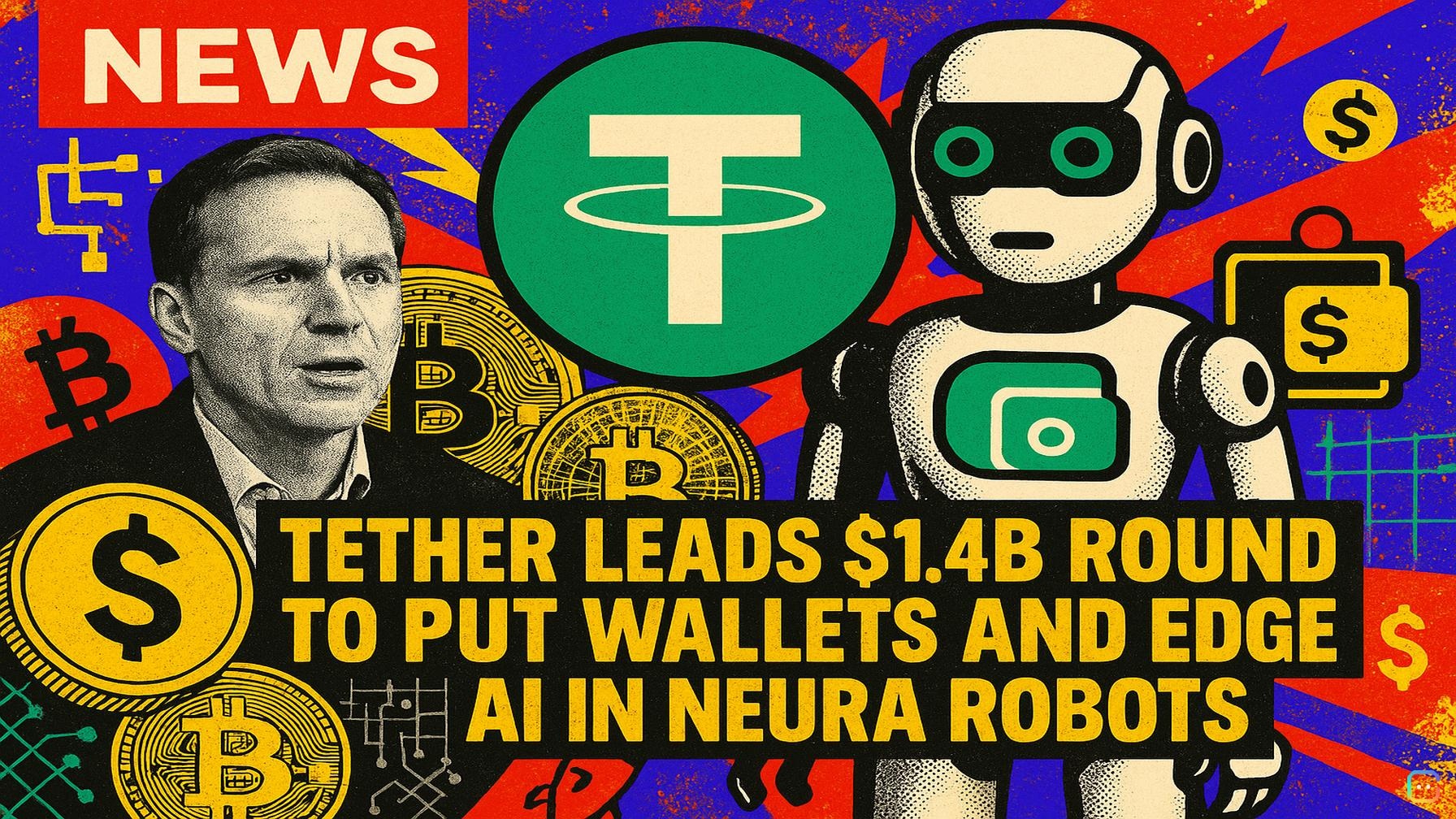
Tether is stepping off the blockchain and onto the factory floor. The company behind the world’s largest stablecoin, USDT, announced Wednesday that it led a financing round of up to $1.4 billion into NEURA Robotics, a German humanoid-robotics startup — a deal billed as one of the largest private investments ever in the physical AI and humanoid-robot sectors.
Founded in 2019 and based in Metzingen, Germany, NEURA builds a wide array of robotic systems: humanoid robots, precision robotic arms, autonomous mobile robots and service robots meant to operate side-by-side with humans in factories, warehouses, hospitals and homes. Alongside Tether, the round attracted heavyweights from tech and industry, including Nvidia, Amazon, Qualcomm Technologies, Bosch, imec.xpand, Schaeffler, the European Investment Bank, Lingotto Horizon and InterAlpen Partners.
NEURA’s founder and CEO David Reger framed the investment as part of a larger shift: “The future of AI will not only live on screens. It will move, interact, learn and work beside us in the real world,” he said. “We believe physical AI and cognitive robotics will become one of the largest technology shifts of the coming decades, transforming industries ranging from manufacturing and logistics to healthcare, services, and household robotics.”
For crypto audiences, the deal is notable not just for its size but for Tether’s planned technology integrations. Tether will deploy two core pieces of its stack into NEURA’s ecosystem:
- A wallet development kit (WDK): an open-source toolkit to embed self-custodial wallet functionality directly into robotic platforms. That would allow machines to receive payments for completed tasks and execute transactions under predefined rules — effectively making financial settlement part of a robot’s workflow.
- QVAC edge AI runtime: software that enables AI models to run locally on a device rather than relying on cloud servers. Local inference reduces latency, improves resilience and limits dependence on centralized compute providers — critical in industrial settings where uptime and precision matter.
Tether CEO Paolo Ardoino described the move as infrastructure for autonomous machines: “As robotics moves beyond scripted automation and into true autonomy, the infrastructure behind it must evolve as well. Autonomous machines need the ability to process information locally, make decisions, and transact without relying on centralized intermediaries.” He added that QVAC provides edge-first intelligence while WDK supplies the secure financial layer, together enabling robots to execute tasks, account for outcomes and operate independently.
The transaction highlights a widening axis between crypto firms and the physical world: stablecoin issuers and blockchain toolmakers are now positioning themselves as plumbing for a potential machine economy — enabling micro- and machine-to-machine payments, on-device settlement and crypto-native service monetization. For NEURA, the capital and these integrations could accelerate deployments where robots not only act but get paid and coordinate value exchange autonomously.
Whether this vision scales will depend on technical reliability, commercial adoption and the evolving regulatory landscape around digital payments and autonomous systems. For now, the round cements NEURA’s deep-pocketed backers and signals Tether’s ambition to move beyond pure digital money into the infrastructure of physical AI.
Read more AI-generated news on: undefined/news