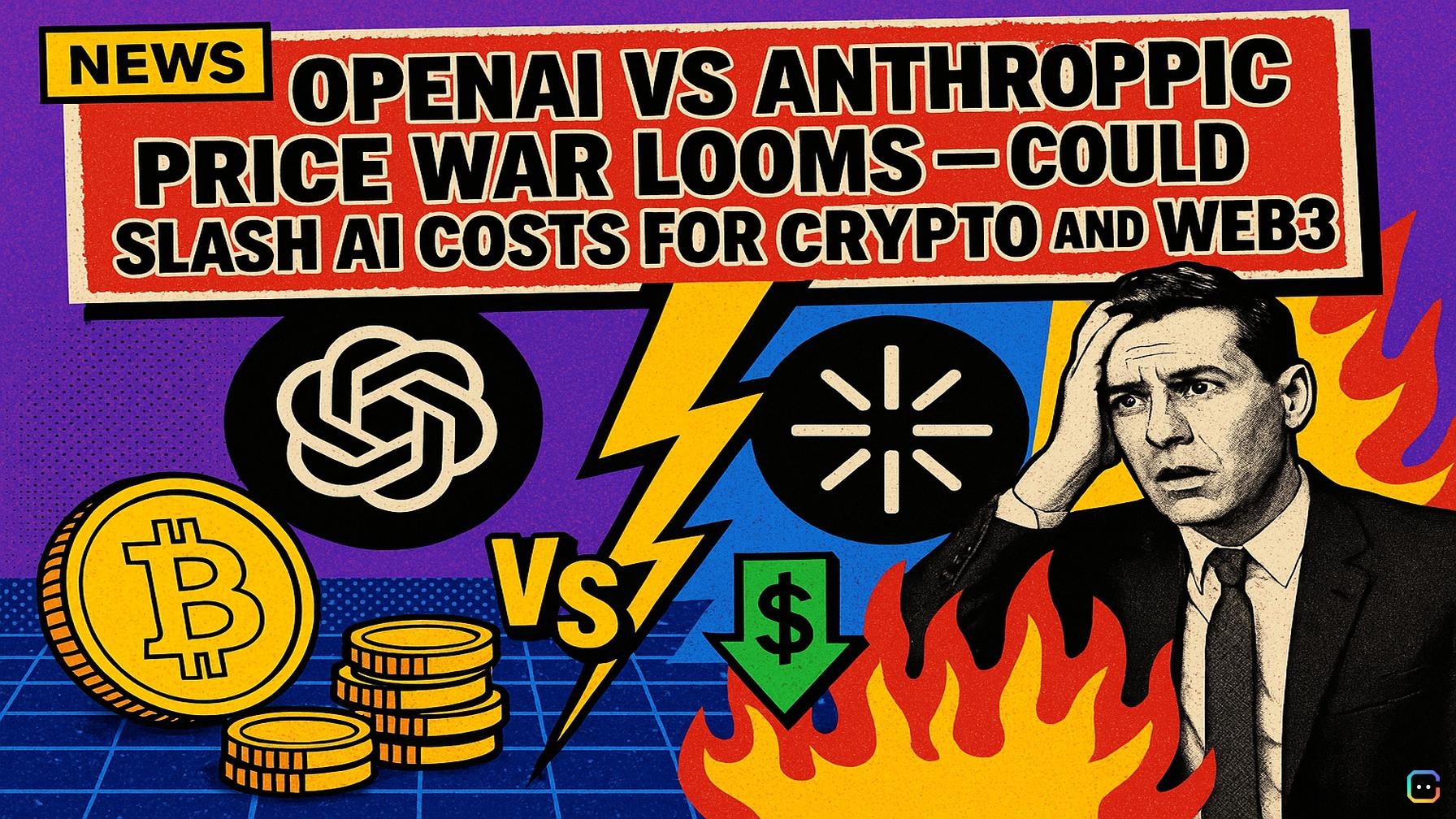
OpenAI is eyeing a price fight with Anthropic — and the move could reshape who wins the AI infrastructure race.
Why it matters
- Both OpenAI and Anthropic filed confidentially for IPOs this month and are still unprofitable, setting the stage for aggressive market moves (Wall Street Journal).
- OpenAI told the WSJ it’s considering big price cuts for developers and enterprises. CEO Sam Altman said, “I think we'll have a lot of ways we can help people get more value for less spend.”
- The urgency is clear: OpenAI posted a -122% adjusted operating margin in Q1 2026 — effectively losing $1.22 for every $1 of revenue (WSJ).
The competitive backdrop
- ChatGPT’s dominance is eroding. Decrypt data shows ChatGPT’s share of global generative-AI web traffic fell from 77.6% in May 2025 to 53.7% by April 2026.
- For the first time, more companies tracked by the Ramp AI Index are paying Anthropic than OpenAI.
- Anthropic’s annualized run rate reportedly exploded from $9 billion at the end of 2025 to $47 billion by May 2026 — a 422% jump driven largely by Claude Code — and the company recorded its first profitable quarter in Q2 2026 (Decrypt).
What’s driving the squeeze
- Real enterprise deployments are shifting from cheap flat-fee chatbot subscriptions to metered API usage. Heavy users move off $20/month tiers onto per-token billing, which scales compute (and cost) quickly.
- That pattern has produced “tokenmaxxing”: organizations burning through AI tokens (the bits processed by models) at reckless speed, often without clear ROI. Examples cited in industry coverage: an Uber CTO burning through the 2026 AI budget by April, and some JP Morgan staff registering AI spend that rivals or exceeds salary levels (bank executives and reports). JP Morgan analysts even ran a note titled “AI Bills Are Out of Control.”
- Palantir CEO Alex Karp compared the behavior to an addiction at AIPCon, highlighting how cultural hype is accelerating consumption.
The structural trap — and the counterpoint
- Venture investor Tommy Shaughnessy (Delphi Ventures) argues the $20/month consumer price was always a loss leader: it’s below the true cost of heavy usage and was designed to drive adoption. When real businesses scale, API bills escalate and margins disappear.
- Others counter that a Western AI oligopoly has room to charge higher per-token fees, pointing to Chinese models that undercut prices by a wide margin. One social-media hot take framed Western providers as “raping API customers” with outsized margins — a blunt critique of pricing strategy.
China’s open-source lever
- Open-source inference providers are scaling quickly, often running Chinese models (DeepSeek, GLM, MiMo, Kimi, Minimax) that reportedly compete on coding benchmarks with Claude Opus at roughly one-thirteenth the price of closed alternatives.
- Shaughnessy’s key point: the model itself is the biggest cost for an inference provider — and many Chinese labs open-source high-end models, essentially giving them away. That drives down the floor on pricing and makes margin recovery for OpenAI and Anthropic a tougher math problem.
- The only escape valve would be China pivoting to closed-source models — a move that would materially favor U.S. labs. So far, most Chinese AI labs appear committed to openness.
What to watch (especially for crypto and Web3 projects)
- Potential price cuts from OpenAI and any matching moves from Anthropic: could lower costs for AI-heavy dApps, or force provider consolidation.
- Growth of inference providers and cheap Chinese models: could enable new, cost-sensitive crypto-native tools (or fuel a race to add AI capabilities into on-chain and off-chain products).
- Profitability and IPOs: both firms’ margin pressures and decisions on price strategy will affect valuations and partner economics.
- Regulatory or geostrategic shifts in China’s openness: any change there would ripple through global AI pricing and competitive dynamics.
Bottom line
A price war between OpenAI and Anthropic is increasingly plausible as both chase scale, profitability and IPO readiness. That fight will reshape who can realistically offer AI at scale — and how cheap, fast, and ubiquitous AI becomes for developers, enterprises, and crypto-native projects alike. Keep an eye on pricing moves, API meter adoption, and open-source-model developments; they’ll determine whether AI costs keep falling or whether a new price floor emerges.
Read more AI-generated news on: undefined/news