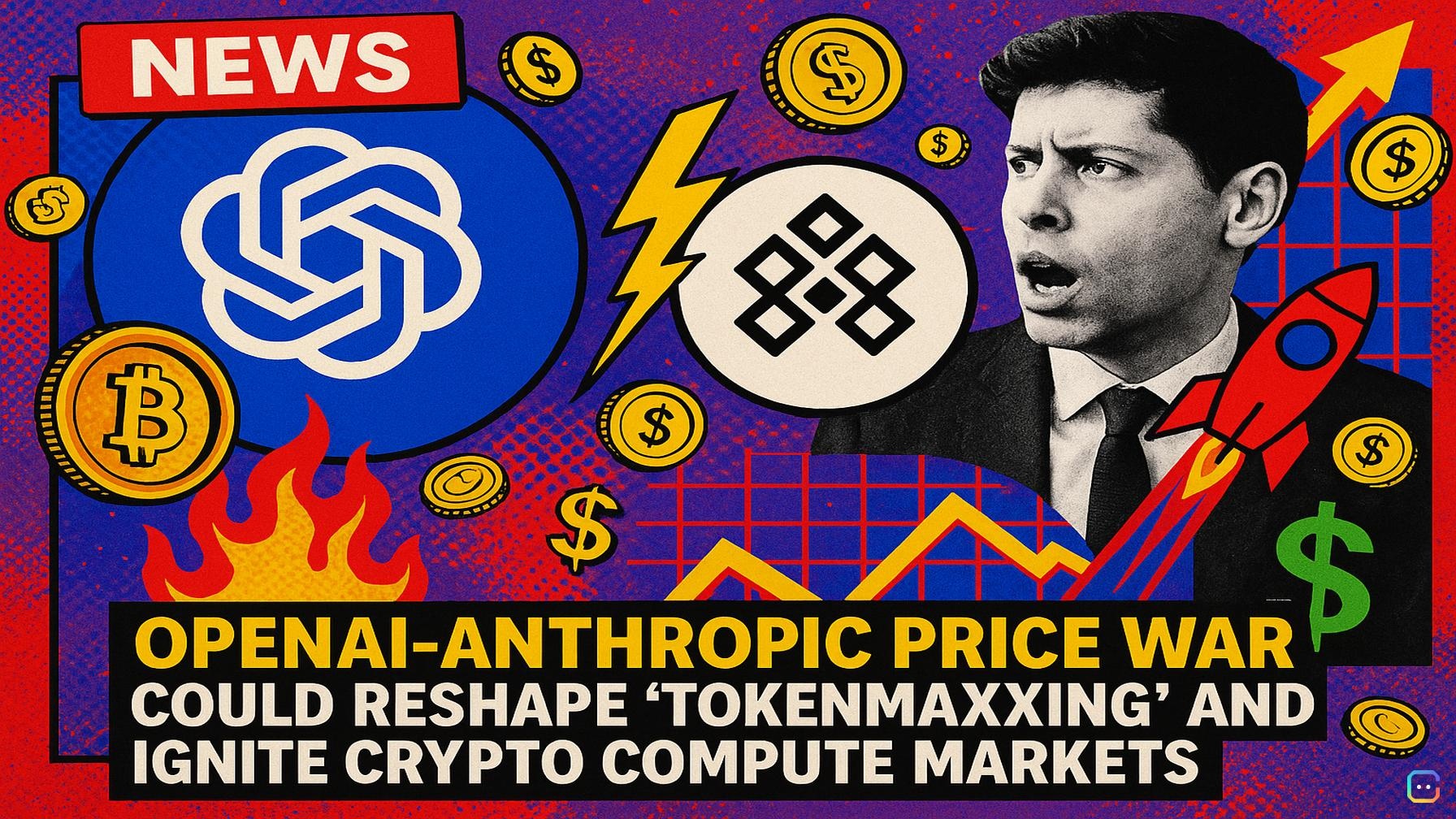
Headline: OpenAI Prepares for a Price War With Anthropic — What That Means for AI “Tokenmaxxing” and Crypto’s Compute Market
OpenAI is reportedly weighing deep price cuts for developers and enterprises as it braces for anticipated moves from rival Anthropic, the Wall Street Journal says. The talks are still fluid — both companies filed confidentially for IPOs this month and neither is profitable — but the pressure is clear.
Key facts
- Sam Altman hinted at lower prices at a recent event: “I think we'll have a lot of ways we can help people get more value for less spend,” the WSJ quotes him saying.
- OpenAI’s Q1 2026 adjusted operating margin was -122% (it lost $1.22 for every dollar of revenue).
- ChatGPT’s share of global generative-AI web traffic slid from 77.6% in May 2025 to 53.7% in April 2026 (Decrypt).
- For the first time, more companies tracked by the Ramp AI Index are paying for Anthropic than for OpenAI.
- Anthropic’s annualized run rate rocketed from $9B at end-2025 to $47B by May 2026 — a 422% jump in five months — driven largely by Claude Code. Q2 2026 was Anthropic’s first profitable quarter.
- OpenAI has reprioritized coding tools (Codex) in response, but is playing catch-up.
Why prices matter: the adoption binge and “tokenmaxxing”
Companies everywhere are racing to put AI to work, and usage is exploding. Examples cited in coverage:
- Uber’s CTO reportedly exhausted the company’s 2026 AI budget by April.
- JP Morgan employees in some divisions are spending more on AI usage than their own salaries, per the bank’s chief data officer.
- Palantir CEO Alex Karp compared the behavior to an addiction at AIPCon; JP Morgan analysts warned in a note that “AI Bills Are Out of Control.”
Silicon Valley shorthand now calls this overconsumption “tokenmaxxing” — burning through as many model tokens (the data units AI processes) as possible, often without clear ROI. The business pattern is familiar: a low flat-fee consumer plan (the $20/month ChatGPT-style price) is a loss leader to drive adoption; real enterprise deployments move to metered API pricing, which consumes far more compute and costs providers more to service.
Structural squeeze and competing views
- Delphi Ventures’ Tommy Shaughnessy argues the $20 flat fee was always below heavy-usage costs; big customers migrate to tokenized APIs and expose margins.
- Critics counter that Western labs effectively run an oligopoly and can charge high prompt-processing fees — some Chinese models charge much less, which may indicate room for price flexibility.
- A vocal X user noted providers’ margins look “insane” versus hardware and power costs; others point out providers are subsidizing usage to capture market share.
Open-source models and inference providers: a game-changer
Open-source Chinese models (DeepSeek, GLM, MiMo, Kimi, Minimax) are being hosted by fast-scaling inference providers and are reportedly competing with Claude Opus on coding benchmarks at roughly one-thirteenth the price of closed offerings. Delphi’s Shaughnessy sums up the structural shift: Chinese labs often open-source frontier-grade models, and that model cost is the biggest expense for an inference provider — when the model is free, the provider’s cost base is far lower.
Implications:
- As long as high-performing models remain open-source, the floor on intelligence pricing keeps falling, making margin recovery at premium labs (OpenAI, Anthropic) mathematically hard.
- The thesis flips only if major Chinese labs go closed-source — which would be bullish for U.S. providers.
Why crypto readers should care
- Lower AI inference costs and an intensifying price war have direct implications for crypto-native services that rely on AI: on-chain oracles, trading bots, on-chain indexing, NFT metadata generation, and smart contract auditing could become much cheaper to run.
- The economics pressure centralized providers to innovate on pricing and infrastructure. That could accelerate decentralized and tokenized compute marketplaces — a natural fit for crypto: marketplaces where compute is priced, bought and sold in tokens, or where validators/stakers supply GPU cycles — offering a hedge against rising API bills.
- Conversely, if large labs subsidize usage long-term, they could squeeze indie inference operators and slow decentralization — making the business model and tokenomics of distributed compute projects critical design points.
Bottom line
OpenAI vs. Anthropic is shaping up as a high-stakes price fight driven by rapid enterprise adoption and the economics of token-based metered usage. Open-source models and cheap inference are complicating margin recovery for big labs and creating an opening for decentralized or tokenized compute markets — a space crypto projects are well-positioned to exploit if they can nail performance, reliability and pricing models.
Read more AI-generated news on: undefined/news