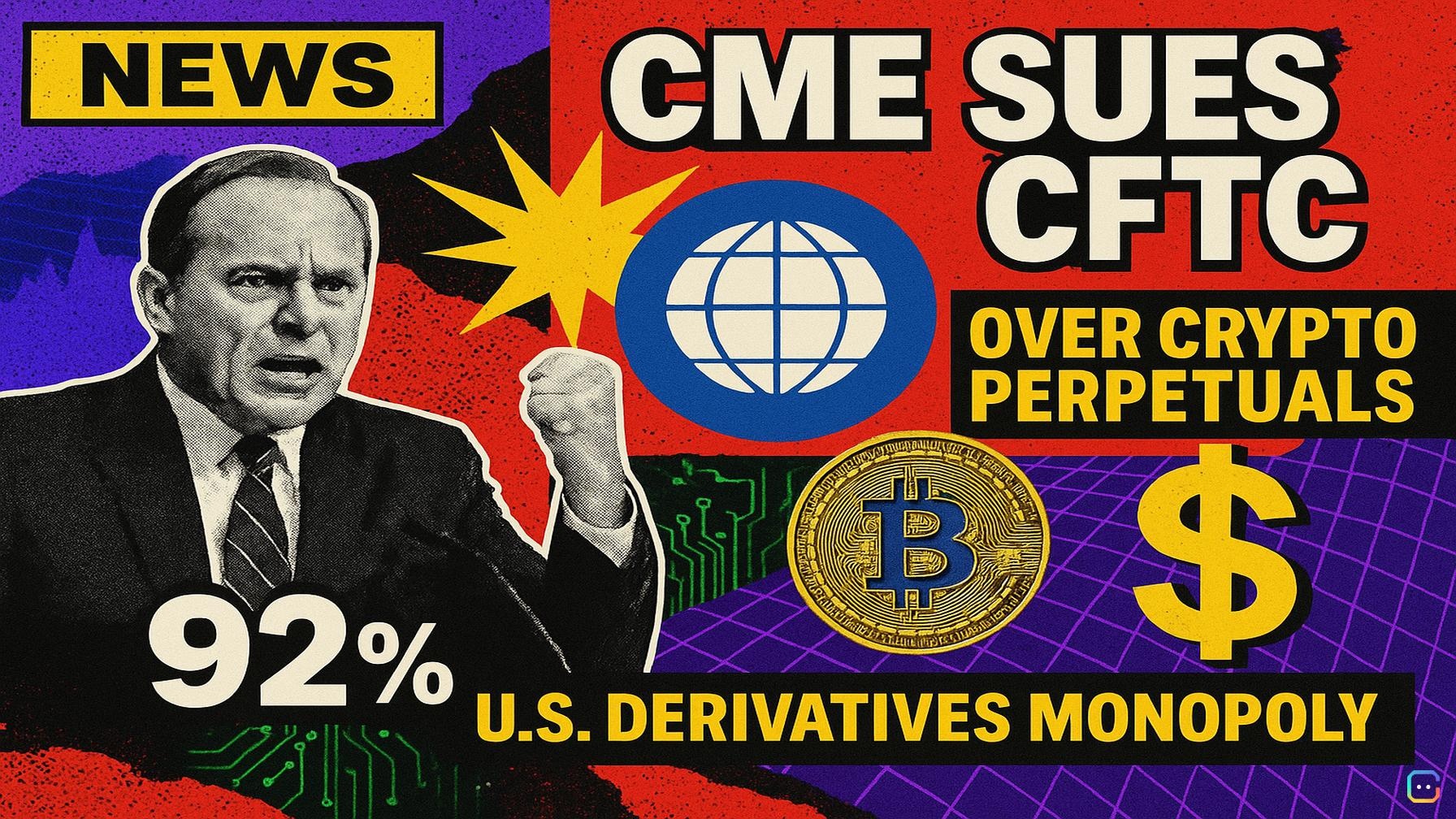
Jake Chervinsky, head of the Hyperliquid Policy Center, has accused CME Group of filing a lawsuit to protect what he calls a near-monopoly in the U.S. derivatives market after the exchange sued the Commodity Futures Trading Commission (CFTC) over regulated crypto perpetual futures.
In a June 19 post on X, Chervinsky blasted CME’s challenge as a “shocking miscalculation” and “an unforced error,” saying the suit exposed the exchange as “a petty incumbent monopolist afraid of competition.” The Hyperliquid Policy Center cited Better Markets data estimating CME controls roughly 92% of U.S. exchange-traded derivatives volume — a market concentration Chervinsky says leads to less choice and higher costs for traders.
The lawsuit challenges the CFTC and its chairman, Michael Selig, over the regulator’s approval of crypto perpetual futures offered by platforms including Coinbase and Kalshi. CME argues those products were mischaracterized as futures when, under the Dodd-Frank framework, they should be regulated as swaps. The exchange says the CFTC departed from historical treatment and effectively approved a new product type without following Congress’s rulemaking process.
Perpetual futures have already gained traction since their regulated U.S. launch, generating more than $1 billion in trading volume, according to previous reporting. Hyperliquid and other critics note that U.S. traders had long been forced to use offshore platforms for perpetual-style contracts while regulated domestic options were unavailable — a situation the recent approvals aimed to fix. Hyperliquid called these new offerings “the first genuinely new derivatives product to reach regulated U.S. markets in more than a decade.”
CME has defended its position publicly and in court. Outgoing CME executive Terrence Duffy told CNBC the company planned legal action after the CFTC cleared domestic platforms to list perpetuals, arguing those contracts fall under the swap classification created by Dodd-Frank.
The dispute is unfolding alongside a broader regulatory review. The CFTC and Securities and Exchange Commission have launched a joint public consultation on how swaps, security-based swaps, mixed swaps and other derivatives should be classified under Title VII of Dodd-Frank. CFTC Chairman Selig said the review could resolve “longstanding ambiguities” in the law, while SEC Chairman Paul Atkins said additional clarification is overdue. The consultation will accept public comments for 60 days after its publication in the Federal Register.
What’s at stake is more than a single product category: the outcome could reshape how new derivatives are introduced and who gets to capture the volume and fees in a market dominated by a single exchange.
Read more AI-generated news on: undefined/news