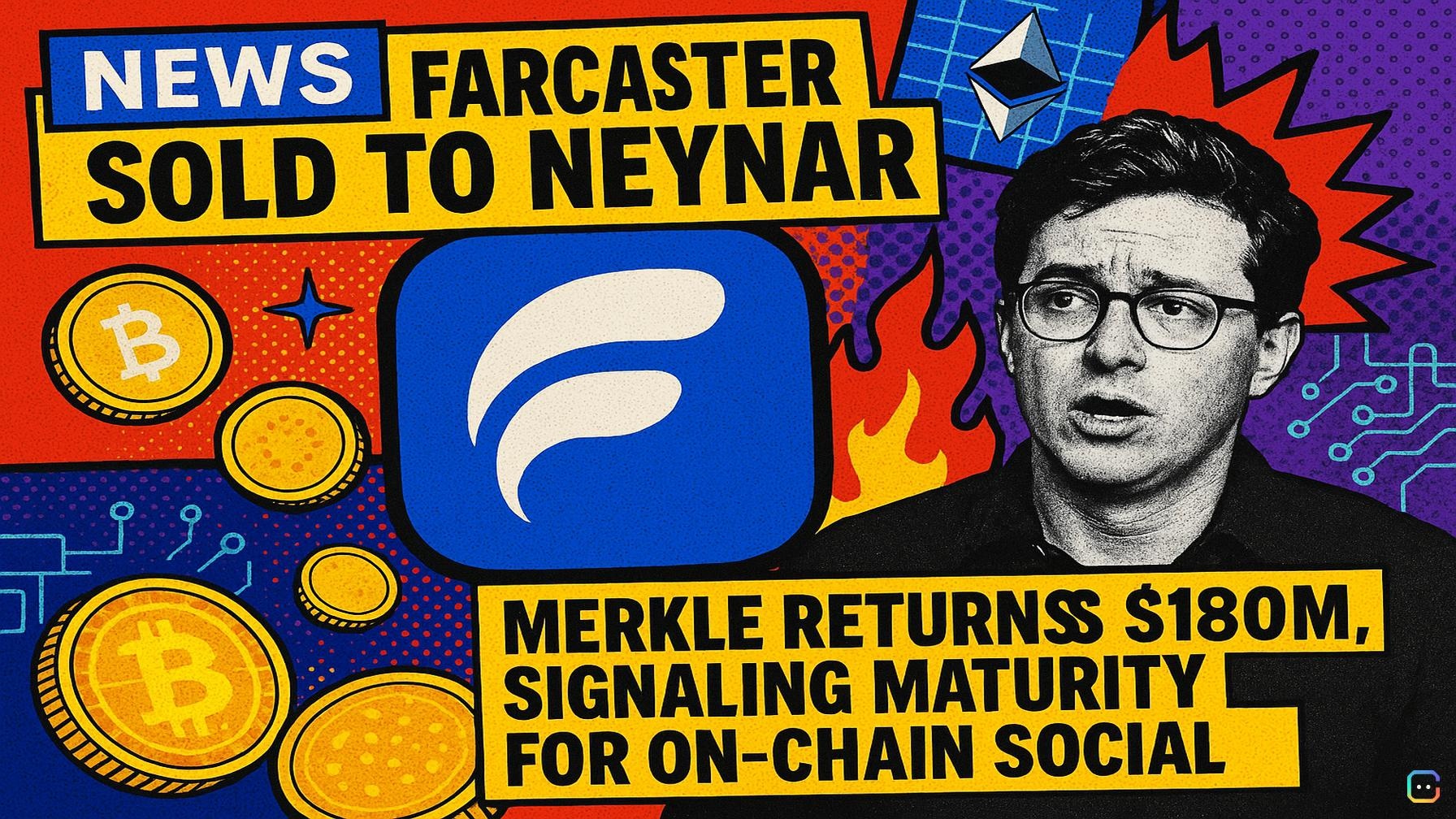
Merkle Manufactory will return the full $180 million it raised to investors after selling the Farcaster protocol to infrastructure firm Neynar, the company’s co-founder Dan Romero announced this week — a move that signals a shift in how decentralized social projects are being operated and funded.
“Farcaster is not shutting down,” Romero tweeted Thursday, directly addressing rumors. “The protocol works and will continue to work.” He added that Neynar, a venture-backed startup, will take ownership of Farcaster’s protocol contracts, code repositories, core app and the Clanker project over the coming weeks, and will assume responsibility for running and maintaining the protocol going forward. Neynar plans to “shift Farcaster in a more developer-focused direction,” Romero said.
Key facts
- Merkle Manufactory, founded in 2020 by Dan Romero and Varun Srinivasan, raised $180 million from investors including a16z Crypto and Paradigm.
- Farcaster was last valued at roughly $1 billion after a $150 million Series A in 2024.
- Romero said Farcaster had about 250,000 monthly active users in December and over 100,000 funded wallets.
- The sale transfers operational control to Neynar, while Merkle will repay investors the full $180 million it had raised.
Why it matters
The deal and Merkle’s decision to return investor capital mark a notable turn for decentralized social platforms: instead of remaining purely founder- or ideology-driven experiments, these projects are increasingly being treated as infrastructure that needs stable operators focused on reliability, developer tooling and sustainable scale.
The Farcaster handover comes amid other stewardship shifts across on-chain social. Lens Protocol — developed by the team behind Aave — confirmed that Mask Network will take over stewardship of the project, though that move does not involve an outright acquisition. Together, these changes suggest a maturing phase for on-chain social where infrastructure teams step in to run and scale networks.
Industry voices: practicality over purity
“On-chain social isn’t dying, it’s just shedding the myth that decentralization alone is enough,” Lia Savillo, Head of Socials at creative strategy agency Hype, told Decrypt. “The next era will be built by teams that prioritize infra, UX, and sustainability over ideology.” She called the recent stewardship changes “a healthy correction,” arguing early efforts were driven more by culture and ideals than long-term operational thinking.
Ethereum co-founder Vitalik Buterin has also highlighted Farcaster and Lens as tests of whether social protocols can change operators without breaking user networks, governance or identity. “We need mass communication tools that serve the user's long-term interest, not maximize short-term engagement,” he wrote Wednesday — a line of thinking that reflects the broader push for durability over hype.
What’s next
Over the coming weeks, Neynar will take control of Farcaster’s code and operations and steer development toward a developer-first model. Merkle’s repayment of $180 million to its backers closes a chapter for the startup and leaves Neynar to build the next phase of the protocol’s lifecycle. For observers, the transaction is less an end than a sign that on-chain social is entering a phase focused on infrastructure, reliability and developer velocity rather than purely experimental, founder-led initiatives.
Read more AI-generated news on: undefined/news