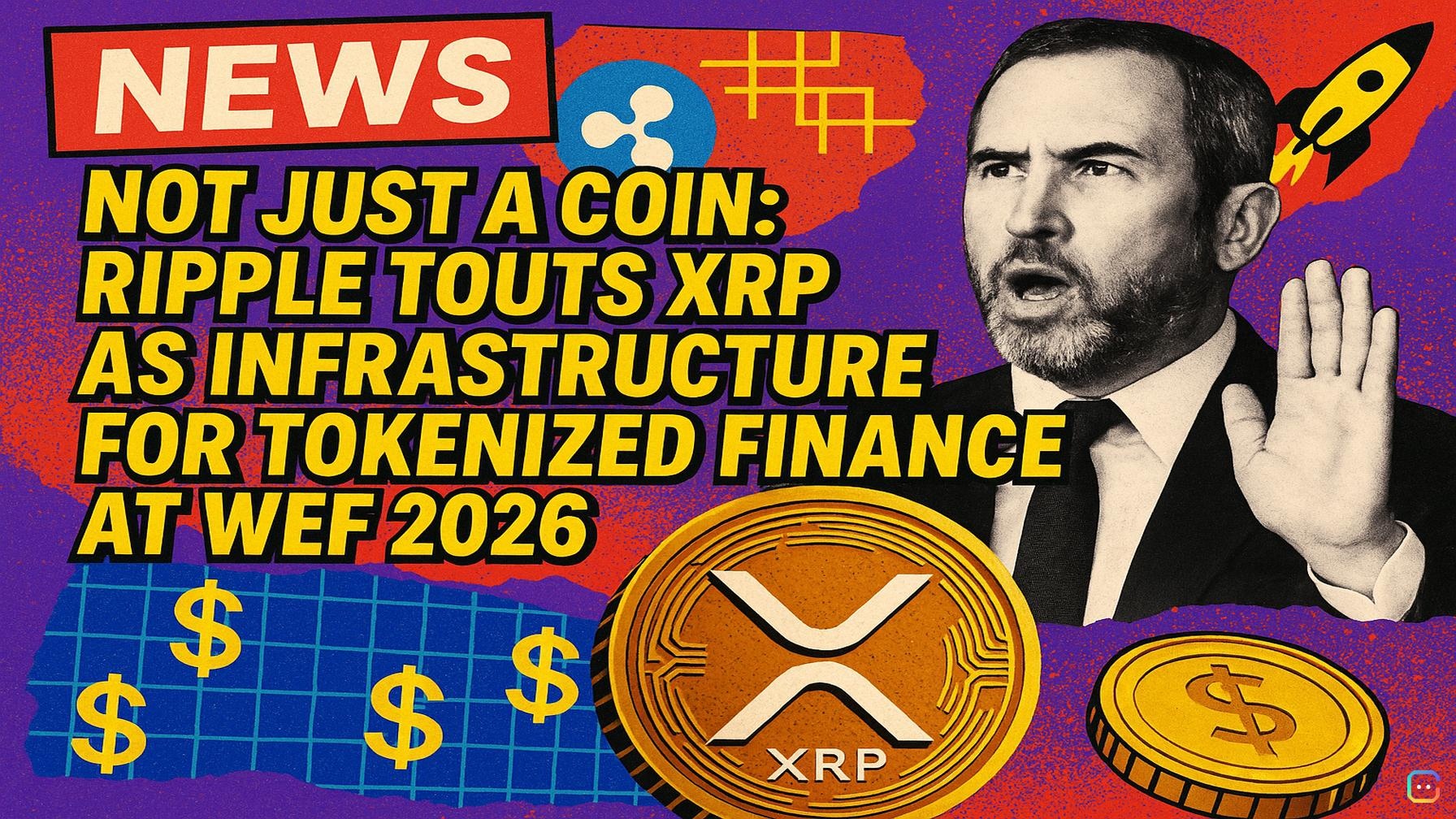
Headline: At WEF 2026, Ripple Frames XRP as Infrastructure for Tokenized Finance — Not Just a Tradable Coin
At the World Economic Forum 2026, Ripple CEO Brad Garlinghouse outlined a deliberate strategic shift: XRP is being positioned less as a speculative trading token and more as the plumbing for institutional tokenization and settlement. Garlinghouse argued this transition is already happening in the market, driven by live tokenization projects, bank integrations, and growing on-chain settlement volumes.
Tokenization: From Experiment to Balance-Sheet Tool
Garlinghouse used tokenization to explain the change. He highlighted data from the XRP Ledger showing tokenized asset volume jumping from roughly $19 trillion to $33 trillion in a single year — a scale that signals institutional deployment rather than pilot experiments. That type of activity implies participation from banks, custodians and regulated entities moving real value, not just developers or retail traders.
What institutions are now doing, Garlinghouse said, is figuring out how tokenized instruments fit into existing balance sheets, liquidity frameworks and settlement workflows. That shifts the conversation from “can this be tokenized?” to “how do we operationalize tokenized assets in live financial systems?”
Infrastructure Needs: Throughput, Finality, Reliability
Institutional-scale tokenization creates new infrastructure requirements: networks must handle high transaction volumes consistently, provide deterministic settlement finality, and run continuously without interruption. Ripple positions the XRP Ledger as engineered to meet those needs — emphasizing reliability and execution under real-world financial constraints rather than novelty for its own sake.
In this context, rails for tokenized finance stop being optional add-ons and become foundational pieces of the financial stack. XRP, then, is discussed not primarily as an asset to trade, but as part of the machinery that enables tokenized assets to be issued, moved and settled.
Bridging Regulated Assets and On-Chain Liquidity
Garlinghouse also addressed the core tension the industry faces: institutions want programmability and on-chain liquidity but cannot sacrifice compliance, custody or trust. Ripple’s response is to build regulated pathways between tokenized assets and decentralized liquidity, working directly with global banks to enable interactions with on-chain systems while remaining inside regulatory frameworks.
Within that model, XRP functions as a settlement and connectivity layer — facilitating finality, providing access to liquidity, and enabling interoperability between regulated ledgers and decentralized rails. Garlinghouse argued that this gives the XRP Ledger a structural advantage as tokenized assets, DeFi rails and institutional settlement converge.
Bottom line
Ripple’s message at WEF 2026 reframes XRP’s role in the evolving financial ecosystem: its primary utility is shifting toward infrastructure — the settlement and connectivity layer underpinning tokenized finance — rather than being viewed mainly as a tradable commodity. Whether institutions broadly adopt this model will hinge on proof of seamless integration, regulatory clarity, and reliable, scalable on-chain settlement.
Read more AI-generated news on: undefined/news