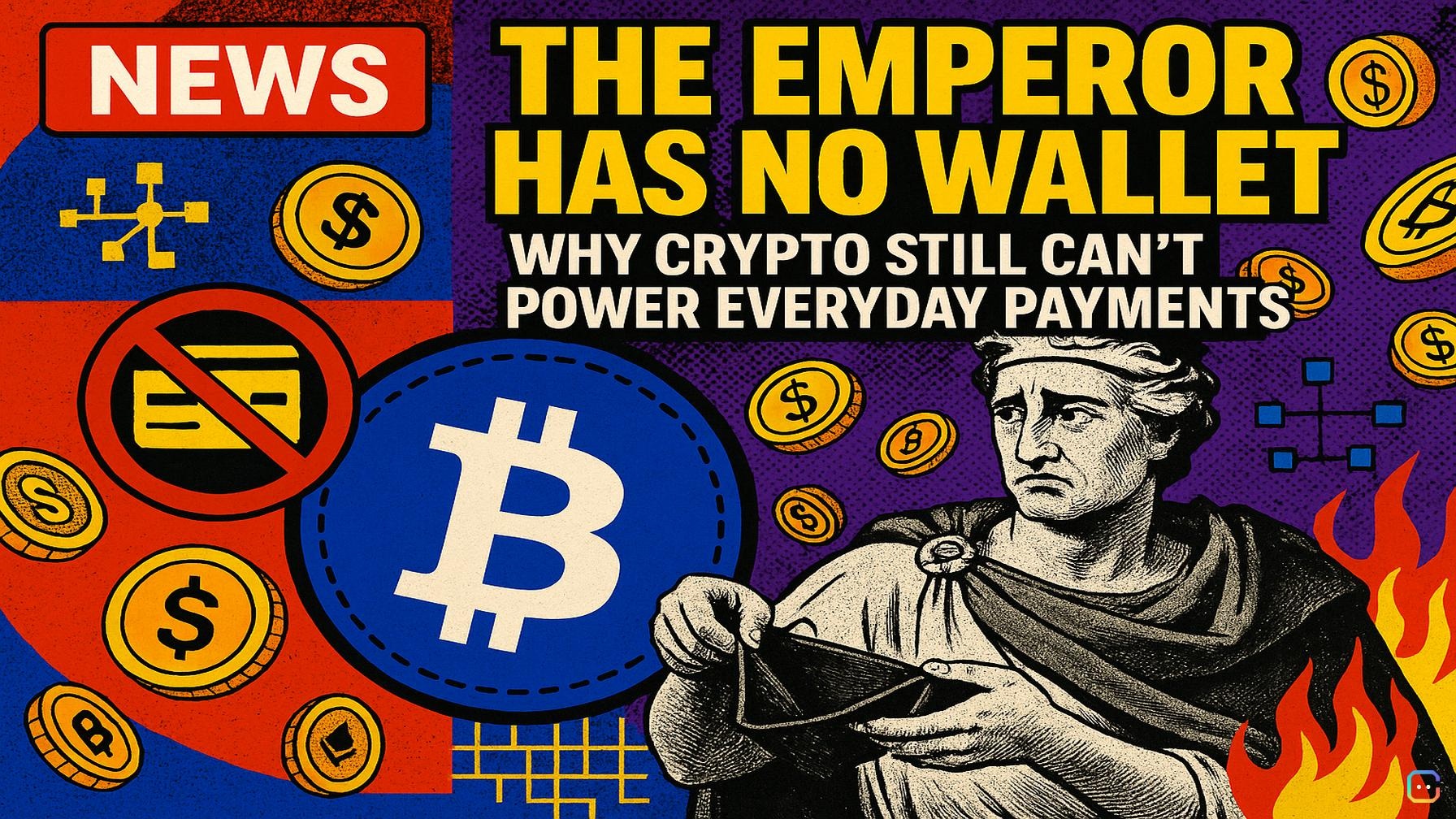
Headline: The Emperor Has No Wallet — Why Crypto Still Isn’t Ready for Everyday Use
For more than a decade the crypto industry has promised to reinvent money: permissionless, trustless, borderless, and resilient to the failures of traditional finance. Yet despite billions in venture funding, nonstop headlines and waves of retail hype, global ownership remains stubbornly low — commonly cited estimates sit below 10% — and the share of people actually using crypto to pay for goods and services is almost certainly far smaller.
That gap between promise and practice matters. If crypto were solving clear, everyday problems, usage would reflect it. Instead, for most people crypto is something to buy and hope appreciates, not something to use.
Where the promise falls short
The largest smart-contract platforms introduced programmable finance and an entire decentralized ecosystem. For developers, onchain composability is powerful. For ordinary users, the experience is often prohibitive. Self-custody requires private-key management and wallet recovery protocols that terrify newcomers. Buyers must contend with fragmented exchanges, different token standards, cross-chain bridges, and transaction fees that can spike without warning. All of this creates a steep onboarding curve — not the seamless consumer experience needed for mass adoption.
Some networks marketed themselves as the solution — faster, cheaper, higher-throughput blockchains — but repeated outages have exposed a hard truth: infrastructure that blinks offline can't serve as the backbone of commerce. Other projects pitched a bridge to banking institutions, but retail adoption for day-to-day spending remains effectively non-existent. Much of the market activity still centers on speculation: trading, memecoins, and volatile bets rather than consistent payments or services.
Centralization undercutting decentralization
Although decentralization is a core selling point, most users hold assets on centralized exchanges because self-custodial wallets remain incomprehensible to many. These exchanges layer on leverage, derivatives and yield products that mainstream users neither want nor fully understand. Deposits are frequently rehypothecated — reused as collateral elsewhere — producing synthetic exposures akin to the opaque balance sheets crypto set out to remove. When markets turn, these structures amplify forced liquidations, creating cascades of selling and price dislocations that have little to do with onchain fundamentals.
Offchain financialization has become dominant. Perpetual futures often outstrip spot volume, leveraged tokens multiply exposure, wrapped assets and re-collateralization create multiple layers of claim on the same underlying token. The consequences are real: when bitcoin (or any major asset) dives sharply, billions of dollars in leveraged positions can be liquidated in a single day, forcing price moves that are driven more by financial plumbing than by changes in utility or adoption.
User experience: built by engineers, for engineers
Most consumer finance apps hide complexity behind intuitive interfaces. Crypto, by contrast, still frequently hands new users concepts like slippage tolerances, bridge risk and liquidity pools before they’ve completed a single transaction. One mistake can permanently destroy funds. Onboarding feels less like opening a bank account and more like configuring a server — an experience that discourages mainstream users.
What mass adoption requires
Speculation has been useful: it funded infrastructure, attracted talent and built awareness. But it is not the path to permanence. The next chapter of crypto will be written by projects that quietly integrate into daily life, not by token price rallies or meme cycles.
Key priorities should include:
- Abstraction: hide complexity so payments and transfers feel as easy as sending a text.
- Robust, always-on infrastructure: systems must be reliable enough for commerce.
- Clear, simple financial products: yields and savings products that don’t require advanced degrees to understand.
- Integrations with familiar apps and rails: payment flows that feel natural to consumers and businesses.
- Transparency in risk and balance-sheet practices: reduce rehypothecation and opaque leverage that create systemic fragility.
Until crypto products meet those standards, the technology will remain a niche asset class — interesting, sometimes revolutionary in potential, but not yet indispensable for everyday people.
Conclusion
Crypto rebuilt many of the complexities it promised to remove — only faster and more automated. Fixing that won’t come from more chains or ever-more-complicated token models. It will come from user-first design, real-world utility and infrastructure built for reliability and simplicity. Only then will crypto move beyond speculation and into daily life.
For all the code and idealism, the emperor still doesn’t have a wallet most people can use.
Read more AI-generated news on: undefined/news