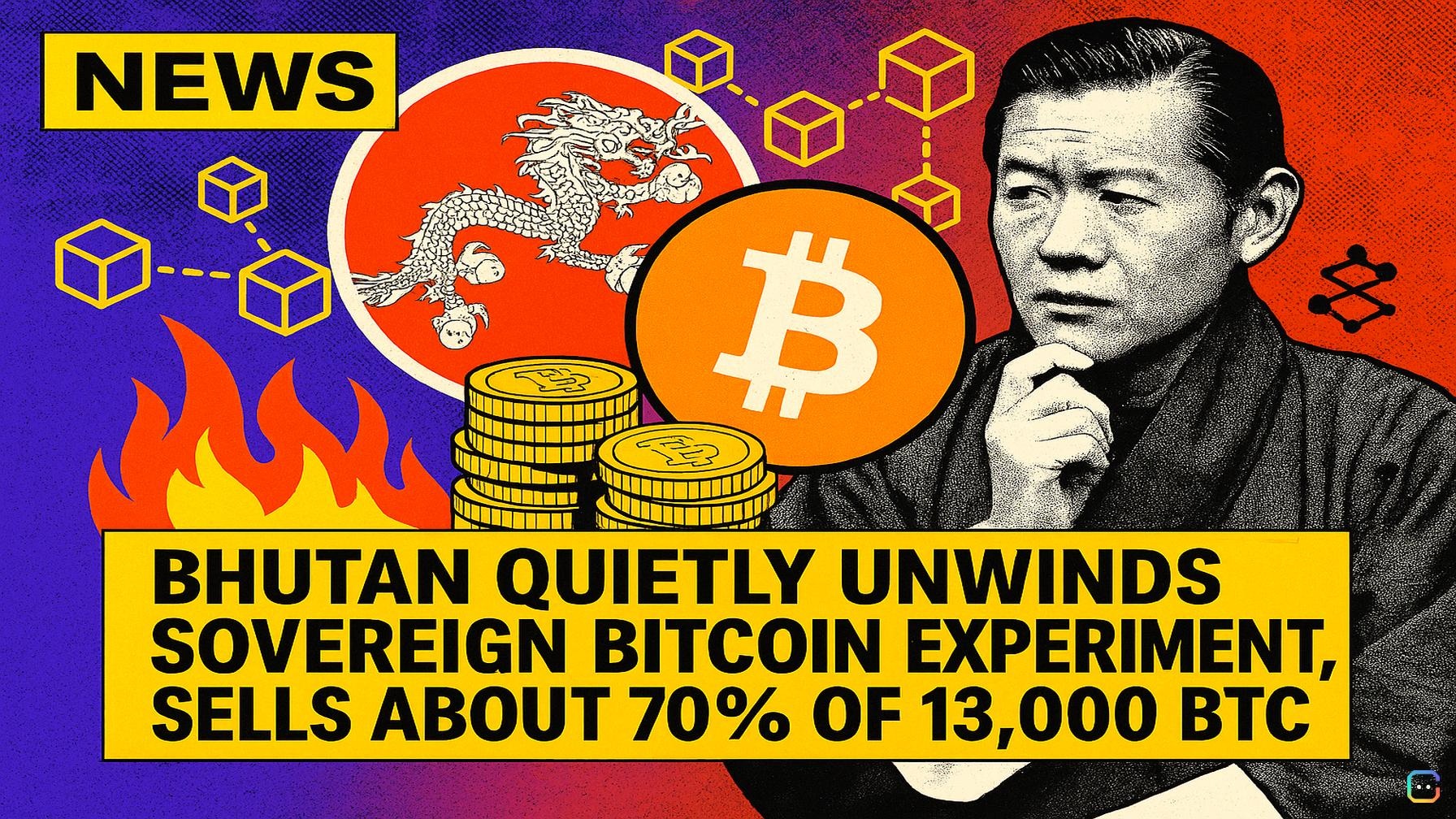
Bhutan appears to be quietly dismantling one of the most unusual national bitcoin experiments.
On Thursday, Arkham Intelligence traced a transfer of roughly 319.7 BTC (about $22.68 million) from Bhutanese government addresses to two destinations: roughly 250 BTC moved to a wallet previously used to route sales through Galaxy Digital and OKX, while another 69.7 BTC went to a fresh, unlabeled address. That transfer is just the latest in a steady run of disposals.
At its peak in October 2024, Bhutan — via its sovereign wealth vehicle Druk Holding and Investments — held about 13,000 BTC, mined using hydropower from the kingdom’s rivers. The operation was widely touted as a proof-of-concept for sovereign bitcoin mining: a tiny, energy-rich state with low infrastructure costs experimenting with turning renewable power directly into BTC. But in the 18 months since, holdings have plummeted by roughly 70%. Arkham’s data shows Bhutan’s balance now sits at 3,954 BTC (around $280.6 million), with roughly $215.7 million of bitcoin moved out of its addresses so far this year and $162.6 million of that going to unlabeled wallets.
There’s growing evidence the country may have also stopped mining. Arkham reports Bhutan’s last inbound transaction above $100,000 was more than a year ago, suggesting the kingdom may simply be drawing down existing reserves rather than selling newly mined coins. Druk Holding did not respond to repeated requests for comment from CoinDesk.
Economics help explain the unwind. When Bhutan’s experiment began, bitcoin traded north of $90,000 and mining difficulty was lower. Today, BTC is nearer $71,000, network difficulty is at all-time highs, and the post-halving block reward sits at 3.125 BTC — all factors that compress margins for smaller, sovereign-run mining setups. Mining hardware also depreciates quickly with each difficulty adjustment, and the hydropower that once made mining attractive could now generate more reliable revenue sold to neighboring India than by powering miners.
Bhutan’s liquidation stands out against the broader market trend. While the kingdom is reducing exposure, several large holders and institutional channels have been accumulating: an entity listed as “Strategy” bought 4,871 BTC for about $330 million over a recent weekend (reported as boosting its total to 766,970), U.S. spot ETFs absorbed roughly 50,000 BTC in March, the Ethereum Foundation staked some $93 million of ether instead of selling, and even some gold-backed sovereign funds have been adding crypto exposure amid geopolitical tensions. Bhutan is currently the only sovereign-level holder visibly liquidating on this scale.
The story underscores a practical point: turning a nation’s renewable power into bitcoin can work as a proof-of-concept, but scaling and sustaining that position through price drawdowns and rising network difficulty is operationally challenging. The kingdom that once held 13,000 BTC mined from its mountains now has less left than many single-week institutional purchases.
Read more: Bhutan moves another 500 bitcoin to exchanges as 2026 outflows top $150 million.
Read more AI-generated news on: undefined/news