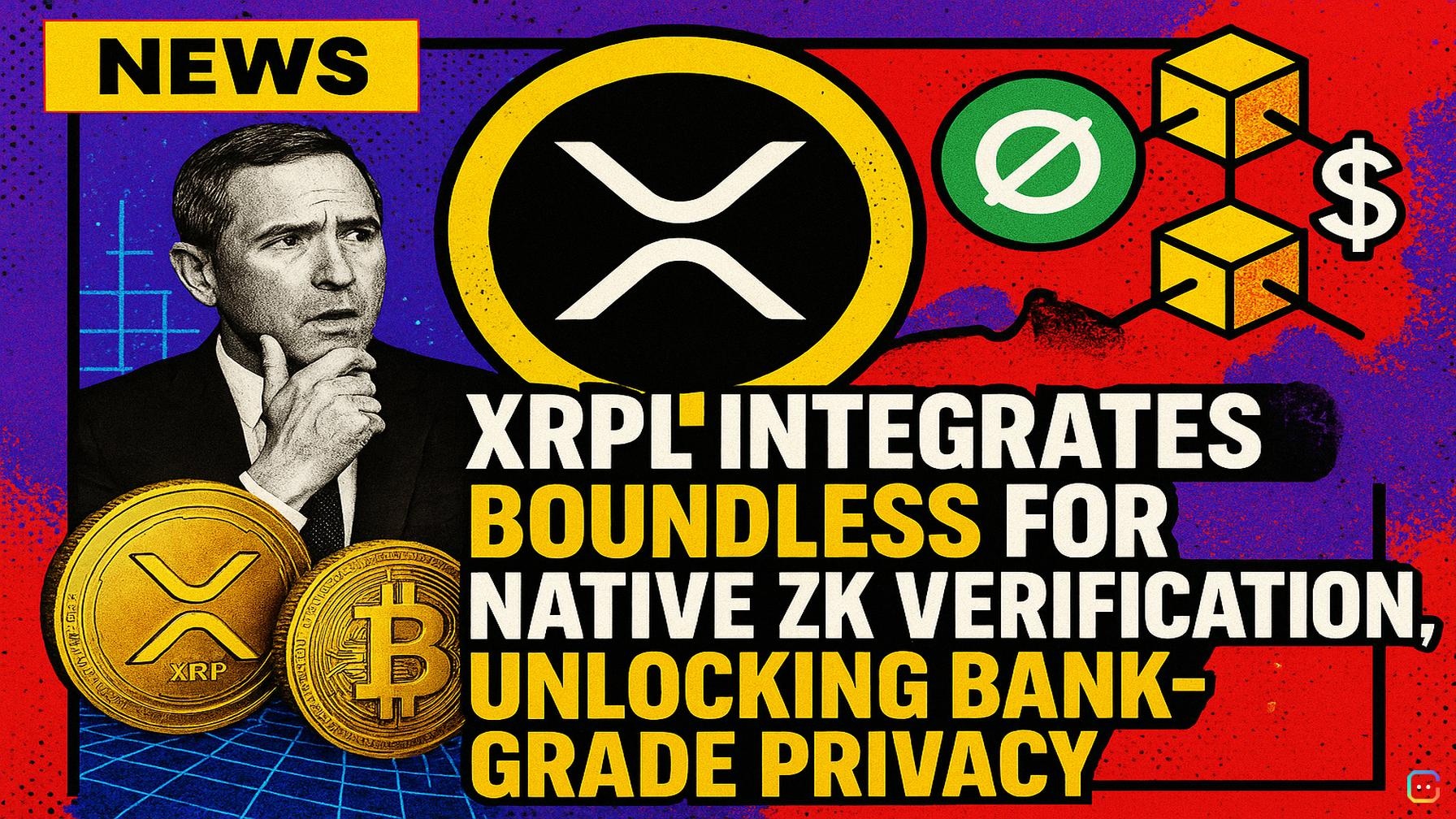
The XRP Ledger has taken a major step toward making public blockchains usable for banks and other regulated institutions by adding native verification for zero-knowledge (ZK) proofs through an integration with ZK proving network Boundless — a deployment the company says is the first of its kind on XRPL.
Why this matters
Public ledgers expose transaction flows, treasury positions and counterparty links by default — a feature that creates competitive and compliance risks for banks, asset managers and other financial firms. Zero-knowledge proofs let one party prove a statement (for example, that a payment is valid, funded and compliant) without revealing the underlying details — the amount, sender or recipient — similar to a credit check that verifies eligibility without disclosing private financial data. By verifying ZK proofs on-chain, XRPL can now support private, auditable transactions while keeping those sensitive details off the public record.
Institutional traction and what it enables
XRPL already hosts notable institutional engagements that many layer-1 chains lack. Users include:
- SBI Holdings (Japan)
- Zand Bank (UAE)
- Archax (U.K.)
- Guggenheim Treasury Services (U.S.)
More than $550 million has been deployed into XRPL ecosystem initiatives, and the Boundless connection gives these institutional participants a clear path to transactional privacy they previously lacked on the ledger. That makes XRPL a more practical option for bank settlements, OTC funds and other regulated use cases that need confidentiality plus verifiability.
The broader cryptography angle
The integration comes as the crypto industry reassesses cryptographic assumptions after a recent Google quantum computing paper prompted chains to consider quantum risk. ZK proof systems are founded on different mathematics than the elliptic-curve cryptography most signatures use, and many ZK constructions are seen as easier to migrate to quantum-resistant or post-quantum variants than traditional signature schemes. Adding ZK infrastructure now positions XRPL to build on cryptographic approaches that may be more future-proof against quantum threats.
Bottom line
By embedding ZK proof verification via Boundless, XRPL reduces a longstanding barrier to institutional adoption: the tension between public transparency and the privacy needs of regulated financial actors. The move strengthens XRPL’s institutional case and places it among blockchains actively preparing for both current regulatory realities and evolving cryptographic risks.
Read more AI-generated news on: undefined/news