Morning Minute — Tyler Warner
(Opinions are mine. Also: check our new daily news show — five minutes or less — on Apple Podcasts or Spotify.)
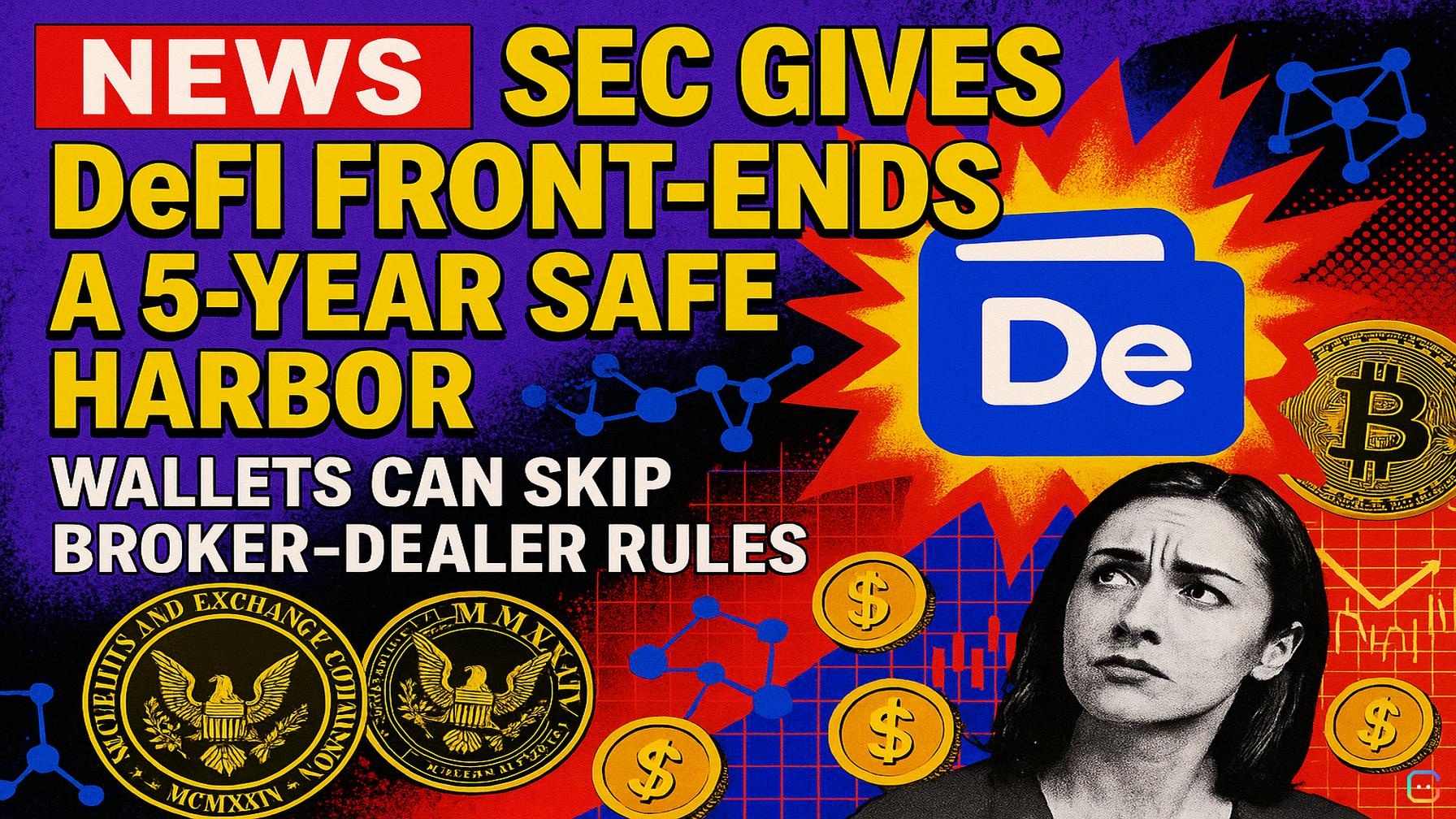
GM. Big day for DeFi: the SEC’s Division of Trading and Markets just issued staff guidance that effectively creates a five‑year safe harbor for “Covered User Interfaces” — and it could change how decentralized finance front‑ends and wallet apps operate.
What the guidance says
- Covered User Interfaces (CUIs) — think DeFi front‑ends, wallet apps, browser extensions and any software that helps users execute crypto‑securities transactions through their own self‑custodial wallets — can operate without registering as broker‑dealers.
- It’s effective immediately and runs for five years, provided platforms follow clear conditions:
- Never take custody of user assets or private keys.
- Don’t recommend or solicit specific trades.
- Charge fixed, neutral fees (no transaction‑based compensation).
- Disclose relationships with connected trading venues.
- In practice, that covers tools like Uniswap’s front‑end, MetaMask‑style extensions, and similar DeFi UX tooling.
Why this matters
- Broker‑dealer registration would have forced DeFi front‑ends to adopt traditional brokerage infrastructure: full KYC on every user, net capital requirements, FINRA oversight, employee licensing, and ongoing supervision. This guidance lets many DeFi UX providers avoid that burden — for now.
- Caveat: staff guidance is not law and can be reversed by a future SEC leadership. That’s why the Clarity Act — which would codify protections like this — still matters. Its chance of passing this year is being estimated at about 53%, so the long‑term fate of this safe harbor could come down to politics.
Market movers: Strategy (STRC) goes shopping
- Strategy’s 8‑K shows it sold 10.03 million STRC shares for $1.001 billion in net proceeds between April 6–12, buying 13,927 BTC at an average price of $71,902.
- The purchase was funded entirely by STRC (no dilution to common stock). Strategy now holds about 781,000 BTC — putting it close to BlackRock’s IBIT stash.
- STRC trading volume exploded to $1.1 billion in a single session today, a new record (previous record: $746M on March 12). STRC is designed to trade at par ($100) and pays an 11.5% annual yield via monthly dividends.
- When volume spikes into a dividend cutoff, institutional demand often pulls purchases forward — and that feeds into weekly BTC buys. With roughly $21.6 billion still available in the STRC ATM program, the buying pressure looks set to continue.
Bitcoin: geopolitics, short squeezes, and STRC support
- Bitcoin opened Monday at $70,741 after weekend headlines about an Islamabad collapse and a Hormuz blockade rattled markets. By the evening BTC recovered to about $74,500, erasing the drawdown.
- Equities rallied and oil fell back below $93/bbl as markets reassessed whether a naval action could actually choke the strait. This marks at least the third time in 2026 that a weekend geopolitical panic reversed during the U.S. session — and mechanical bids from STRC flows and ETFs have repeatedly acted as a floor.
- CoinDesk flagged roughly $6 billion in leveraged shorts concentrated between $72,200–$73,500; $79K remains the next key resistance. A massive STRC buy this week could be the shove that gets BTC closer to that level.
Kraken: insider misuse, extortion attempt
- Kraken disclosed it’s being extorted by a group threatening to release videos showing internal systems and client data. CSO Nick Percoco said on X: systems were not breached, funds were never at risk, and Kraken will not pay or negotiate with criminals.
- The incident stems from two separate support staff members improperly accessing limited client data: one access flagged in Feb 2025 after a video appeared on a criminal forum, and a more recent second incident. Both employees were fired, access revoked, controls tightened, and roughly 2,000 affected accounts were notified.
- Extortion demands began right after the second access was cut off. Kraken says it has evidence to identify the culprits and is working with law enforcement across jurisdictions. The company also warned this is part of a broader pattern of organized insider recruitment targeting crypto, gaming, and telecom firms.
Circle: no wallet freezes without legal orders
- Jeremy Allaire, speaking from Seoul, confirmed Circle will not unilaterally freeze USDC wallets — only acting when directed by law enforcement or a court. “Circle follows the rule of law,” he said.
- The comment comes after researcher ZachXBT documented over $420 million in illicit USDC flows since 2022 and highlighted cases where Tether froze USDT quickly while stolen USDC remained in visible wallets. The April 1 Drift Protocol exploit (~$285M), where $230M in USDC moved from Solana to Ethereum over six hours, is a recent example where Circle had the technical ability to intervene but did not.
- Allaire framed the issue as a “moral quandary” that needs a legislative solution. He hopes the Clarity Act will include safe‑harbor rules that give major stablecoin issuers clear guidance on when and how to act.
Also in the feed: corporate treasuries, ETFs, meme‑coin tracker and more — see the show for a five‑minute roundup.
That’s the Morning Minute. Stay tuned — this is shaping up to be a consequential week for DeFi, Bitcoin flows, and stablecoin policy.
Read more AI-generated news on: undefined/news