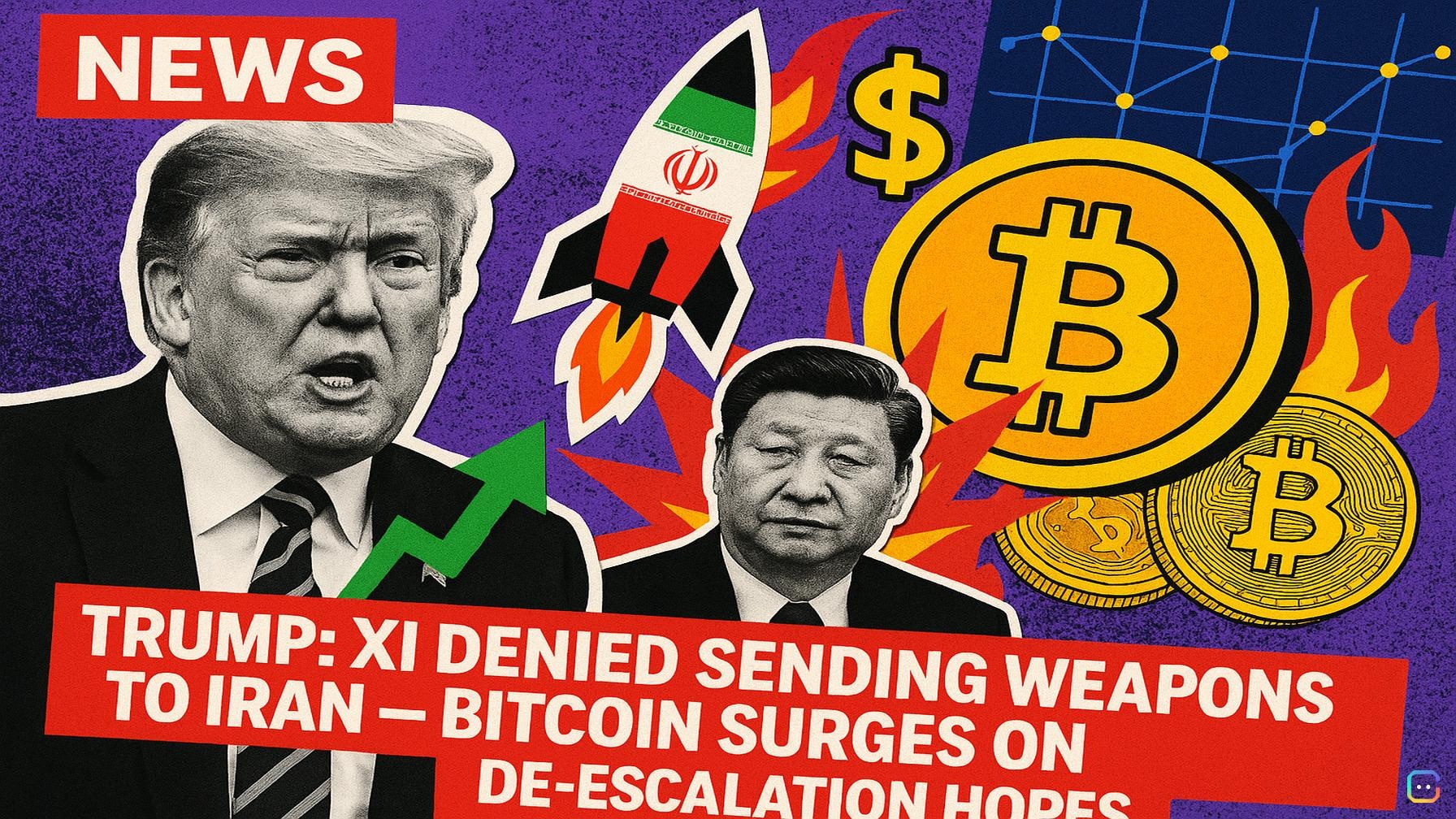
President Trump says he and China’s Xi Jinping exchanged letters denying Beijing is sending weapons to Iran — a development markets, and Bitcoin in particular, have been watching closely.
Trump told Fox Business on Wednesday that he wrote to Xi after U.S. intelligence reports suggested a shipment of missiles may have been sent to Tehran. “I wrote him a letter asking him not to do that, and he wrote me a letter saying, essentially, he’s not doing that,” Trump said. He followed up on Truth Social, saying China had “agreed not to send weapons to Iran” and that the two leaders were “working together smartly, and very well.” Trump also noted China is “very happy” the U.S. is moving to reopen the Strait of Hormuz, a critical route for Beijing’s energy imports.
The exchange matters diplomatically even without independent verification. Trump last week threatened a 50% tariff on any country found supplying weapons to Iran — a veiled warning aimed at Beijing — and Xi’s written denial gives Washington a way to de-escalate that front without public confrontation. U.S. intelligence has not confirmed that Chinese missiles have been used against American or Israeli forces; analysts say a key distinction is that Chinese firms have supplied dual-use components tied to Iran’s missile and drone programs, not necessarily finished weapons systems, which limits what Xi’s letter does and does not commit Beijing to.
The timing is notable: Trump and Xi are scheduled to meet in Beijing on May 14–15, where trade and tariff negotiations are expected to be front and center. China is Iran’s largest crude buyer and among the states with the most to lose from a prolonged Strait of Hormuz closure. Xi’s first public remarks about the war — telling Spain’s prime minister that “the international order is crumbling into disarray” — underscore Beijing’s cautious, influential role.
Markets reacted quickly. Bitcoin, which has been unusually sensitive to every diplomatic signal in the Iran conflict, moved sharply on the newsflow: BTC rallied roughly 5% to about $74,400 after Trump’s comments suggesting Iran might return to talks, then slid to a session low near $70,617 when a naval blockade was announced and oil spiked toward $105. Traders noted that these swings are amplified by heavy short positions and persistent market fear.
The wider macro stakes are clear. Any credible path toward U.S.–China cooperation on Iran could relieve an oil-driven inflation shock that has kept the Federal Reserve hawkish and pressured risk assets since February. Market analyst Sam Daodu has outlined a scenario in which renewed talks push Bitcoin into a $75,000–$80,000 range, with a potential climb toward $100,000 by year-end if a comprehensive deal materializes.
Whether Xi’s denial reflects Beijing’s actual behavior remains to be seen, but the letter exchange signals an active backchannel between Washington and Beijing at a volatile moment for geopolitics, energy markets, and crypto.
Read more AI-generated news on: undefined/news