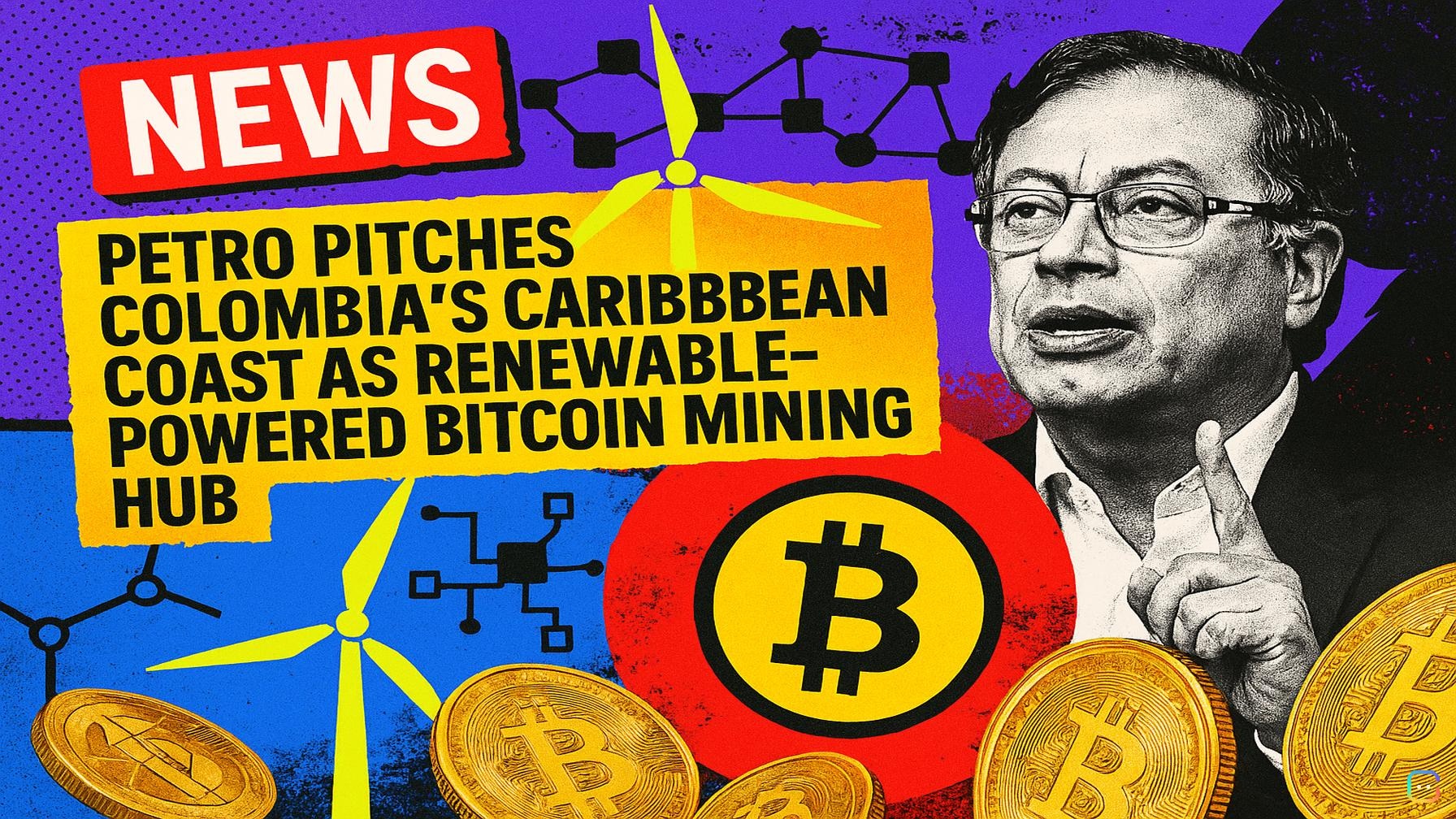
Colombia is pitching its Caribbean coast as the next renewable-powered bitcoin mining hub.
President Gustavo Petro said in an X (formerly Twitter) post that Barranquilla, Santa Marta and Riohacha could host bitcoin mining operations that tap into the country’s surplus clean energy. He framed the proposal as “an immense boost to the development of the Caribbean,” and suggested the Wayúu — Colombia’s largest Indigenous community on the same coast — could receive co-ownership stakes in the project.
Why this makes sense on paper
- Colombia already generates a large share of its electricity from renewables. A 2024 World Bank report found the country draws as much as 75% of its power from renewable sources — more than twice the global average.
- The Caribbean coast has significant wind and solar capacity that remains underutilized commercially, meaning miners could run on otherwise idle, low-carbon electricity. Petro argued this would both put idle power to productive use and avoid the fossil-fuel emissions criticisms that have dogged mining in other regions.
A regional playbook
Petro’s post directly referenced recent successes in neighboring Paraguay. Luxor Technology strategist Alessandro Cecere noted Paraguay’s share of global bitcoin hashrate has surged to about 4.3%, driven by cheap hydroelectric power from the Itaipu Dam. According to Hashrate Index data, Paraguay has climbed to become the world’s fourth-largest bitcoin mining jurisdiction behind only the U.S., Russia and China.
Paraguay’s case highlights both opportunities and pitfalls. The country runs nearly entirely on renewable hydro, producing roughly six times the electricity its 7 million people consume. That surplus lured industrial miners in 2021–2022 when power could be contracted for around $0.03 per kWh. But prices have roughly doubled since then, and steep deposit requirements imposed by state utility ANDE have pushed smaller operators out — even as well-capitalized miners like HIVE Digital and Penguin Group continue to expand.
A shifting global landscape
Colombia’s pitch comes as the global mining map is in flux. CoinDesk reported in March that many publicly listed U.S. miners are pivoting toward AI and high-performance computing, collectively signing more than $70 billion in AI contracts and selling down bitcoin treasuries to fund the transition. As some U.S. operators chase higher-margin AI workloads, portions of global hashrate are effectively up for grabs — especially by countries with low-cost electricity and supportive regulation.
The road ahead
Colombia checks several boxes: abundant renewables, underutilized coastal wind and solar, and political interest at the top. But moving from a presidential X post to operational mining hubs will require concrete policy work — mining licenses, tariff agreements, grid access, community arrangements (including any co-ownership with the Wayúu), and environmental and social safeguards. Those implementation details will determine whether Colombia can turn its renewable surplus into a sustainable, competitive node in the global bitcoin-mining ecosystem.
Read more AI-generated news on: undefined/news