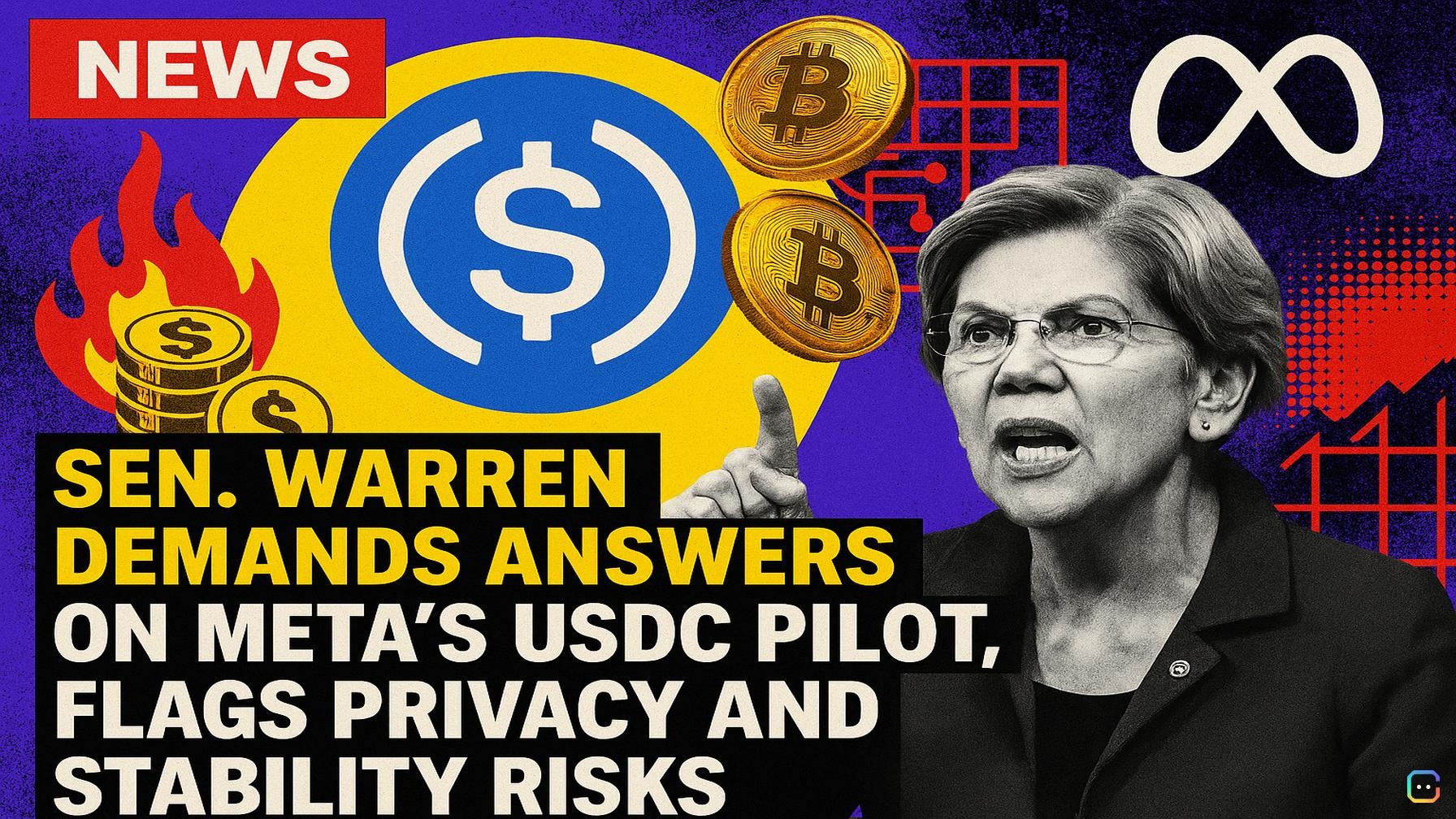
Meta’s quiet USDC pilot has drawn a formal rebuke from Senator Elizabeth Warren, who says the company must answer detailed questions about its stablecoin experiment or face scrutiny from lawmakers.
In a letter to CEO Mark Zuckerberg obtained by Fortune, Warren called Meta’s “lack of transparency” around the program “troubling” and asked for answers by May 20 about the scope, partners and guardrails of the test. She warned that Meta’s move into payments using dollar‑pegged tokens could have “serious implications for competition, privacy, the integrity of our payments system, and financial stability.”
What Warren is asking Meta to disclose
- Which stablecoins and wallets the company is using for the pilot (Fortune reports USDC is involved).
- How Meta chooses third‑party issuers such as Circle.
- What data Meta collects from linked wallets and users.
- How the company will separate its social platforms from any financial services to avoid conflicts of interest.
- Any discussions Meta has had with regulators — including the Federal Reserve, SEC, CFTC and banking agencies.
The pilot in brief
Late April saw Meta begin testing USDC payouts to a limited group of creators in Colombia and the Philippines, letting them receive earnings in Circle’s dollar‑pegged token via supported wallets rather than local fiat through traditional rails. Reports indicate the pilot uses Solana and Polygon networks and is powered on the backend by Stripe, which recently added stablecoin settlement after acquiring infrastructure firm Bridge. Test participants must link third‑party crypto wallets to their Meta accounts while Meta evaluates UX, fees and compliance.
Meta’s position
A Meta spokesperson told reporters the company “is not developing its own stablecoin” and is instead “enabling third‑party stablecoins like USDC for payment purposes,” drawing a line between this effort and the earlier Libra/Diem project.
Why lawmakers care
Warren — a senior Democrat on the Senate Banking Committee and long a critic of Big Tech’s forays into finance — frames the issue as more than a product test. Given Meta’s global user base, she argues, integrating stablecoins at scale could reshape market competition, erode privacy protections, stress payment systems and give rise to “shadow bank” risks outside traditional regulation. She cited Meta’s prior Libra/Diem push as evidence the firm may push regulatory limits, and says a shift from issuing a token to embedding one should not remove the need for scrutiny.
Regulatory backdrop
The timing of Warren’s letter coincides with a key moment in Congress: the Senate Banking Committee recently reached a compromise on the CLARITY Act’s stablecoin provisions, banning bank‑like interest on passive balances while permitting activity‑linked rewards. That deal cleared a major hurdle and moved the broader digital‑asset market structure bill — which would set federal rules for exchanges, token classification and stablecoin oversight — toward a committee markup. How lawmakers ultimately define those rules will shape whether pilots like Meta’s can scale.
Bottom line
Warren’s letter makes clear that Washington no longer treats “using” a widely adopted stablecoin as a narrow technical choice. At Meta’s scale, even integrating someone else’s token raises systemic policy questions — and lawmakers say they expect clear answers and close oversight before such experiments advance.
Read more AI-generated news on: undefined/news