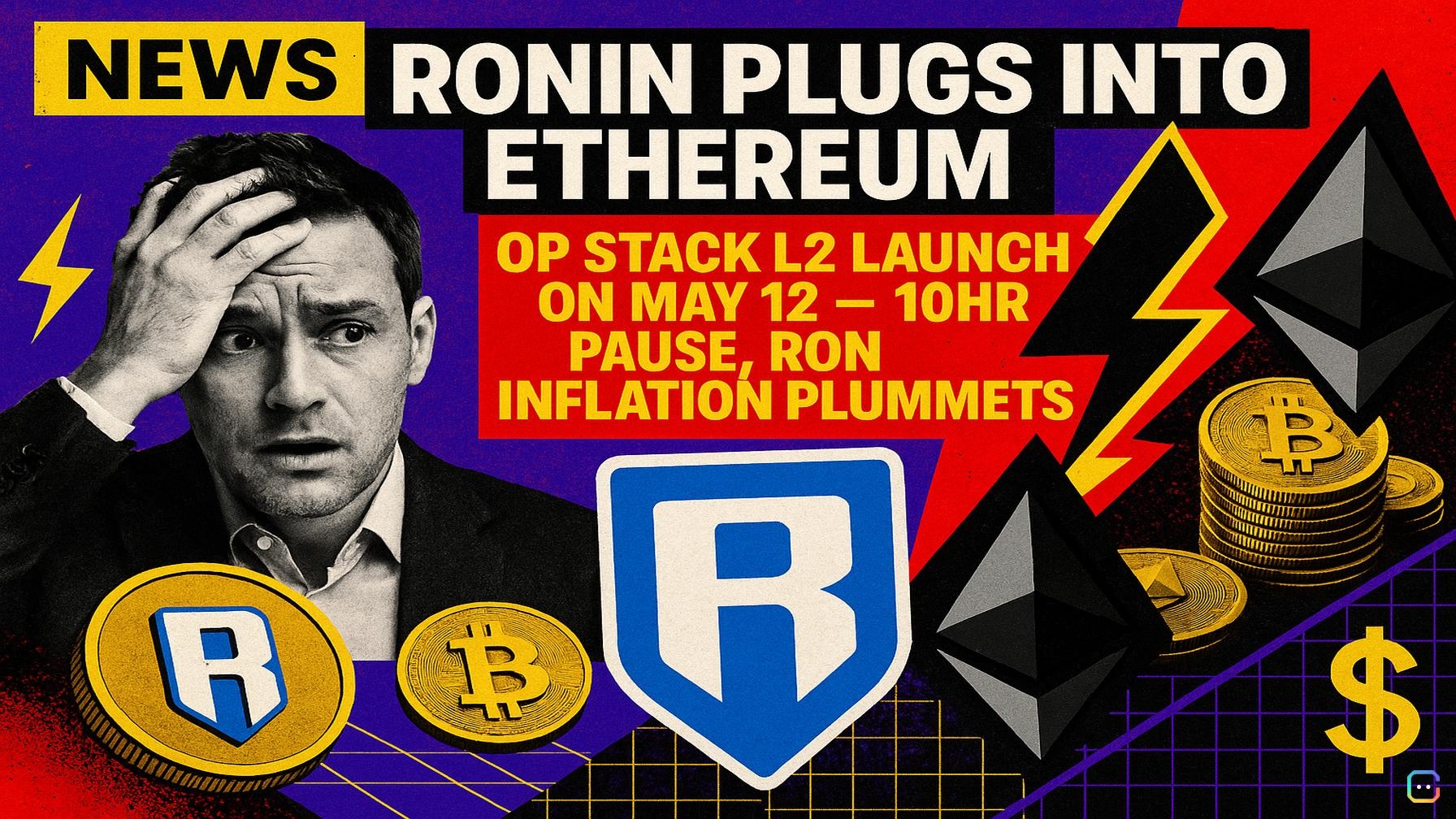
Ronin, the gaming-focused blockchain that powers Axie Infinity, will complete its long-planned migration from an independent sidechain to an Ethereum Layer 2 on May 12 — a move the team says is about “plugging back into the mothership.”
What’s happening and when
- The network will execute a hard fork at block 55,577,490, expected at roughly 15:16 UTC on May 12.
- All Ronin transactions will be paused for about 10 hours during the migration window. That includes transfers, swaps, NFT trades and smart-contract interactions.
- Ronin mainnet node operators must upgrade to release 1.2.2 before the fork to remain in sync.
Why the change matters
- Architecture: Ronin will replace its nine-validator sidechain model with OP Stack rollup infrastructure, linking the chain directly to Ethereum for settlement and data availability. The team frames this as returning to Ethereum’s security model rather than relying on a small, centrally managed validator set.
- Data availability: Ronin will integrate EigenDA to keep transaction data off-chain while making it verifiable and accessible to Ethereum, improving scalability without sacrificing verifiability.
- Ecosystem: The migration brings Ronin into the OP Stack ecosystem alongside chains such as Celo and Fraxtal.
Tokenomics and fees
- RON inflation is set to drop dramatically under a new Proof of Distribution model — from north of 20% annually down to below 1%.
- Marketplace fees will rise from 0.5% to 1.25%.
- A previously earmarked 90 million RON for staking will be redirected to the Ronin treasury.
Security context
Ronin’s pivot to an Ethereum-native rollup follows a history-making exploit in March 2022, when attackers drained $625 million in ETH and USDC from the network’s bridge — the largest DeFi bridge exploit to date. That incident highlighted the risks of a small, centralized validator set, and the Layer 2 migration is explicitly designed to inherit Ethereum’s security instead of relying on Ronin’s standalone validators.
Preparatory steps
As part of its hardening process, Ronin migrated its bridge to Chainlink’s cross-chain interoperability protocol in April 2025, a precursor to the full L2 transition.
What users should do
- Expect service disruption for ~10 hours from the stated block/time.
- Hold off on time-sensitive on-chain activity until the upgrade completes.
- Node operators must install release 1.2.2 ahead of the fork.
This migration represents a major technical and economic reset for Ronin — moving the network closer to Ethereum for security and data availability while reshaping RON’s issuance and marketplace economics.
Read more AI-generated news on: undefined/news