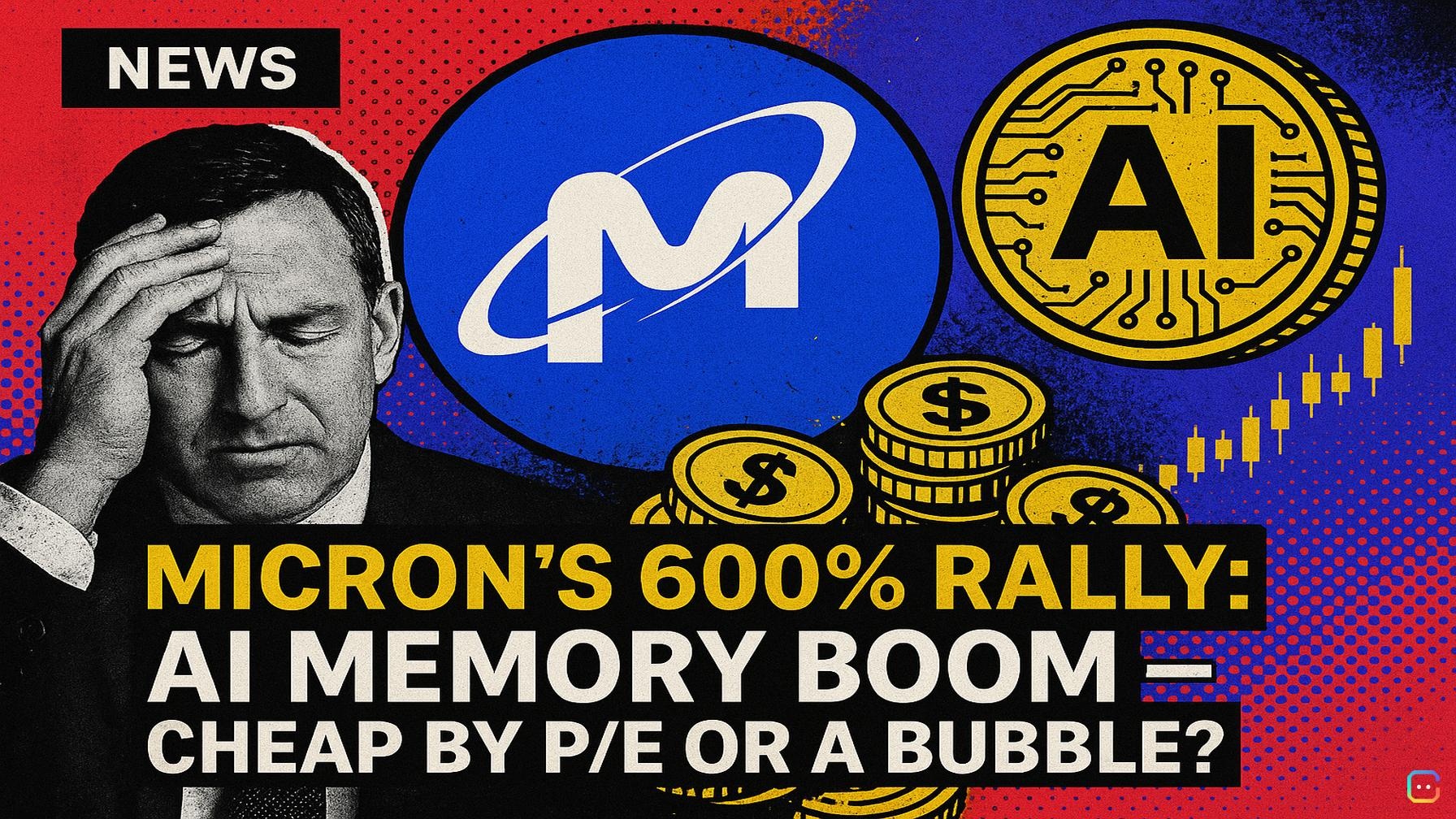
Is Micron too expensive right now? At about $698 a share — up from a 52-week low of $90.93 and not far from a high of $818.67 — that’s the question investors keep asking. The stock has already climbed more than 600% from its lows, which looks extreme on the surface. But strip back the headlines and the valuation math tells a different story: Micron’s forward P/E sits roughly between 7x and 8x, with a PEG near 0.26, putting it well below the broader S&P 500 on a forward basis.
Why the disconnect between eye-popping gains and seemingly reasonable forward multiples? It comes down to one structural story: a severe memory shortage driven by AI demand. Micron’s bullish scenario is straightforward — prices for DRAM and NAND have exploded, demand outstrips supply, and Micron is uniquely positioned as the only major U.S. DRAM supplier in a global, three-player market.
Key numbers fueling the optimism
- Trailing P/E of about 39x, and multiply that by the consensus fiscal 2026 EPS of $32.45 gives a theoretical target of roughly $1,275. Even a conservative EPS of $30.28 yields around $1,190.
- Q1 fiscal 2026 results (reported November 2025): revenue $13.6 billion, up 57% year-over-year; DRAM made up 79% of revenue; gross margin 45.3%.
- Pricing moves cited by bullish analysts: NAND up 413% year-over-year and DRAM up 355% year-over-year (per Mizuho).
And the supply constraint looks real. Intel CEO Lip-Bu Tan warned the crunch could persist until 2028, and Micron management said in its Q1 call that they’re still unable to meet customer demand across segments. Micron also disclosed they’ve already agreed price and volume for their entire calendar 2026 HBM supply — including HBM4 — a striking signal that HBM capacity is fully booked.
Street targets and split sentiment
Analyst upgrades have followed. On May 19, Citigroup set a target of $840, Melius Research $1,100, and Mizuho $800 — averaging over $913 just from those three. Mizuho’s Vijay Rakesh, a long-term bull, lifted his target to $800 and argues pricing tailwinds from AI servers could persist into 2026 and beyond. Rakesh projects HBM revenue growing at a 40% CAGR to top $100 billion by 2028 and forecasts fiscal 2027 revenue and EPS growth of 66% and 80% year-over-year, respectively.
The bear case is equally explicit
Not everyone buys the perpetual shortage thesis. Some analysts warn that memory markets are cyclical — supply eventually normalizes, pricing power fades, and margins compress. Seeking Alpha’s Victor Dergunov downgraded Micron to Sell on May 18, calling the price action parabolic and flagging a market cap approaching $1 trillion. He suggested a near-term correction to the $500–$600 range is plausible.
There are concrete risks: Samsung and SK Hynix are aggressively ramping capacity, which could blunt pricing power; the average 12-month analyst target across full coverage is about $600, implying downside from current levels; and macro factors matter — the 30-year Treasury yield recently hit 5.198% (the highest since July 2007), a backdrop that generally pressures tech stocks priced on future growth.
Insider moves also catch attention. CEO Sanjay Mehrotra sold 40,000 shares at $536 in early May, and insiders moved roughly 106,000 shares — about $47 million — over the past three months.
So, is it too late to buy?
It depends on which narrative you believe. Bulls say Micron isn’t expensive: forward multiples look cheap, supply constraints are structural, and Micron occupies a critical position in the AI-driven memory market. Bears argue that a near-$1 trillion valuation for a cyclical, commoditized industry already bakes in too much optimism and that normalization or competitive capacity additions could unwind gains.
For crypto-focused investors tracking AI, data-center, and semiconductor exposure, Micron’s story is a core example of how AI-driven memory demand can reshape valuations — but it’s also a reminder that cycles and competition still matter. The split on Wall Street means the MU price-target debate will stay highly contested into the second half of 2026.
Read more AI-generated news on: undefined/news