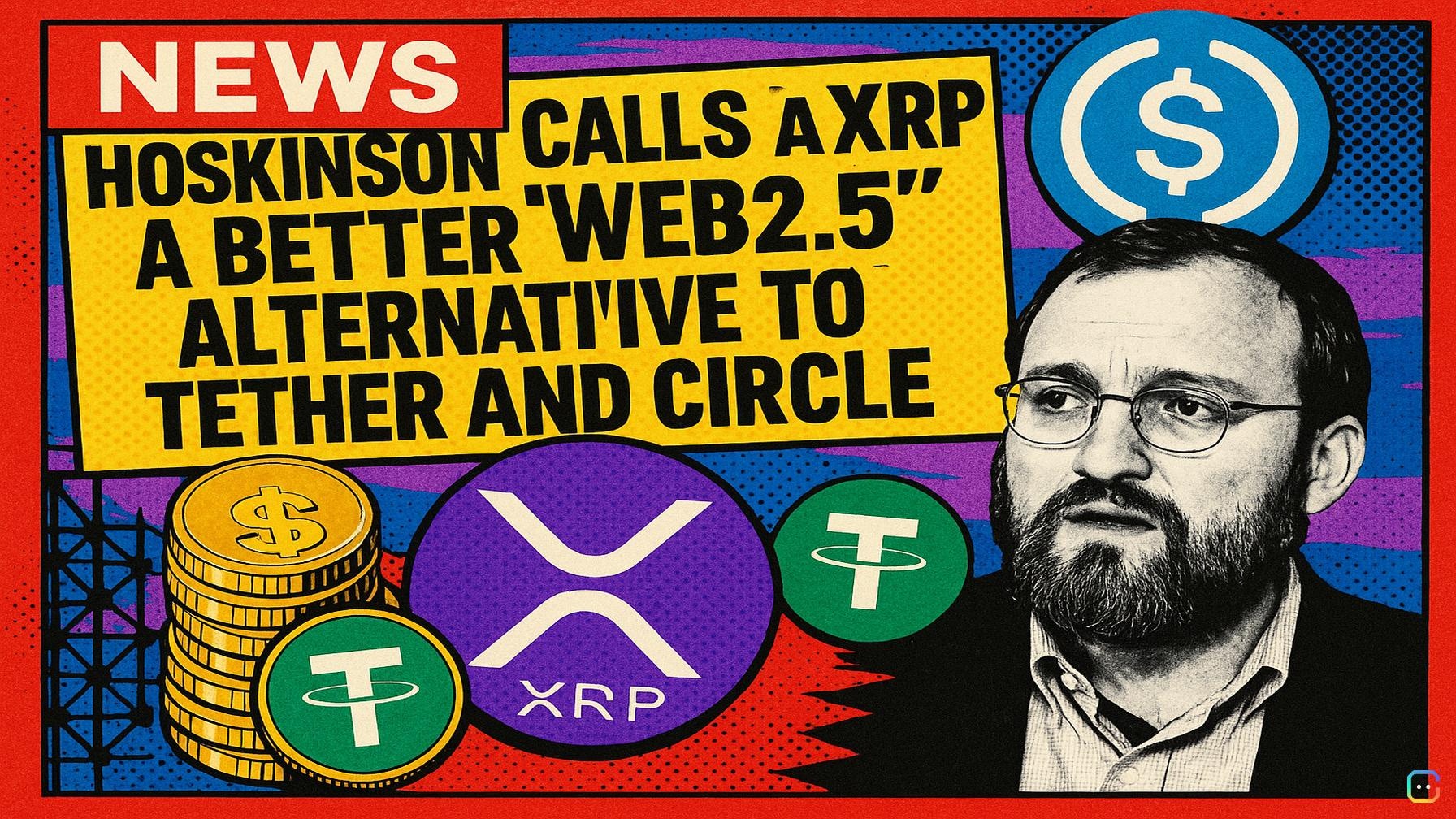
Cardano founder Charles Hoskinson took an unexpected swipe at centralized stablecoins this week, praising XRP as a stronger “Web2.5” alternative to issuers like Tether and Circle — a remark that stands out given his often-tense history with parts of the XRP community.
“I think XRP as a Web2.5 product is better than Tether or Circle. I like it a lot more,” Hoskinson said, according to posts shared on X by Angry Crypto Show. He tied his preference to principles of openness: “I believe in open standards, open protocols, and open ecosystems,” he added, stressing that developers can build on the XRP Ledger without seeking permission from Ripple.
Hoskinson’s endorsement frames the XRP Ledger as a permissionless environment, contrasting it with centralized stablecoin models that rely on corporate controls. Stablecoin issuers such as Tether and Circle can, and have, frozen funds, blocked addresses, and enforce access through company-run compliance systems — features Hoskinson implicitly criticized by praising XRP’s open-access design.
Why timing matters
Stablecoins are no small corner of crypto anymore. Fiat-backed stablecoin supply surpassed $319 billion in April 2026, and adjusted stablecoin transaction volume reached $10.9 trillion in 2025. Those numbers coincide with fresh regulatory scrutiny in Washington: recent debates around the CLARITY Act — including a controversial stablecoin rewards provision — have pitched crypto firms against U.S. banking groups, raising the stakes for how stablecoins are regulated.
A notable shift in tone
Hoskinson’s compliment is notable because his relationship with the XRP community has frequently been strained. Some XRP proponents have accused him of involvement in an “ETHgate” theory — the claim that Ethereum received regulatory favors that Ripple did not — an allegation Hoskinson has repeatedly denied. He has pointed out he left Ethereum in 2014 and says he had no role in later actions involving Ripple or the SEC.
The comment also follows prior public disagreements with Ripple leadership over policy. Earlier this year Hoskinson criticized Ripple CEO Brad Garlinghouse for backing a crypto market structure bill, warning that poorly written rules could entrench bad regulations for years. Those exchanges illustrated how Cardano and Ripple leaders can align on some industry objectives while diverging on decentralization, governance, and regulatory strategy.
Cardano context: governance under the microscope
Hoskinson’s praise of XRP arrives as Cardano itself faces governance questions. He recently launched a review of more than 11,000 DAOs to assess governance design, roadmaps, executive roles, and strategy. The scrutiny followed a contentious Cardano treasury vote: 81% of active stake opposed a 32.9 million ADA proposal to fund Input Output Global’s research lab for another year — a result that exposed fractures over resource allocation and oversight.
Taken together, Hoskinson’s comments do more than compare tokens. They underline a broader argument he’s been making about permissionless systems: that networks allowing builders to operate without corporate gatekeepers are preferable to centralized models — even when those centralized models play a critical role in today’s stablecoin-driven crypto economy.
Read more AI-generated news on: undefined/news