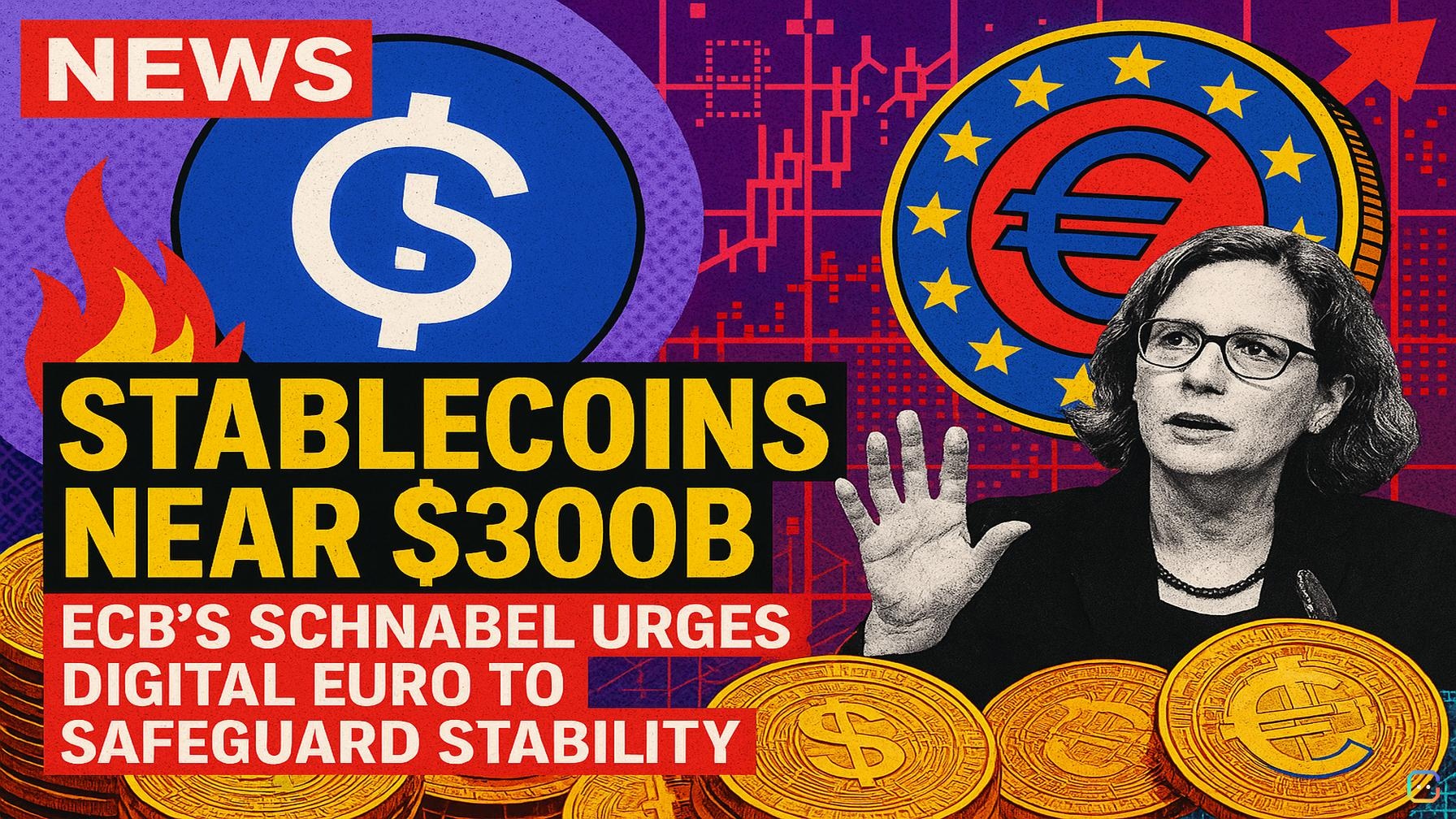
Headline: ECB’s Isabel Schnabel: Stablecoins Near $300B — Digital Euro Needed to Protect Financial Stability
Stablecoins are approaching a $300 billion market cap, and European Central Bank executive board member Isabel Schnabel warned Monday that their rapid rise presents mounting risks — from runs and liquidity mismatches to a deepening reliance on the U.S. dollar. Speaking at the 2026 Bank of Korea International Conference in Seoul, Schnabel argued the answer is not to block innovation but to ensure central banks provide a safe, trusted digital alternative: the digital euro.
Key takeaways from Schnabel’s remarks
- Market size and concentration: ECB figures cited by Schnabel put the stablecoin market at nearly $300 billion. Tether’s USDT and Circle’s USDC together account for roughly 90% of that market, even as overall expansion has slowed.
- Fragility and risk: Stablecoins can be vulnerable to runs if users lose confidence in the assets backing them. Schnabel warned about liquidity mismatches and instability when trust in reserve assets deteriorates.
- Dollar dominance: Because almost all stablecoins are dollar-denominated, their growth could further entrench the U.S. dollar’s international dominance. “Today, virtually all stablecoins in circulation are denominated in dollars, with other currencies playing a negligible role,” she said.
- Policy stance: Schnabel stressed that central banks shouldn’t resist technological innovation. Instead, they should build safeguards that preserve trust, monetary control, and financial stability.
Why a digital euro?
Schnabel argued a retail digital euro would preserve public access to central bank money in Europe and reduce dependence on foreign payment providers. A digital euro — legal tender and pan-European by design — could also address fragmentation across Europe’s payments landscape and help keep payment revenues within the region.
Progress on the digital euro project
The ECB has been steadily advancing the digital euro program:
- March: ECB executive board member Piero Cipollone said technical standards for the digital euro are expected to be published in 2026 so banks, payment firms and merchants can prepare before any final issuance decision.
- April: The ECB announced partnerships with European Card Payment Cooperation, nexo standards, and the Berlin Group to reuse existing European payment standards. The goal is to lower implementation costs and allow providers to integrate digital euro services via existing infrastructure.
- Timeline published by the ECB: digital euro legislation expected in 2026; a 12-month pilot to test person-to-person and point-of-sale payments planned for the second half of 2027; technical readiness aimed for potential issuance by 2029. The project is currently in a technical preparation phase.
Contrast with the U.S.
Schnabel’s comments arrived amid a divergent U.S. posture: days earlier, U.S. Treasury Secretary Scott Bessent reiterated that the current U.S. administration does not support creating a U.S. central bank digital currency, urging Congress to advance the Clarity Act instead.
Bottom line
As stablecoins grow and remain heavily dollar-linked, the ECB sees a real need for a public digital alternative to safeguard monetary sovereignty and financial stability. The digital euro program is moving from design to technical preparation, with legal and pilot milestones set over the next few years — positioning Europe to offer a regulated central bank digital currency if policymakers give the green light.
Read more AI-generated news on: undefined/news