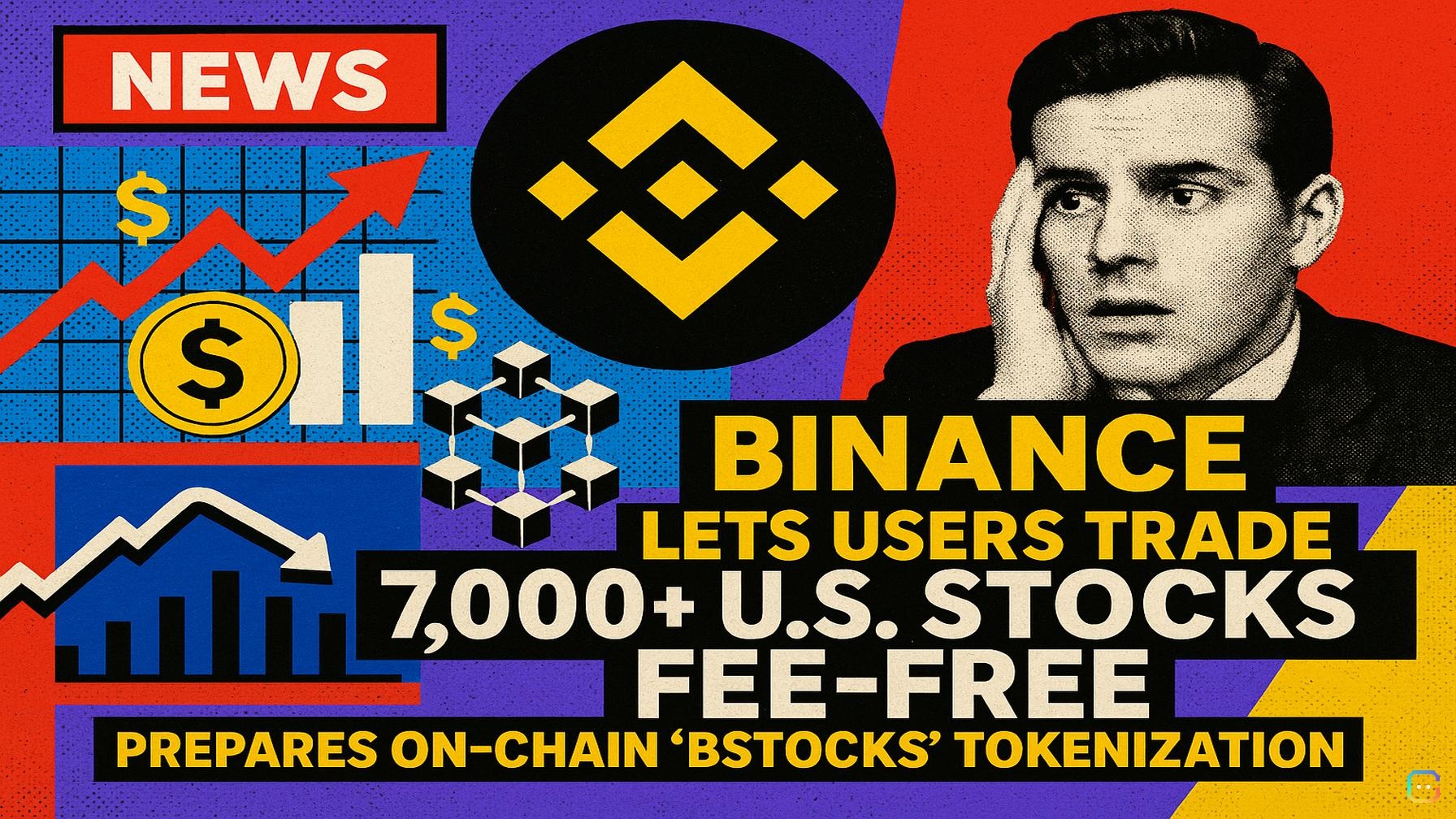
Binance just pushed the boundaries between traditional finance and crypto: the exchange opened access to more than 7,000 U.S. stocks and ETFs and announced plans to let users turn those shares into on-chain tokens.
What launched
- Retail customers (non-U.S. users) can now trade thousands of U.S. equities and ETFs with zero commissions and buy fractional shares starting at $5, part of Binance’s goal to become a “multi‑asset financial super app,” co‑CEO Richard Teng told Fortune.
- Trades are processed through broker‑dealer Nest Trading, with New York’s Alpaca Securities handling custody, dividend distribution and corporate actions.
- Binance will accept crypto payments for purchases — including USDC, USDT, BNB and other digital assets.
bStocks: tokenization coming soon
- Binance unveiled “bStocks,” a forthcoming feature that will let users mint synthetic, tokenized versions of the equities they buy on the BNB Chain. The company says customers will be able to initiate the tokenization process themselves in the coming weeks.
- Binance frames tokenized equities as a bridge between real‑world assets (RWA) and DeFi, enabling use cases such as lending, collateral and other yield-generation strategies.
Why this matters
- For Binance, the move is strategic: large exchanges are trying to reduce reliance on crypto market cycles by capturing more of users’ investable balances, according to Ivan Patriki, co‑founder of analytics platform Quantmap. Keeping users in one app for stocks, crypto and DeFi can boost engagement and fee capture across asset classes.
- Proponents see tokenized stocks as a major driver for RWA adoption. Misha Putiatin of Symbiotic says making equities “composable” with DeFi could create a dependable yield base for on‑chain markets.
Risks and regulatory headwinds
- The product structure is complex: Binance is the interface, Nest Trading is the broker‑dealer and Alpaca is the custodian, which creates operational and regulatory risk if any link is disrupted, warns Vytautas Mackonis, COO of RWA protocol ALCUM.
- The U.S. regulatory picture is unsettled. Last week the SEC delayed a planned “innovation exemption” for tokenized assets, citing concerns over third‑party tokens and digital share representations that could confuse dividend payments and shareholder voting rights.
- Critics also flag practical questions about redeemability, price synchronization with the underlying stock (especially when markets are closed), and whether tokenized equities will be permitted as collateral in DeFi, Patriki says. He predicts a “hybrid market” where brokers, exchanges, banks and blockchain platforms compete for the same user balances — not the end of brokers but a new competitive landscape.
Market context and competitors
- Binance has dabbled in tokenized assets before, offering tokenized products via Ondo Finance on Binance Alpha in February; those products did not confer all shareholder rights (for example, voting).
- Rivals are also expanding: Coinbase integrated Yahoo Finance tickers to let users trade underlying digital assets or tokenized stocks as part of an “Everything Exchange” strategy. Kraken launched regulated tokenized equity perpetual futures on its xStocks framework for eligible non‑U.S. users, and Nasdaq is working with Kraken’s parent Payward on xStocks‑based tokenized equities with a planned 2027 launch.
Traction so far
- Tokenized stocks and ETFs are gaining momentum: daily trading volume reached $1.68 billion (up 39% month‑over‑month), monthly transfer volume hit $3.63 billion (up 36%), and holders rose 31% to 292,590, per rwa.xyz.
What to watch
- The bStocks rollout timeline and exact mechanics of minting/redeeming.
- How custody, dividend and voting rights are handled in practice.
- Regulatory responses in the U.S. and other jurisdictions.
- Whether tokenized equities achieve meaningful DeFi composability and secondary‑market liquidity.
Bottom line: Binance’s offering accelerates the push to fuse traditional equities with crypto rails — promising new utility and liquidity on chain, but raising unresolved legal, operational and regulatory questions that will shape whether tokenized stocks become a durable part of the on‑chain financial stack.
Read more AI-generated news on: undefined/news