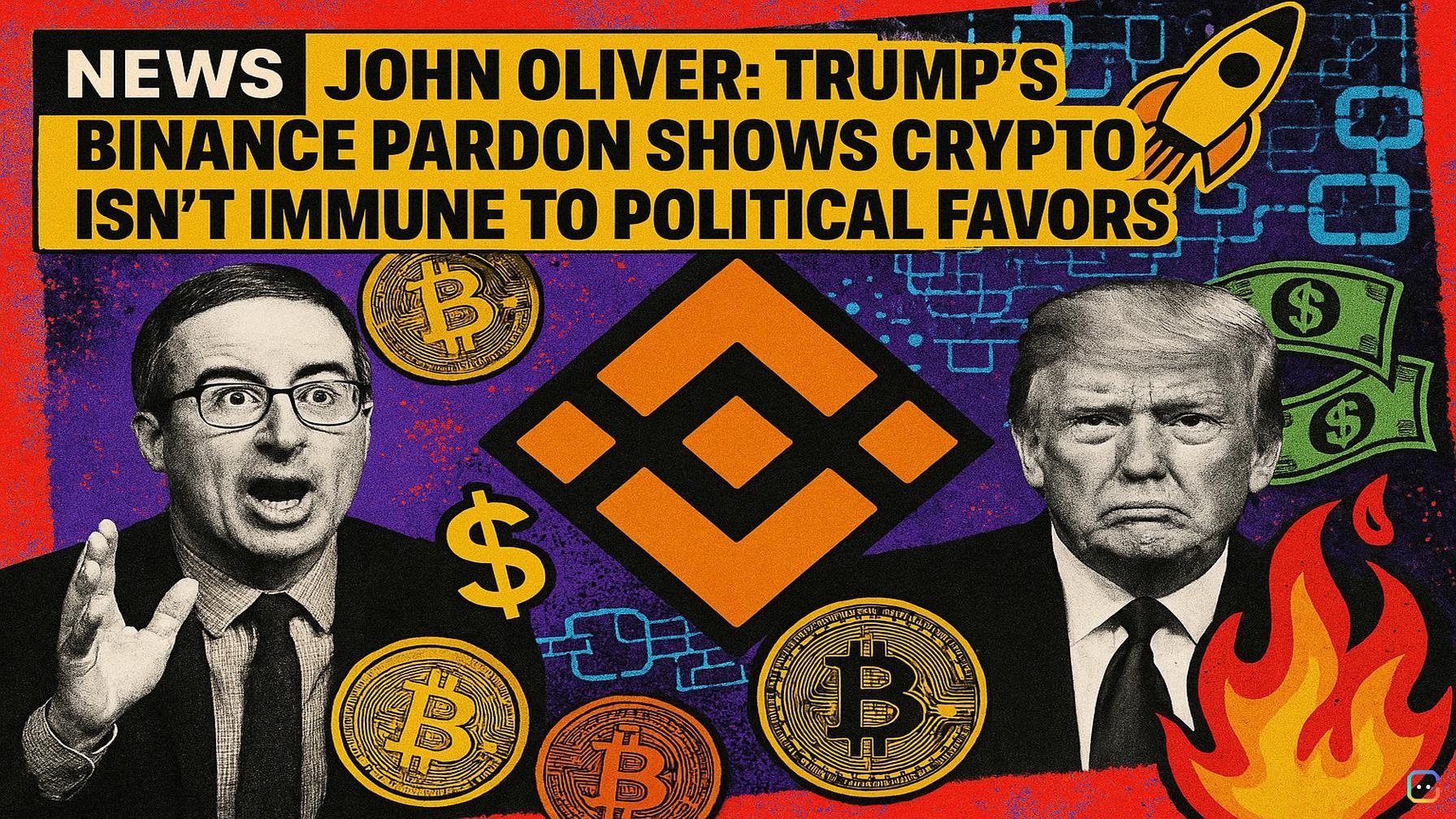
Headline: John Oliver Slams Trump’s Pardons — Warns Crypto Industry Is Not Immune After Binance Pardon
Comedian and commentator John Oliver devoted a segment on Last Week Tonight to a blistering critique of President Donald Trump’s use of the constitutional pardon power — and the implications for victims, accountability and even the crypto industry.
Why it matters
- The president’s constitutional right to pardon federal crimes is broad and largely unchecked. Oliver says that while the power can do good, Trump’s approach has repeatedly favored allies, major donors and high-profile figures instead of following traditional norms.
- That favoritism has direct consequences for victims and for sectors under heavy regulatory scrutiny, including crypto, where enforcement actions are meant to deter money laundering and protect users.
Key points from the segment
- Pardons and commutations: Oliver noted Trump issued 238 commutations during his first term and, less than two years into his second term, has reportedly handed out nearly 2,000 pardons and commutations — with rumors of roughly 250 more to mark the U.S.’s 250th birthday.
- Pattern of favoritism: Oliver highlighted past presidential pardons that were exceptions (for example, Gerald Ford for Nixon and Joe Biden’s pardon of Hunter Biden). He contrasted them with Trump’s record of pardoning allies and political allies — from early examples like Charles Kushner and Paul Manafort to more controversial cases such as George Santos and Rudy Giuliani.
- January 6 pardons: After his inauguration, Trump pardoned multiple January 6 rioters, including the leader of the Proud Boys and about 600 protesters charged with assaulting law enforcement or resisting arrest. Oliver said legal experts see this as an unprecedented early-term break with longstanding norms.
- Public safety concerns: Oliver cited examples where pardoned individuals later allegedly reoffended. He singled out one pardoned rioter, Andrew Paul Johnson, who was arrested months later on child sexual abuse charges and reportedly tried to use expected funds from a proposed $1.8 billion “anti-weaponization” compensation fund tied to Trump to buy a victim’s silence.
- Financial winners: More than 50 of Trump’s second-term pardons have been for white-collar crimes such as fraud and money laundering. Oliver highlighted Trevor Milton, Nikola’s founder, who was convicted of wire fraud after donating more than $1.8 million to Trump’s re-election campaign; his pardon erased some $600 million in restitution owed to investors. Oliver said the second-term pardons have wiped out more than $1.3 billion in restitution owed to victims and survivors.
- Crypto angle — Binance and Changpeng Zhao: Oliver recapped the high-profile crypto case: in 2023 Binance and CEO Changpeng Zhao pleaded guilty to failing to prevent money laundering, admitting the platform had moved funds for Russian drug traffickers, Hamas militants and other criminal organizations. The company paid roughly $4 billion in fines. Yet, according to the segment, Trump issued Zhao a full pardon in October 2025. When asked about the rationale on 60 Minutes, Trump reportedly said, “I don’t know who he is … I just heard it was a Biden witch-hunt,” a line Oliver mocked as a familiar dodge.
- Potential conflicts: Oliver pointed to what he described as a possible quid pro quo: months before the pardon, Binance allegedly arranged a crypto deal for the Trump family that would have paid them about $30 million a month — a fact Oliver presented as context for why the pardon raised eyebrows.
What can be done?
- Oliver acknowledged legal limits: reining in the constitutional pardon power is legally and politically fraught, and past presidents’ questionable pardons were often balanced by clemency that helped many deserving people.
- But he argued that the balance now appears reversed: clemency is increasingly going to “scumbags and fraudsters with connections to Trump,” while victims and everyday accountability suffer. “Trump loves to rail about how tough he is when it comes to law and order,” Oliver concluded. “But that toughness is clearly deeply selective. Because he’ll happily put violent people and fraudsters right back in the streets to victimize people again just because they support him.”
Why crypto readers should care
- The Binance case underscores a key risk for crypto firms: regulatory enforcement can be substantial, but political interventions — including pardons — can undermine deterrence and leave victims without restitution.
- High-profile pardons of crypto executives raise questions about governance, political exposure and how industry actors engage with policymakers. For crypto companies operating in an increasingly regulated environment, those reputational and legal risks matter as much as fines and compliance costs.
Bottom line: Oliver framed the pattern of pardons as more than political theater — a real-world shift that can free violent offenders and erase financial accountability for corporate malfeasance, with fallout that reaches into sectors like crypto where enforcement and trust are critical.
Read more AI-generated news on: undefined/news