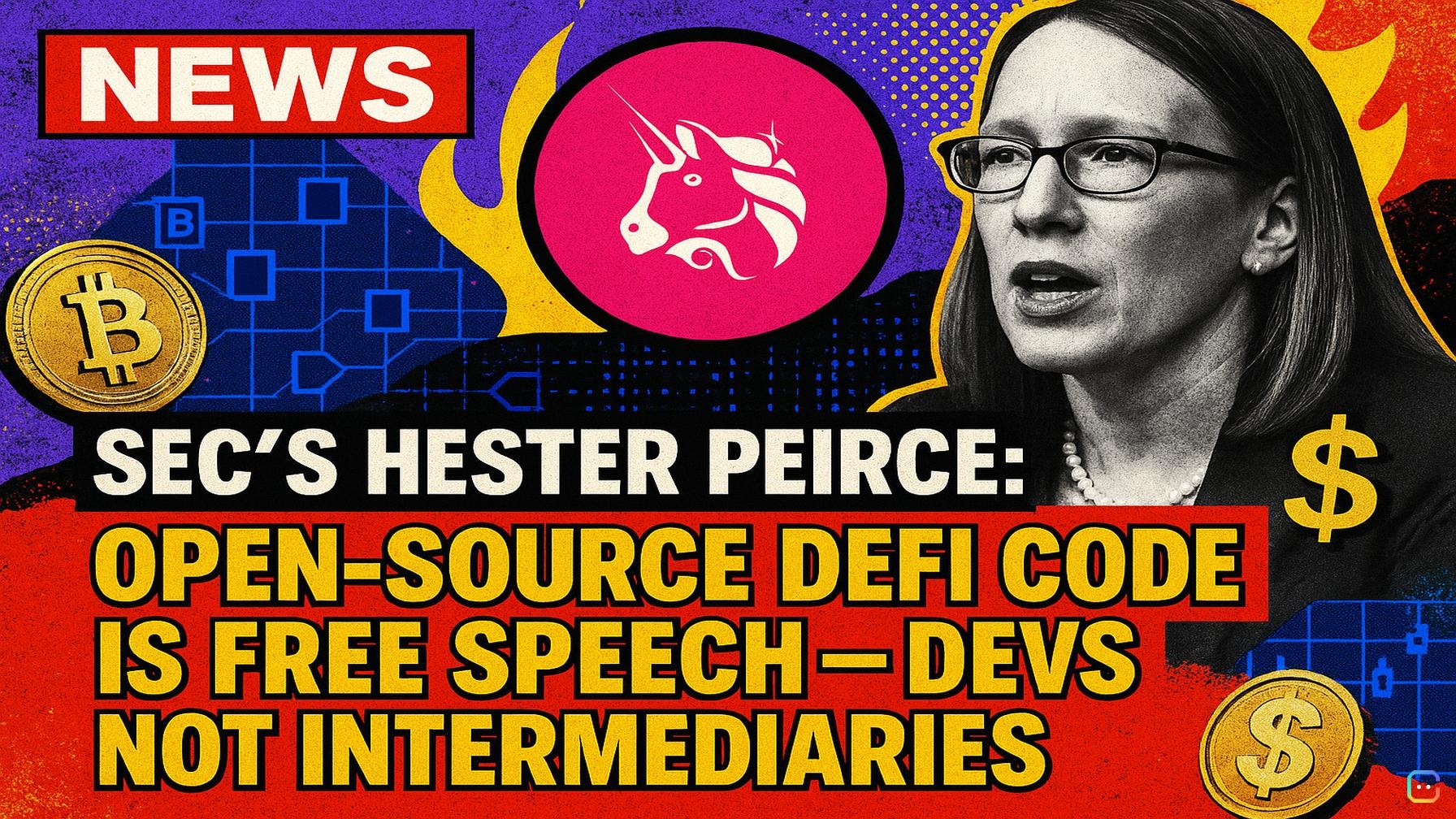
At a Princeton conference this week, SEC Commissioner Hester Peirce drew a clear — and potentially game-changing — distinction between writing blockchain code and being held responsible for how others use that code.
Speaking at the IC3 Blockchain Camp, Peirce argued that publishing open‑source DeFi software is a form of protected speech under the First Amendment and should not automatically make developers into securities intermediaries simply because third parties build on or use their work. “Blockchains are used to do many things other than transact in securities,” she noted, underscoring that the technology’s uses extend well beyond traditional securities activity (a point highlighted in a June 4 CoinMarketCap post about her remarks).
Peirce said legal liability ought to land on the actors who actually engage in unlawful conduct — not on the engineers who wrote the underlying tools. That view pushes back against a model that treats code authors as de facto service providers whenever their creations are repurposed for potentially regulated activity.
Her comments come amid a broader recalibration at the SEC under Chair Paul Atkins. The agency appears to be moving away from heavy-handed “regulation by enforcement,” with the Crypto Task Force reviewing how existing securities laws should be applied — if at all — to decentralized systems. Peirce, long a proponent of clearer rules for crypto, has been one of the most visible voices arguing for regulatory clarity and restraint.
Peirce also highlighted a structural tension: many SEC rules were written for intermediaries such as brokers, dealers, exchanges, clearinghouses and investment advisers. She questioned whether those intermediary-focused regulations sensibly translate to distributed blockchain networks that serve many functions beyond securities transactions.
Her remarks followed recent SEC staff guidance on broker‑dealer registration that suggested certain front‑end websites and software interfaces that let users access decentralized protocols may not meet the traditional legal definition of a broker. That guidance, together with the agency’s draft Strategic Plan through fiscal 2030 — which describes blockchain and crypto as technologies capable of reshaping U.S. financial infrastructure — signals the SEC is actively rethinking the scope of its regulatory categories.
Taken together, the staff guidance, strategic plan and Peirce’s Princeton speech paint a picture of an agency trying to redraw boundaries that were never clearly set. For DeFi developers and protocol teams, that could mean reduced risk of being treated as regulated intermediaries simply for publishing code — though major uncertainties remain as regulators refine where the line will be drawn.
Image credits: Pixabay; chart from TradingView.
Read more AI-generated news on: undefined/news