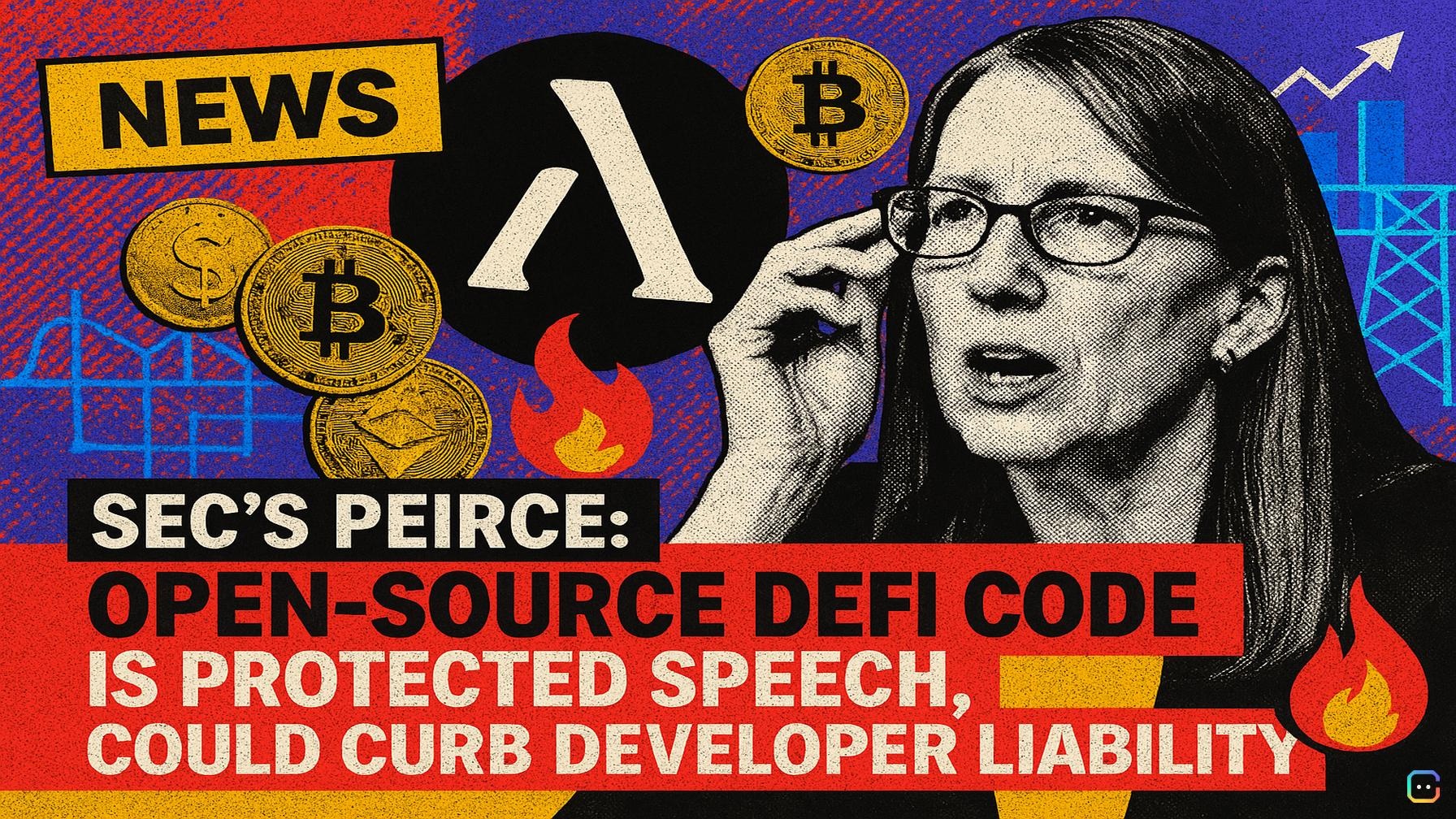
Headline: SEC’s Hester Peirce argues open-source DeFi code is protected speech — a potential turning point for developer liability
At Princeton’s IC3 Blockchain Camp, SEC Commissioner Hester Peirce drew a sharp distinction between writing blockchain software and being held responsible for how others use it — a distinction that could reshape regulatory risk for developers in decentralized finance.
Peirce told attendees that publishing open‑source blockchain code should be treated as protected speech under the First Amendment. She warned against automatically labeling developers as securities intermediaries simply because third parties use the tools they build. As she put it, “blockchains are used to do many things other than transact in securities,” and the agency’s rules shouldn’t be shoehorned onto the technology itself.
Her argument: legal liability belongs with people who actually commit unlawful conduct, not with the engineers who write the underlying infrastructure or front‑end software that others leverage for both legitimate and illicit activity.
Context: an agency in reevaluation
Peirce’s remarks come amid a broader recalibration at the SEC since Paul Atkins became chair. The agency has signaled a pullback from “regulation by enforcement” and tasked its Crypto Task Force with reassessing how existing securities laws should apply to digital assets and decentralized systems.
Peirce — long a leading voice for clearer, developer‑friendly rules — highlighted a core problem: the SEC’s regulations were written around traditional intermediaries (brokers, dealers, exchanges, clearinghouses, transfer agents, investment advisers and investment companies). Those categories, she argued, don’t map cleanly onto distributed networks and software that serve many purposes beyond securities transactions.
Recent signals from the agency back up the shift. SEC staff recently issued guidance on broker‑dealer registration that suggested some front‑end websites and software platforms that provide access to decentralized protocols may not fit the traditional broker definition. Meanwhile, the agency’s draft Strategic Plan through fiscal 2030 explicitly frames blockchain and crypto assets as technologies capable of reshaping U.S. financial infrastructure — implying the SEC expects to continue engaging with the sector while rethinking how to regulate it.
What this could mean
- Reduced legal risk for open‑source contributors, if courts or regulators accept the First Amendment framing and narrow broker‑dealer interpretations.
- Ongoing uncertainty, since protection for publishing code won’t necessarily shield developers who directly facilitate or profit from unlawful securities offerings.
- A potential easing of the “chilling effect” that has discouraged some developers from contributing to DeFi projects, if the SEC follows through with clearer, tech‑sensitive guidance.
Taken together — Peirce’s speech, recent staff guidance, and the SEC’s strategic plan — the message is that the agency is trying to redraw boundaries that weren’t designed with decentralized systems in mind. How far that redrawing goes will determine whether developers are treated as creators of protected tools or as intermediaries carrying the burdens of securities law.
Read more AI-generated news on: undefined/news