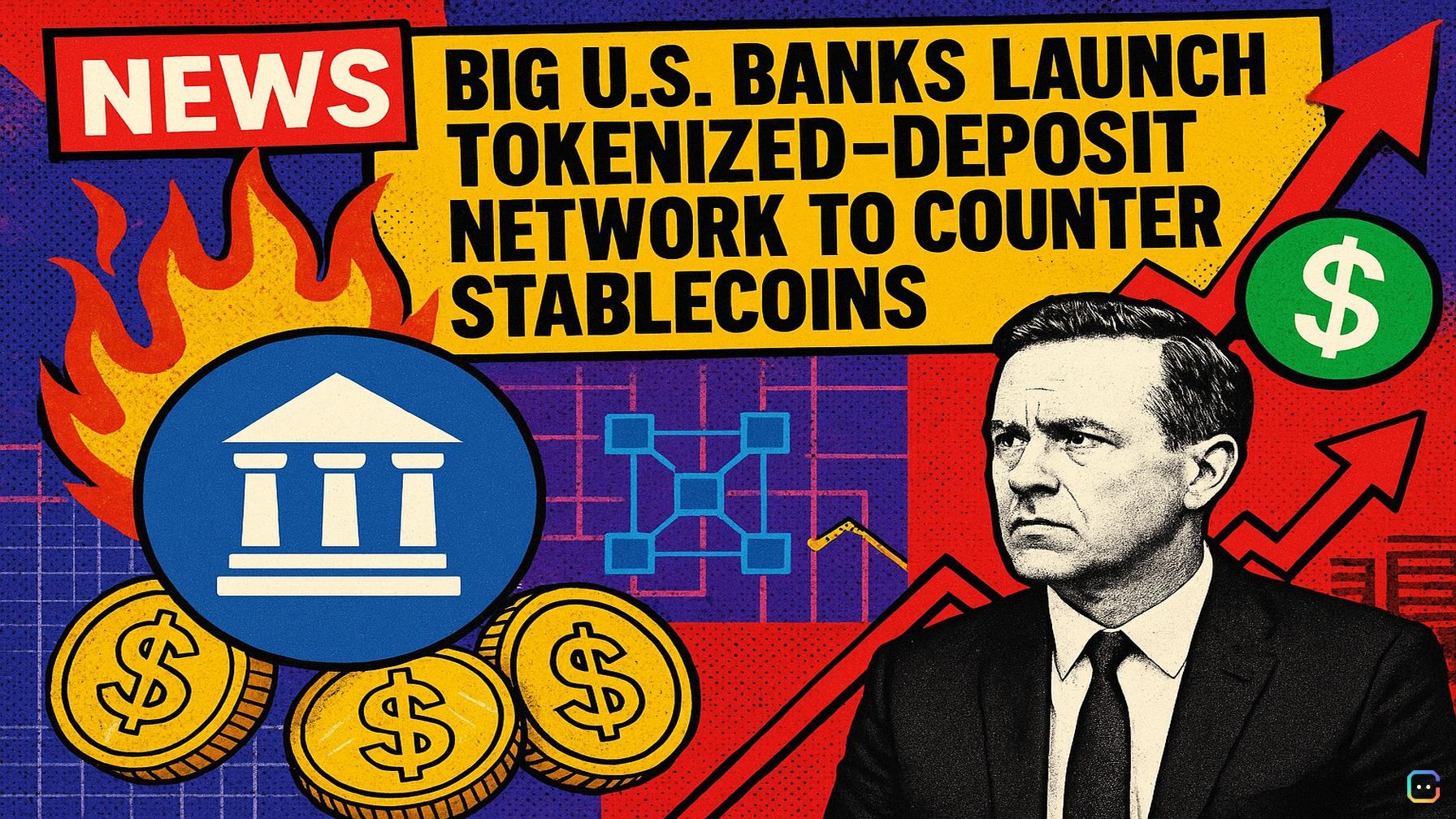
Headline: Big U.S. banks build tokenized deposit network to blunt stablecoin threat
America’s biggest banks are moving quickly to bring bank money onto blockchains — and to keep those deposits under their control. JPMorgan Chase, Bank of America, Citigroup and other major lenders said Friday they will launch a shared tokenized-deposit network through The Clearing House by the first half of 2027. The platform will let bank deposits be represented as digital tokens that move across blockchain rails with 24/7 settlement, essentially giving traditional bank cash many of the speed and programmability benefits that helped stablecoins take off.
Why banks are doing this
Stablecoins such as Circle’s USDC and Tether’s USDT dominate on-chain cash today, used for trading, cross-border transfers and even yield products. Banks worry that as stablecoins grow, retail and corporate deposits could migrate from traditional accounts into crypto wallets — draining core deposits and squeezing bank earnings.
Tokenized deposits offer a middle path: customers’ funds remain inside the banking system but are represented as transferable tokens that can settle instantly on blockchain infrastructure. That lets banks onboard clients to on-chain workflows while preserving regulatory and custodial control.
What proponents say
Reid Noch of TD Securities frames the market as a three-way race: stablecoins, tokenized deposits and tokenized money-market funds are competing to become the dominant on-chain cash instrument. He also emphasizes the practical benefits: blockchain rails could slash costs and settlement friction for cross-border and domestic payments that today often take one or two business days.
Cody Carbone, CEO of the Digital Chamber, sees the initiative as a milestone for blockchain adoption: the largest U.S. banks “voluntarily coming onchain” signals that mainstream finance is committing to blockchain infrastructure.
How the bank approach differs from crypto
That shift doesn’t mean banks are embracing crypto’s open, public model. As Noelle Acheson notes, banks have long experimented with private blockchains designed to move money internally while tightly controlling users and transactions. The Clearing House network scales that private approach across multiple banks, but remains distinct from the permissionless networks where stablecoins freely circulate.
Some bank executives have publicly downplayed the stablecoin threat — but institutions are clearly taking it seriously. A Jefferies report from March estimated stablecoins could trigger a 3%–5% runoff in core deposits over the next five years and shave average bank earnings by roughly 3%.
Potential impact
If the Clearing House project succeeds, it could become a powerful alternative for corporate payments and treasury operations, competing directly with stablecoins for enterprise liquidity and on-chain cash management. At the same time, it underscores a broader trend: traditional finance is increasingly adopting blockchain tools even as it competes with crypto-native products built on the same infrastructure.
Bottom line: banks aren’t conceding the on-chain cash market. They’re building a bank-backed version of it — one designed to keep deposits inside the regulated system while offering many of the speed and efficiency benefits that made stablecoins so popular.
Read more AI-generated news on: undefined/news