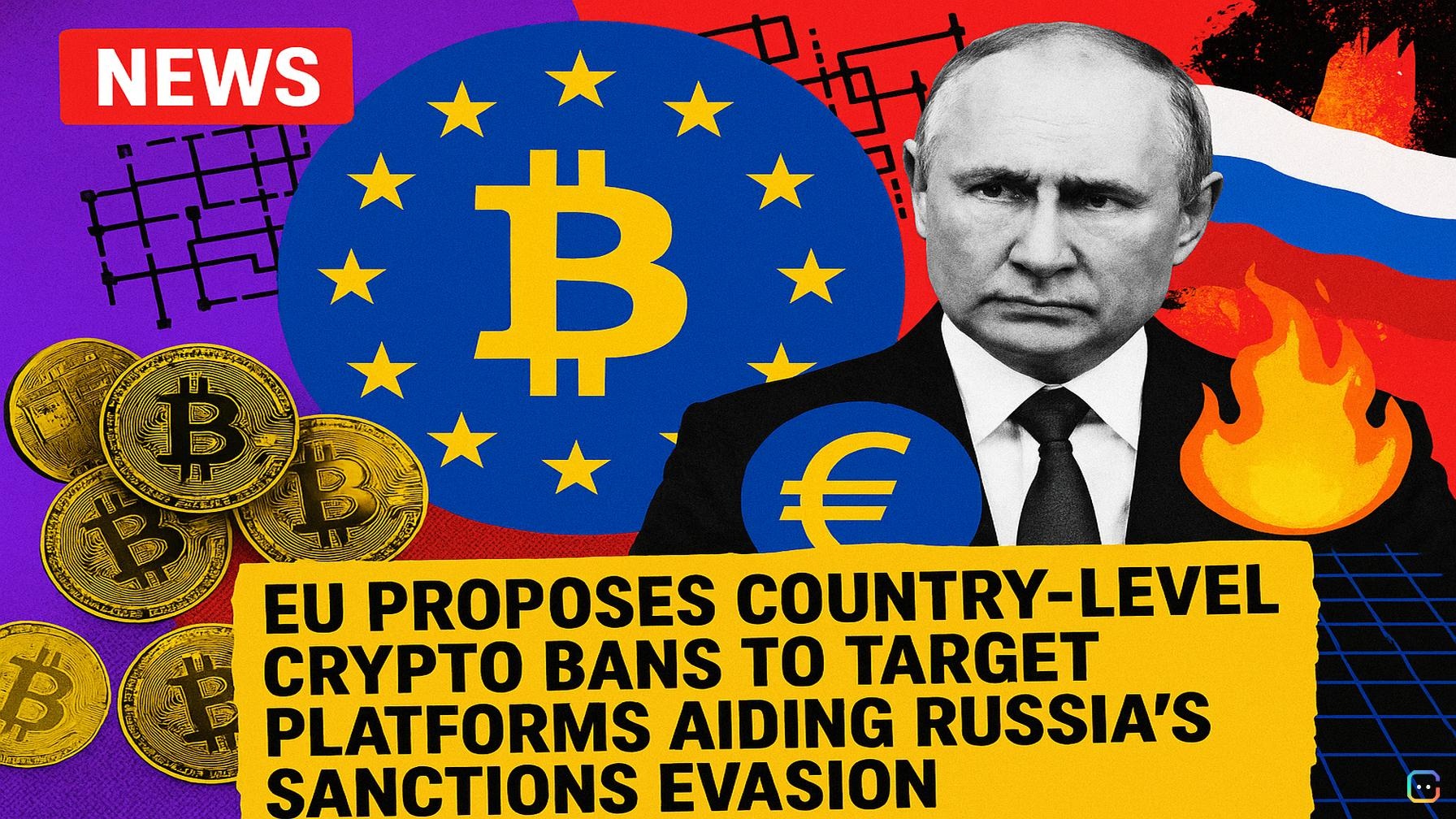
The European Commission has proposed a new round of sanctions that could mark the EU’s first-ever country-level restriction on foreign crypto services tied to Russian sanctions evasion. The draft 21st sanctions package targets 20 non-EU entities — including banks, oil traders and cryptocurrency platforms — that Brussels says have provided services to sanctioned Russian individuals and entities.
Under the proposal, transaction bans would be extended to the named non-EU firms. More significantly, the Commission is seeking the power to block crypto services originating from entire non-EU jurisdictions if platforms based there are found to be enabling sanctioned Russian actors. “It will act as a strong deterrent for the countries hosting platforms that help Russia evade our sanctions,” European Commission President Ursula von der Leyen said, adding the measures are intended to “close remaining channels” used to bypass existing restrictions.
The move comes as regulators on both sides of the Atlantic sharpen their focus on crypto infrastructure alleged to support sanctioned states and illicit finance. Blockchain analytics firm Chainalysis reported that illicit cryptocurrency addresses received $154 billion in 2025, and flagged roughly $93.3 billion in transaction volume involving the ruble‑pegged stablecoin A7A5 — a substantial portion of state-linked crypto flows by its estimate. Earlier this year Elliptic identified five exchanges it said provided pathways used to evade sanctions while operating outside traditional banking oversight.
Enforcement is already underway in several jurisdictions. In May the UK sanctioned Huobi Global S.A. — which authorities linked to HTX — over allegations it provided services to the Russia‑connected A7 network, imposing asset freezes, payment restrictions and internet measures. Elliptic described that action as the first application of Regulation 17A against a cryptoasset exchange, extending correspondent-banking and payment restrictions related to designated entities. In June the U.S. Treasury designated four Iranian crypto exchanges — Nobitex, Wallex, Bitpin and Ramzinex — alleging they helped sanctioned actors use the digital-asset ecosystem to move funds outside conventional financial channels.
The Commission’s package isn’t limited to crypto: it also proposes tougher measures on Russia’s energy and trade sectors, including additional restrictions on oil vessels and the bloc’s first sanctions aimed at Russian fisheries. “Our sanctions keep biting hard and cutting deep; they are weakening the economic foundations of Russia’s war effort,” von der Leyen said.
The proposals land at a time when Russia itself is preparing a domestic crypto regulatory overhaul expected in July, which would create licensed trading platforms and a more formalized local market as international scrutiny of Russia‑linked flows increases.
If adopted, the EU’s more aggressive stance could accelerate fragmentation in global crypto regulation — increasing pressure on exchanges, pushing more activity on privacy tools and alternative rails, and elevating the role of blockchain analytics in enforcement. The next steps will be political: the member states must agree to the package and the Commission must be granted the expanded authority to target whole jurisdictions’ crypto services.
Read more AI-generated news on: undefined/news