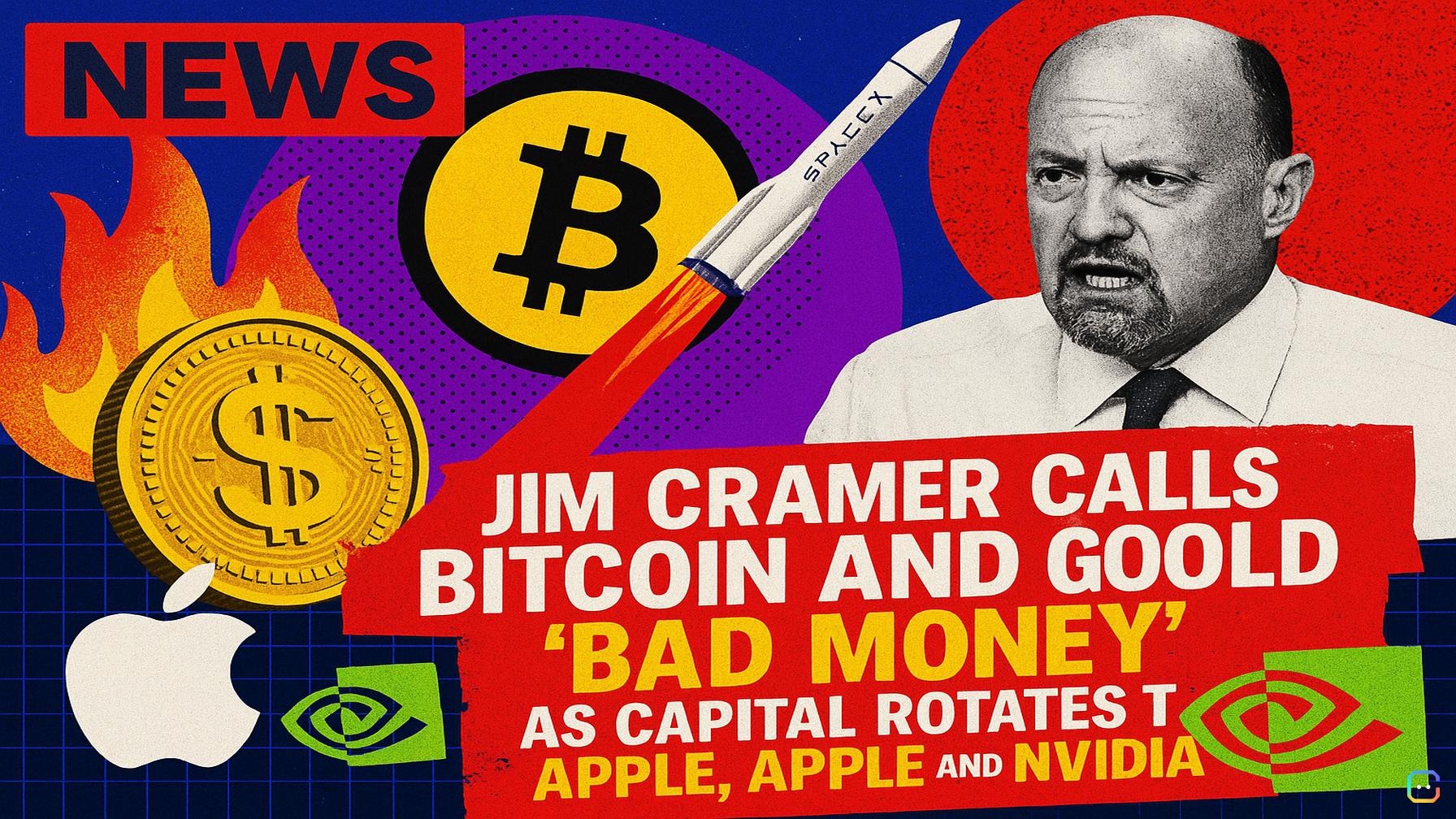
CNBC host Jim Cramer stirred the market conversation this week by labeling Bitcoin and gold “bad money,” arguing investors are pulling liquidity out of those assets and redirecting it toward high-growth technology stocks and private-market opportunities.
Cramer made the remark on X amid a choppy month for Bitcoin, which dipped toward the $60,000 area before bouncing back to roughly $62,796 at the time of his comment. His post read in part: “Bitcoin and gold–bad money, being liquidated for SpaceX. Apple and Nvidia –good money–being liquidated,” framing the move as a broad reallocation of capital.
Why it matters
- Cramer’s shorthand puts Bitcoin in the same liquidity debate as gold and big tech: investors may be trimming several holdings to free cash for private deals or AI-linked investments. SpaceX — with a potential IPO on the horizon — has attracted fresh attention, while AI beneficiaries and megacaps like Apple and Nvidia have sucked up large amounts of capital this year.
- The rotation toward private tech and AI could act as a headwind for speculative assets like Bitcoin by reducing available risk capital. Market veterans such as BitMEX co-founder Arthur Hayes have made similar arguments, saying AI is absorbing a large share of new market liquidity.
Context and earlier tensions
Cramer’s comments follow his prior criticism of “Strategy” and Michael Saylor after a reported sale of 32 BTC by the firm, which Cramer said shook market confidence despite the sale being small relative to the company’s total holdings. He previously described the firm as a “key trampoline” for Bitcoin and later charged Saylor with having “murdered Bitcoin,” prompting Saylor to call the decline “just a flesh wound.”
That episode turned attention to how much influence a single large holder can exert over market sentiment. Some traders see such sales as symbolic; others view them as meaningful.
How big was June’s downturn?
Crypto outlets and analysts have stressed that Bitcoin’s June weakness had multiple drivers rather than a single cause. Contributing factors cited include:
- Hawkish Federal Reserve expectations
- US-Iran geopolitical tensions
- The 32 BTC sale by Strategy
- ETF outflows and a prolonged streak of withdrawals
- Leveraged liquidations
A crypto.news analysis argued that SpaceX IPO interest and the AI trade likely acted as a slow-moving pressure rather than the immediate trigger for the crash. That distinction matters for traders: tech rotations can sap demand over time, but sharp price swings still hinge on macro headlines, fund flows and leverage.
What Bitcoin needs next
Cramer’s “bad money” label amplifies the public debate over Bitcoin’s portfolio role, but it doesn’t change the market’s checklist. For a more sustainable recovery, Bitcoin will need clearer signs of renewed ETF demand, calmer macro conditions, and a firm hold above the $60,000 area. Absent those signals, traders will keep watching whether capital continues to flow toward AI, SpaceX, Apple and Nvidia — and what that means for crypto liquidity.
Read more AI-generated news on: undefined/news